Understand the Language of AI

Artificial Intelligence Glossary

Learn the terms used in artificial intelligence, machine learning, generative AI, language models, prompt engineering, agents, automation, research, safety, and responsible AI use.

A Beginner-Friendly Reference

Learn AI One Term at a Time

Artificial intelligence can feel complicated because it introduces unfamiliar words, abbreviations, technologies, and systems.

This glossary explains common AI terms using clear language and practical examples. It is designed for beginners, authors, entrepreneurs, students, educators, creators, professionals, and everyday users.

Some terms describe the technology itself. Others describe how people communicate with AI, how systems use tools, how models are trained, or how users can identify risks and verify information.

How to use this page: Search for a term, browse alphabetically, or follow the related learning links to explore a subject in greater depth.
Browse or Search

Find an AI Term

A B C D E F G H I L M N P R S T U V
No matching glossary terms were found.
A

Terms Beginning with A

Core Technology

Algorithm

A step-by-step mathematical or logical process used by a computer to solve a problem, analyze data, or complete a task.

Example: A recommendation algorithm may rank movies according to a viewer's past activity.
Future Concept

Artificial General Intelligence

A theoretical form of AI capable of learning and performing across a broad range of intellectual tasks at or near human ability.

Also called: AGI.
Related: Types of AI
Foundation

Artificial Intelligence

The broad field of creating computer systems that perform tasks associated with intelligence, including language processing, prediction, recognition, planning, generation, and decision support.

Also called: AI.
Related: What Is Artificial Intelligence?
AI Capability

Artificial Narrow Intelligence

AI designed to perform one task or a limited group of related tasks. Most AI systems currently in use are forms of narrow AI.

Examples: spam filtering, language generation, image recognition, and recommendations.
Machine Learning

Artificial Neural Network

A machine-learning structure inspired loosely by networks of biological neurons. It contains connected layers that process information and learn patterns.

Speculative Concept

Artificial Superintelligence

A hypothetical form of intelligence that would exceed human intellectual abilities across many areas.

Also called: ASI.
Automation

AI Agent

An AI system designed to work toward a goal by planning steps, using tools, taking actions, checking progress, and adjusting when needed.

Example: An agent may research options, create a report, and request approval before sending it.
Related: AI Agents Explained
User Tool

AI Assistant

A conversational or task-oriented AI system that helps users answer questions, create content, analyze information, organize work, or use connected tools.

Workflow

AI Automation

The use of AI to complete repeatable tasks, move information between systems, generate outputs, or support workflows with limited manual effort.

Risk

AI Bias

Unequal, distorted, or unfair patterns in AI outputs caused by training data, system design, evaluation methods, human assumptions, or missing perspectives.

Human-AI Collaboration

AI Copilot

An AI assistant embedded into a person's workflow to provide suggestions, drafts, analysis, code, summaries, or task support while the human remains in control.

Policy and Safety

AI Governance

The rules, standards, oversight, accountability, testing, permissions, and decision processes used to manage artificial intelligence responsibly.

Risk

AI Hallucination

A response in which an AI system generates information that sounds believable but is false, invented, unsupported, or unrelated to the available evidence.

Examples: invented quotations, fake sources, incorrect dates, or nonexistent statistics.
Related: AI Hallucinations
Human Skill

AI Literacy

The ability to understand how AI works, use AI tools effectively, recognize limitations, verify information, protect privacy, and make responsible decisions.

Core Technology

AI Model

A trained mathematical system that processes input and produces predictions, classifications, recommendations, actions, or generated content.

Safety

AI Safety

The field of reducing harmful, unintended, unreliable, insecure, or uncontrolled behavior in artificial intelligence systems.

Technical Connection

API

An application programming interface allows software systems to exchange information and use each other's features through defined commands.

Example: A website may use an AI provider's API to generate text or analyze documents.
Workflow

Automation

The use of technology to complete tasks or processes with reduced manual effort. Automation may or may not include artificial intelligence.
B

Terms Beginning with B

Evaluation

Benchmark

A standardized test or collection of tasks used to compare the performance of AI systems or models.

Data

Big Data

Extremely large or complex collections of information that require advanced tools and computing methods to store, process, and analyze.

User Interface

Bot

A software program designed to perform automated actions. A chatbot is a bot focused on conversation.

C

Terms Beginning with C

Conversational AI

Chatbot

A software system designed to communicate with users through written or spoken conversation.

Difference: A chatbot usually responds to prompts, while an AI agent may continue through multiple actions.
Machine Learning

Classification

The process of assigning information to a category, such as identifying whether an email is spam or whether an image contains a cat or dog.

AI Capability

Computer Vision

Artificial intelligence that analyzes and interprets images, video, scans, documents, objects, faces, or physical environments.

Evaluation

Confidence Score

A numerical estimate indicating how certain a model is about a prediction or classification. A high score does not automatically guarantee correctness.

Language Models

Context

The information available to an AI system while generating a response, including instructions, conversation history, files, retrieved sources, and tool results.

Language Models

Context Window

The amount of text and other information a language model can consider during one interaction or conversation.

Related: Large Language Models
Legal and Publishing

Copyright

Legal protection for original creative works. AI-generated and AI-assisted content may raise questions about authorship, training data, originality, and commercial use.

D

Terms Beginning with D

Foundation

Data

Information used by computer systems. Data may include text, images, audio, video, numbers, transactions, measurements, or human feedback.

Training

Dataset

An organized collection of information used to train, test, evaluate, or operate an AI model.

Machine Learning

Deep Learning

A form of machine learning that uses layered artificial neural networks to identify complex patterns in large amounts of data.

Related: AI vs. Machine Learning
Risk

Deepfake

Synthetic or altered media that realistically imitates a person's face, voice, appearance, or actions.

Generative AI

Diffusion Model

A type of generative model commonly used to create images by gradually transforming noise into a structured visual output.

E

Terms Beginning with E

Language and Data

Embedding

A numerical representation of information that allows AI systems to compare meaning, similarity, relationships, or context.

Model Behavior

Emergent Capability

A skill or behavior that appears as an AI model becomes larger or more capable, even when that exact ability was not directly programmed.

Traditional AI

Expert System

A rule-based AI program designed to imitate decisions within a specialized field using structured knowledge and predefined logic.

F

Terms Beginning with F

Model Training

Fine-Tuning

Additional training that adapts a general model to a specific task, industry, format, style, or collection of examples.

Core Model

Foundation Model

A large general-purpose model trained on broad information that can be adapted to many tasks and applications.

G

Terms Beginning with G

Content Creation

Generative AI

Artificial intelligence designed to create new content such as text, images, music, video, voices, computer code, designs, or plans.

Related: What Is Generative AI?
AI Model

Generative Model

A model trained to produce new outputs that resemble patterns found in its training material.

Accuracy

Grounding

Connecting an AI response to reliable sources, supplied documents, databases, search results, or verified information.

Safety

Guardrails

Rules, restrictions, permissions, filters, approval steps, or technical controls designed to reduce unsafe or unwanted AI behavior.

H

Terms Beginning with H

Risk

Hallucination

A false, unsupported, or invented AI response presented in a way that may sound confident or believable.

Oversight

Human in the Loop

A workflow in which a person reviews, approves, corrects, or controls important AI-generated decisions or actions.

Workflow

Human-AI Collaboration

A process in which people and AI systems contribute different strengths to complete a project or solve a problem.

I

Terms Beginning with I

Model Operation

Inference

The process of using a trained AI model to analyze new input and produce a prediction, answer, classification, recommendation, or generated output.

Core Process

Input

Information given to an AI system, such as a prompt, file, image, question, audio clip, command, or dataset.

Legal and Creative

Intellectual Property

Legal rights connected to creative works, inventions, brands, designs, trademarks, and other original creations.

L

Terms Beginning with L

Language AI

Large Language Model

An AI model trained on large amounts of language-related data so it can process prompts and generate text, summaries, explanations, translations, code, and conversations.

Also called: LLM.
Related: Large Language Models
Machine Learning

Labeled Data

Training examples that include the correct answer, category, or description.

Performance

Latency

The amount of time between sending an AI request and receiving a response or completed action.

M

Terms Beginning with M

Core Technology

Machine Learning

A branch of artificial intelligence in which systems identify patterns from data and improve performance through examples.

Also called: ML.
Related: AI vs. Machine Learning
AI Systems

Memory

Information an AI system retains or retrieves to support future interactions, preferences, instructions, progress, or task continuity.

Core Technology

Model

A trained mathematical system that transforms input into an output.

Training

Model Training

The process of exposing a model to examples, measuring errors, and adjusting internal mathematical relationships so performance improves.

AI Capability

Multimodal AI

Artificial intelligence that can process or generate more than one kind of information, such as text, images, audio, video, and files.

Workflow

Multi-AI Workflow

A process that combines several AI tools or models, with each tool handling the part of a project it performs best.

Related: Multi-AI Workflows
N

Terms Beginning with N

Language AI

Natural Language Processing

The field of AI focused on helping computers process, understand, analyze, and generate human language.

Also called: NLP.
Machine Learning

Neural Network

A layered machine-learning structure made of connected mathematical units that learn patterns from data.

Development

No-Code

Tools and platforms that allow people to build applications, websites, automations, or digital systems without traditional programming.

P

Terms Beginning with P

Model Structure

Parameter

An adjustable mathematical value within an AI model that helps represent patterns learned during training.

Model Output

Prediction

An estimate produced by an AI or machine-learning model about a likely category, result, value, event, or next token.

AI Capability

Predictive AI

Artificial intelligence used to estimate future outcomes, detect patterns, classify information, or calculate probabilities.

Human-AI Communication

Prompt

The question, instruction, description, example, file, or command given to an AI system.

Example: “Explain artificial intelligence to a beginner using three everyday examples.”
Human-AI Communication

Prompt Engineering

The practice of designing clear instructions, context, examples, formats, requirements, and limits to improve an AI response.

Related: Prompt Engineering
Security Risk

Prompt Injection

An attempt to manipulate an AI system by inserting instructions that override, weaken, or conflict with its intended rules.

Productivity

Prompt Template

A reusable prompt structure containing placeholders that can be updated for different topics, audiences, goals, or projects.

Related: How to Write Better Prompts
R

Terms Beginning with R

Accuracy and Retrieval

Retrieval-Augmented Generation

A method that retrieves relevant information from outside sources and provides it to a generative model before the response is created.

Also called: RAG.
Model Capability

Reasoning

The process of analyzing relationships, following steps, comparing evidence, solving problems, or selecting among possible actions.

AI Application

Recommendation System

An AI system that ranks or suggests products, videos, music, books, services, or information based on patterns and preferences.

Machine Learning

Reinforcement Learning

A learning method in which a system improves through actions, feedback, rewards, and penalties.

Ethics and Safety

Responsible AI

The design and use of artificial intelligence with attention to accuracy, fairness, transparency, privacy, security, accountability, and human control.

Physical AI

Robotics

The field of designing and controlling machines that perform physical tasks. Robotics may combine sensors, software, AI, planning, and movement.

S

Terms Beginning with S

Audio AI

Speech Recognition

Technology that converts spoken language into text or structured commands.

Machine Learning

Supervised Learning

A machine-learning method in which a model learns from examples containing correct labels or expected answers.

Data

Synthetic Data

Artificially generated information designed to imitate the structure or patterns of real-world data.

Instructions

System Prompt

Hidden or platform-level instructions that guide an AI system's behavior, role, priorities, tools, and response rules.

T

Terms Beginning with T

Model Setting

Temperature

A setting that influences how predictable or varied a generative model's output may be. Higher settings generally allow more variation.

Generative AI

Text-to-Image

A system that creates images from written descriptions or prompts.

Audio AI

Text-to-Speech

Technology that converts written text into spoken audio.

Language Models

Token

A small unit of language processed by an AI model. A token may be a complete word, part of a word, punctuation mark, number, or symbol.

Related: Large Language Models
Model Training

Training Data

Information used to teach an AI model patterns, relationships, structures, or desired outputs.

Model Architecture

Transformer

A neural-network architecture designed to process relationships within sequences of information. Transformers are widely used in large language models.

AI Agents

Tool Use

The ability of an AI system to use search, files, code, databases, email, calendars, websites, or other connected applications.

Model Development

Training

The process of adjusting a model through examples and feedback so it becomes better at performing a task.

U

Terms Beginning with U

Machine Learning

Unsupervised Learning

A machine-learning method in which a model searches for patterns, groups, or relationships without being given correct labels.

Instructions

User Prompt

The instruction or question provided directly by the person using an AI system.

V

Terms Beginning with V

Evaluation

Validation

The process of checking whether an AI model or system performs effectively on information that was not used to train it.

Search and Retrieval

Vector Database

A database designed to store and search numerical representations of meaning, similarity, and relationships.

Human Review

Verification

The process of checking an AI-generated claim or output against reliable evidence, authoritative sources, testing, or expert review.

Audio AI

Voice Cloning

Technology that creates synthetic speech designed to imitate the sound and speaking characteristics of a particular voice.

Browse by Topic

Major AI Vocabulary Categories

AI Foundations

Artificial intelligence, algorithms, models, data, inference, prediction, and automation.

Explore AI foundations

Machine Learning

Training data, supervised learning, unsupervised learning, reinforcement learning, neural networks, and deep learning.

Explore machine learning

Generative AI

Generative models, text-to-image, diffusion models, multimodal AI, synthetic content, and content creation.

Explore generative AI

Language Models

Tokens, context windows, transformers, prompts, embeddings, system instructions, and language generation.

Explore language models

Prompt Engineering

Prompts, templates, context, examples, requirements, constraints, follow-up prompts, and prompt injection.

Explore prompt engineering

AI Agents

Goals, planning, memory, tool use, actions, permissions, autonomy, guardrails, and human approval.

Explore AI agents

Safety and Ethics

Hallucinations, bias, privacy, deepfakes, transparency, governance, verification, and accountability.

Explore responsible AI

Tools and Workflows

APIs, automation, AI assistants, copilots, multi-AI systems, no-code platforms, and connected tools.

Explore AI tools
Quick Reference

Three Distinctions Every Beginner Should Know

AI vs. Machine Learning

Artificial intelligence is the broader field. Machine learning is one method used within AI.

  • AI describes the overall capability
  • Machine learning describes learning from data
  • Deep learning is part of machine learning

Chatbot vs. AI Agent

A chatbot usually answers. An agent may plan, use tools, take actions, check progress, and continue.

  • Chatbots focus on conversation
  • Agents focus on goals and actions
  • Agents need stronger permissions and oversight

Prediction vs. Generation

Predictive AI estimates an outcome. Generative AI produces new content.

  • Prediction estimates what may happen
  • Classification assigns a category
  • Generation creates text, images, audio, video, or code
Continue Learning

Move from Definitions to Practical Understanding

Knowing the vocabulary makes it easier to compare tools, write better prompts, understand AI limitations, and follow new developments.

The AI Knowledge Center connects each major term to practical guides, examples, learning paths, books, tools, and responsible-use principles.

  • Start with the beginner foundation pages
  • Explore generative AI and language models
  • Practice prompt engineering
  • Learn how AI agents use tools
  • Understand hallucinations and verification
  • Continue through Bruce Goldwell's AI books
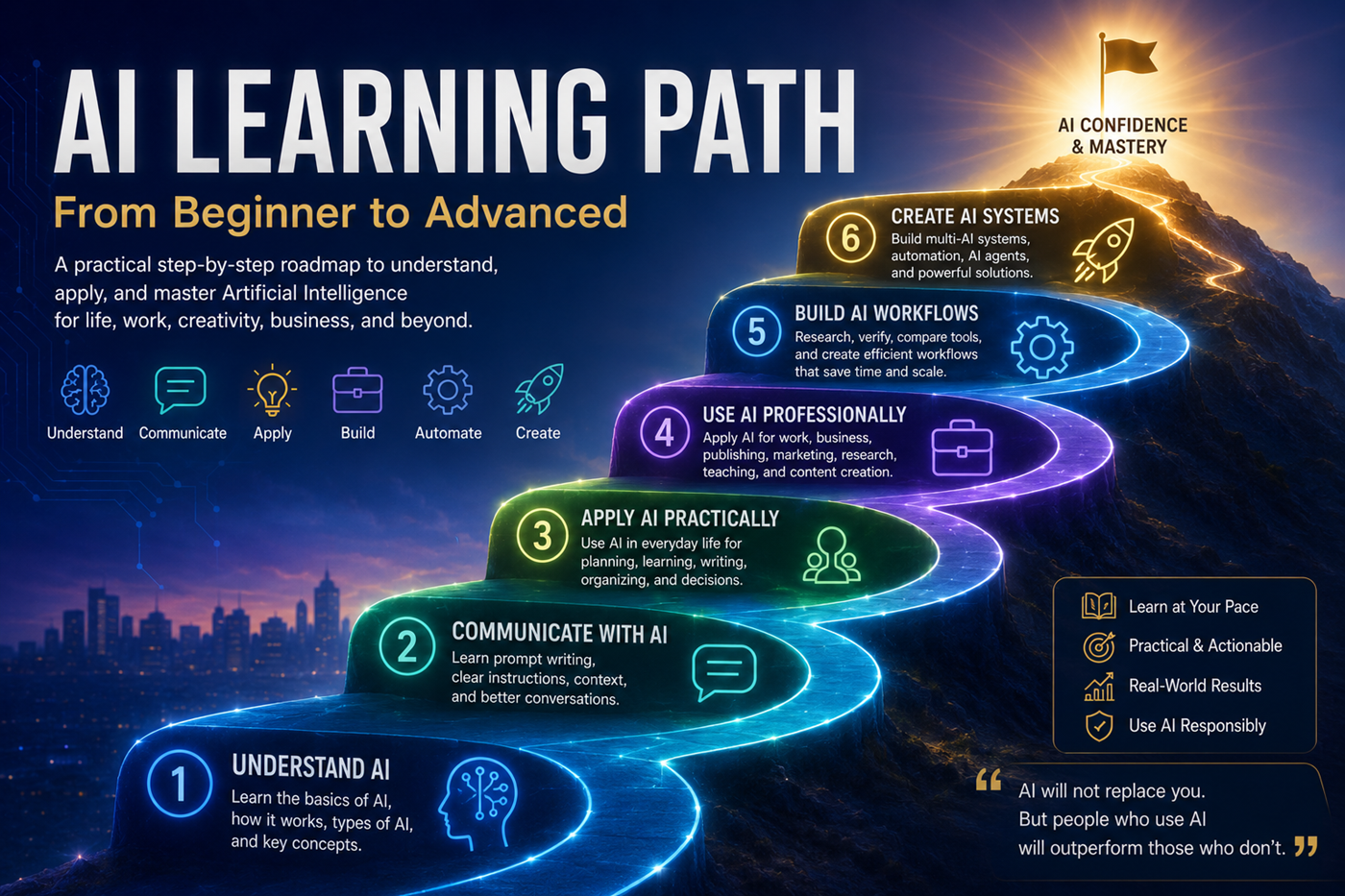
An artificial intelligence learning path connecting definitions, foundational concepts, prompts, tools, agents, safety, and books
Frequently Asked Questions

Questions About AI Vocabulary

What does AI mean?

AI means artificial intelligence, the broad field of creating computer systems that perform tasks associated with human intelligence.

What does LLM mean?

LLM means large language model, an AI model trained to process and generate human language.

What is the difference between a model and an AI tool?

A model is the trained mathematical system. An AI tool is the product, application, or interface through which people use one or more models.

What does hallucination mean in AI?

An AI hallucination is false or invented information generated in a way that may sound believable.

Why are AI terms constantly changing?

Artificial intelligence develops quickly, and companies, researchers, governments, and users may apply terms differently as new systems and capabilities appear.

Need More Answers?

Continue to the AI Frequently Asked Questions

Explore common questions about AI tools, prompts, accuracy, privacy, work, publishing, agents, safety, and the future.

Educational disclaimer: Artificial intelligence terminology continues to evolve. Definitions may vary among researchers, companies, regulators, educators, and technical communities. This glossary provides general beginner-friendly explanations rather than formal legal or technical standards.