Idea Exploration
Explore problems, audiences, possible solutions, business models, product ideas, service concepts, and unanswered customer needs.
Learn how to use artificial intelligence to research opportunities, develop business ideas, create plans, improve productivity, reach customers, build digital products, and create systems that support sustainable growth.
Entrepreneurs often manage research, planning, marketing, communication, content, customer service, product development, and daily operations at the same time.
Artificial intelligence can help entrepreneurs organize these responsibilities, explore possible opportunities, prepare first drafts, compare strategies, create reusable processes, and reduce repetitive work.
AI does not automatically create a successful business. It cannot replace customer understanding, practical experience, sound judgment, persistence, financial responsibility, or the ability to deliver real value. It works best as a flexible assistant directed by a thoughtful entrepreneur.
Use artificial intelligence to support each stage of business development while keeping human judgment and customer value at the center.
Explore problems, audiences, possible solutions, business models, product ideas, service concepts, and unanswered customer needs.
Identify customer questions, competing solutions, market language, trends, objections, opportunities, and areas requiring verification.
Organize the value proposition, customer profile, products, services, pricing considerations, marketing channels, operations, and next steps.
Develop website copy, educational content, emails, social posts, customer guides, campaigns, offers, and promotional materials.
Create templates, checklists, procedures, reusable prompts, customer-response systems, and repeatable business workflows.
Examine results, customer feedback, bottlenecks, missed opportunities, process weaknesses, and possible improvements.
A useful business idea begins with a real problem, a defined audience, and a practical solution people value.
AI can help entrepreneurs brainstorm business possibilities, compare business models, identify potential audiences, explore product formats, and think through how an idea might be delivered.
AI can help organize research and identify useful questions, but important market information should be checked through dependable sources.
Develop questions about customer goals, frustrations, buying concerns, expectations, preferred language, and desired outcomes.
Compare competing offers, customer promises, content strategies, positioning, strengths, weaknesses, and possible market gaps.
Identify the words and phrases customers use when describing their problems, needs, questions, and desired solutions.
Organize possible products, services, partnerships, content topics, customer groups, and distribution channels.
Ask what legal, financial, technical, operational, privacy, safety, or customer-service concerns should be investigated.
Create a step-by-step plan for checking assumptions through surveys, interviews, public data, official sources, and small tests.
A business plan does not need to begin as a long formal document. It can start as a clear explanation of the customer, problem, solution, delivery method, and next steps.
AI can help organize your thinking, identify missing pieces, compare alternatives, create checklists, and transform scattered notes into a structured plan.
Help me organize a practical business plan for the following idea. Include the target customer, customer problem, proposed solution, core offer, possible revenue sources, marketing channels, operating requirements, major risks, assumptions to test, and the first ten action steps.
AI can help entrepreneurs explain what they offer, who it serves, why it matters, and what the customer should do next.
Develop headlines, service pages, product descriptions, frequently asked questions, calls to action, and educational content.
Create welcome messages, follow-ups, newsletters, launch sequences, customer updates, and educational email series.
Transform business ideas into posts, short tips, stories, questions, video scripts, and platform-specific content.
Create guides, tutorials, checklists, demonstrations, comparisons, case examples, and answers to common questions.
Clarify benefits, features, customer outcomes, bonuses, delivery details, guarantees, limitations, and purchasing steps.
Turn a long article, book chapter, presentation, or video into shorter content for multiple channels and audiences.
The quality of a business response depends heavily on the quality of the information and instructions provided.
Explain what the business offers, who it serves, how it delivers value, and what stage of development it has reached.
Describe the customer’s problem, goals, concerns, experience level, purchasing situation, and preferred communication style.
State exactly what the output should accomplish, such as educating, comparing, persuading, organizing, planning, or solving a problem.
Request an outline, table, checklist, email, action plan, customer guide, campaign, script, procedure, or comparison.
AI becomes especially valuable when it helps turn repeated tasks into clear, reviewable, and reusable processes.
Create reusable formats for proposals, emails, project updates, intake forms, content plans, customer messages, and reports.
Turn complex activities into step-by-step checklists for launches, customer onboarding, content creation, quality review, and delivery.
Document how routine tasks should be completed, reviewed, approved, stored, and improved over time.
Identify repetitive steps that may be supported by approved software, integrations, scheduled actions, or AI-assisted tools.
Organize policies, product details, customer questions, instructions, research, brand guidance, and reusable business information.
Create quality-control questions for checking accuracy, tone, compliance, completeness, privacy, customer value, and consistency.
AI can help prepare faster, clearer, and more consistent responses while keeping human care and accountability in the process.
Entrepreneurs can use AI to draft responses, organize common questions, create troubleshooting guides, develop onboarding materials, and identify patterns in customer feedback.
Entrepreneurs can use AI to help organize knowledge into resources that educate, support, or guide customers.
Organize expertise into structured educational resources, practical guides, tutorials, and reference materials.
Turn lessons into exercises, planning pages, assessments, progress trackers, templates, and action steps.
Develop learning objectives, lesson sequences, assignments, quizzes, instructor materials, and student resources.
Package useful forms, prompts, procedures, spreadsheets, scripts, checklists, and repeatable systems.
Build interconnected pages that answer questions, demonstrate expertise, support products, and guide visitors through a topic.
Explore simple calculators, generators, planners, learning tools, customer resources, and no-code or AI-assisted applications.
Entrepreneurs remain responsible for the products, services, claims, communications, recommendations, and systems they release.
Explore additional lessons covering work, prompting, tools, authorship, productivity, and practical AI use.
Improve communication, research, planning, documents, meetings, organization, and professional workflows.
Explore AI for workLearn how clear instructions, useful context, examples, restrictions, and follow-up questions improve AI results.
Learn prompt engineeringExplore tools for writing, research, planning, images, coding, productivity, video, music, and business development.
Explore AI toolsLearn how artificial intelligence can support research, writing, editing, publishing, marketing, and knowledge ecosystems.
Explore AI for authorsFollow a structured journey from basic AI understanding to professional workflows and system development.
Follow the learning pathFind practical answers about artificial intelligence, business use, privacy, accuracy, jobs, safety, and limitations.
Read the AI FAQ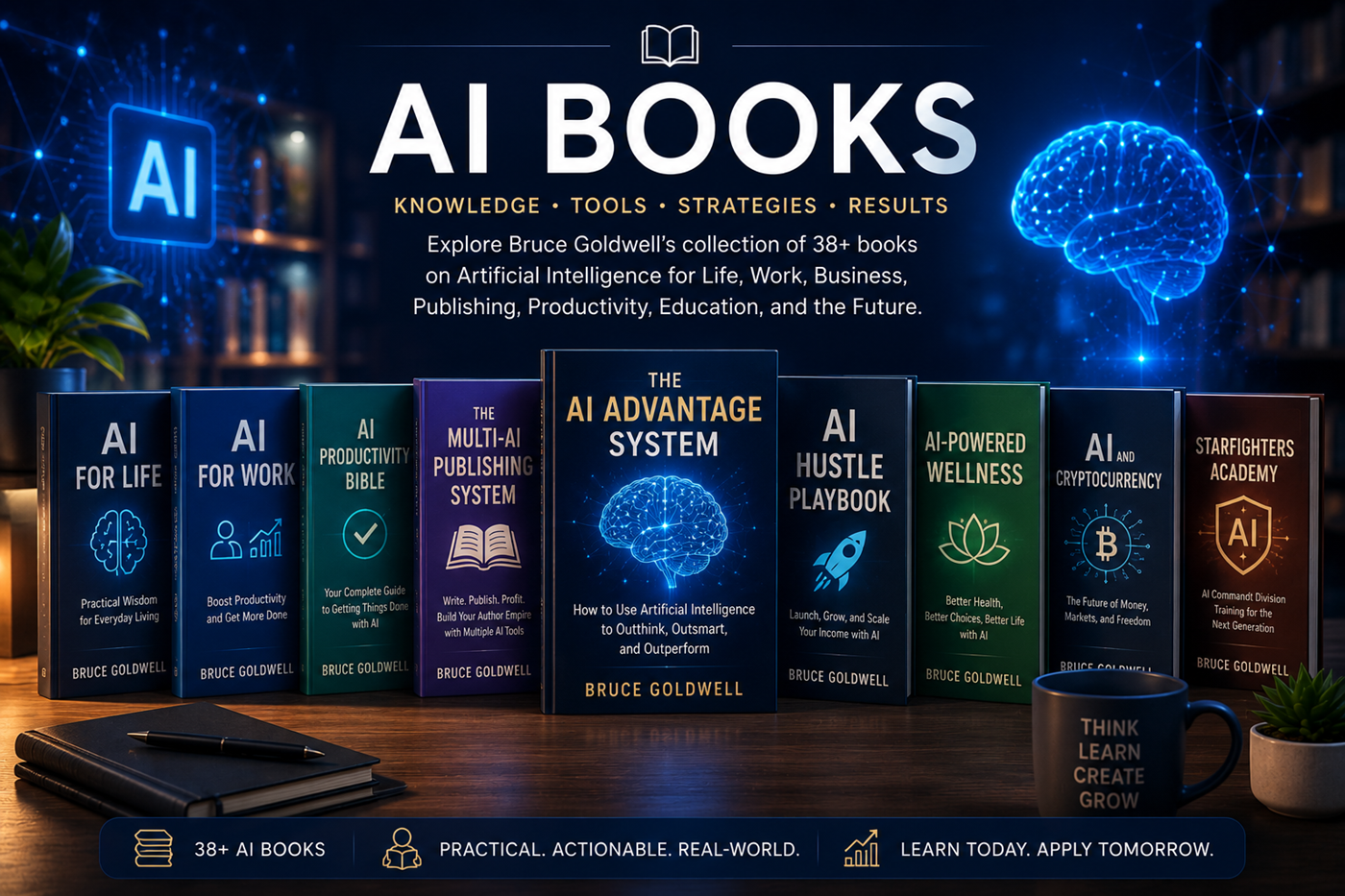
Bruce Goldwell’s AI books explore entrepreneurship, productivity, publishing, research, creativity, digital income, education, and practical artificial intelligence.
The collection is designed to help readers move beyond simple experimentation and begin using AI with greater purpose, structure, realism, and responsibility.
Choose one genuine customer problem, research it carefully, develop a simple solution, and use AI to strengthen your planning, communication, content, and execution.