Idea Development
Explore possible topics, angles, audiences, reader problems, themes, titles, and ways to make an idea more useful or distinctive.
Artificial intelligence can help authors move from an early idea to a finished book while preserving the experience, imagination, judgment, and personal voice that make the work meaningful.
Writing a book involves far more than producing sentences. Authors must develop ideas, conduct research, understand readers, organize chapters, create examples, edit drafts, prepare descriptions, choose keywords, plan marketing, and build connections between books and other resources.
AI can assist with each of these stages. It can help organize information, suggest possibilities, compare options, identify missing pieces, improve structure, and accelerate repetitive tasks. The author must still direct the process, verify information, make creative decisions, and take responsibility for the finished work.
Artificial intelligence can support the publishing journey from the first spark of an idea through long-term book discovery and audience growth.
Explore possible topics, angles, audiences, reader problems, themes, titles, and ways to make an idea more useful or distinctive.
Identify key questions, terminology, source types, competing viewpoints, historical context, reader concerns, and areas requiring verification.
Turn research and ideas into a logical chapter sequence with clear goals, supporting points, examples, transitions, and reader outcomes.
Develop sections, expand notes, explore examples, create exercises, strengthen explanations, and overcome difficult transitions.
Improve clarity, organization, pacing, consistency, grammar, tone, readability, chapter flow, and alignment with the book’s purpose.
Prepare book descriptions, keywords, categories, promotional posts, launch materials, reader resources, and long-term content connections.
A strong book begins with a clear understanding of its purpose, audience, promise, and unique contribution.
Authors can use AI as a brainstorming partner to explore variations of an idea, identify reader questions, examine possible formats, and uncover related themes. This can help reveal whether an idea should become one book, a series, a workbook, a course, or part of a larger knowledge system.
AI can help organize research, but it should not be treated as the final authority for factual claims.
Ask AI to identify the questions a careful author should answer before writing each chapter or major section.
Build a list of key terms, concepts, historical events, organizations, standards, and related topics requiring further investigation.
Examine different interpretations, arguments, advantages, disadvantages, uncertainties, and areas where reliable sources disagree.
Group notes by chapter, claim, source type, theme, timeline, evidence level, or question still requiring an answer.
Ask AI to flag statements that sound absolute, unsupported, exaggerated, outdated, or likely to require stronger evidence.
List every statistic, quotation, legal claim, medical statement, historical date, and changing fact that must be confirmed.
A strong outline gives each chapter a purpose and guides the reader through a logical progression.
AI can help organize ideas into chapters, identify gaps, remove repetition, improve transitions, and suggest the best order for teaching or explaining a subject.
For each chapter, define:
AI can assist with language and structure, but a meaningful book still needs the author’s ideas, experience, perspective, values, and purpose.
Provide your stories, lessons, arguments, examples, research, opinions, and intended reader outcome before asking AI to assist.
Explain the tone, audience, chapter purpose, required points, prohibited claims, format, and desired reading level.
Replace generic language, correct errors, add personal insight, strengthen examples, and ensure the writing sounds like you.
AI often repeats ideas in slightly different language. Review chapters for duplicated lessons, phrases, conclusions, and examples.
Real experiences, precise observations, meaningful stories, and personal lessons make a book more trustworthy and memorable.
The author must approve every claim, paragraph, example, recommendation, and conclusion before publication.
AI can help an author examine a manuscript from several editorial perspectives.
Evaluate the manuscript’s structure, chapter order, missing topics, weak sections, reader journey, and overall effectiveness.
Identify confusing explanations, overly long sentences, vague references, inconsistent terminology, and unnecessary complexity.
Check names, capitalization, headings, timelines, terminology, formatting patterns, voice, and repeated concepts.
Ask whether the reader has enough context, whether chapters deliver their promises, and where attention may be lost.
Review grammar, punctuation, word choice, sentence flow, repeated words, transitions, and readability.
Search for obvious errors, missing words, duplicated text, mismatched headings, incorrect references, and formatting problems.
A finished manuscript still needs clear positioning, persuasive presentation, useful metadata, and a long-term plan for reaching readers.
Generate and compare title options based on clarity, audience, emotional appeal, topic relevance, and the book’s central promise.
Build descriptions that identify the reader’s problem, present the book’s value, highlight benefits, and create a clear reason to read.
Create stronger descriptionsExplore reader language, topic phrases, search intentions, related questions, and keyword variations without relying on irrelevant repetition.
Explore Amazon keywordsClarify the book’s genre, topic, intended audience, comparable titles, educational purpose, and most accurate marketplace position.
Create launch posts, email drafts, article ideas, interview questions, short-form content, reader guides, and promotional campaigns.
Explore book marketingIdentify companion books, advanced editions, workbooks, courses, updated editions, topic hubs, and logical next steps for readers.
A book can become the foundation of an interconnected system of pages, resources, programs, tools, articles, videos, and future publications.
AI can help authors identify the ideas hidden inside a manuscript and organize those ideas into a broader ecosystem that serves readers in multiple ways.
A knowledge hub, a learning path, a series, a course, a workbook, a blog, a video collection, a reader community, a research resource, and a platform for future ideas.
Authors do not have to depend on one artificial intelligence platform for every stage of the publishing process.
Use source-oriented tools to discover topics, locate references, compare claims, and identify areas requiring deeper investigation.
Use conversational AI to develop ideas, structure outlines, clarify audiences, build workflows, and organize publishing projects.
Use language-focused tools to expand notes, develop explanations, create examples, revise passages, and compare alternative approaches.
Compare information across tools and confirm important claims with original documents and authoritative human sources.
Develop covers, illustrations, promotional graphics, video concepts, music, narration ideas, and other supporting media.
Prepare descriptions, keywords, marketing materials, website pages, metadata, reader resources, and long-term content plans.
Publishing creates responsibility. Authors must review AI-assisted material for accuracy, originality, fairness, privacy, copyright concerns, and potential harm.
Continue with focused lessons for each major stage of the AI-assisted publishing process.
Learn how to use artificial intelligence as a planning, drafting, revision, and development partner.
Explore AI-assisted writingDevelop research questions, organize findings, compare claims, identify sources, and create a verification process.
Improve book researchTurn ideas and research into a logical chapter structure that guides the reader toward a clear outcome.
Build better outlinesReview structure, clarity, consistency, grammar, pacing, repetition, readability, and reader experience.
Explore AI editingCreate descriptions that clearly present the problem, promise, benefits, audience, and reason to read.
Write stronger descriptionsDevelop promotional posts, campaigns, reader resources, articles, interviews, and long-term discovery systems.
Explore book marketing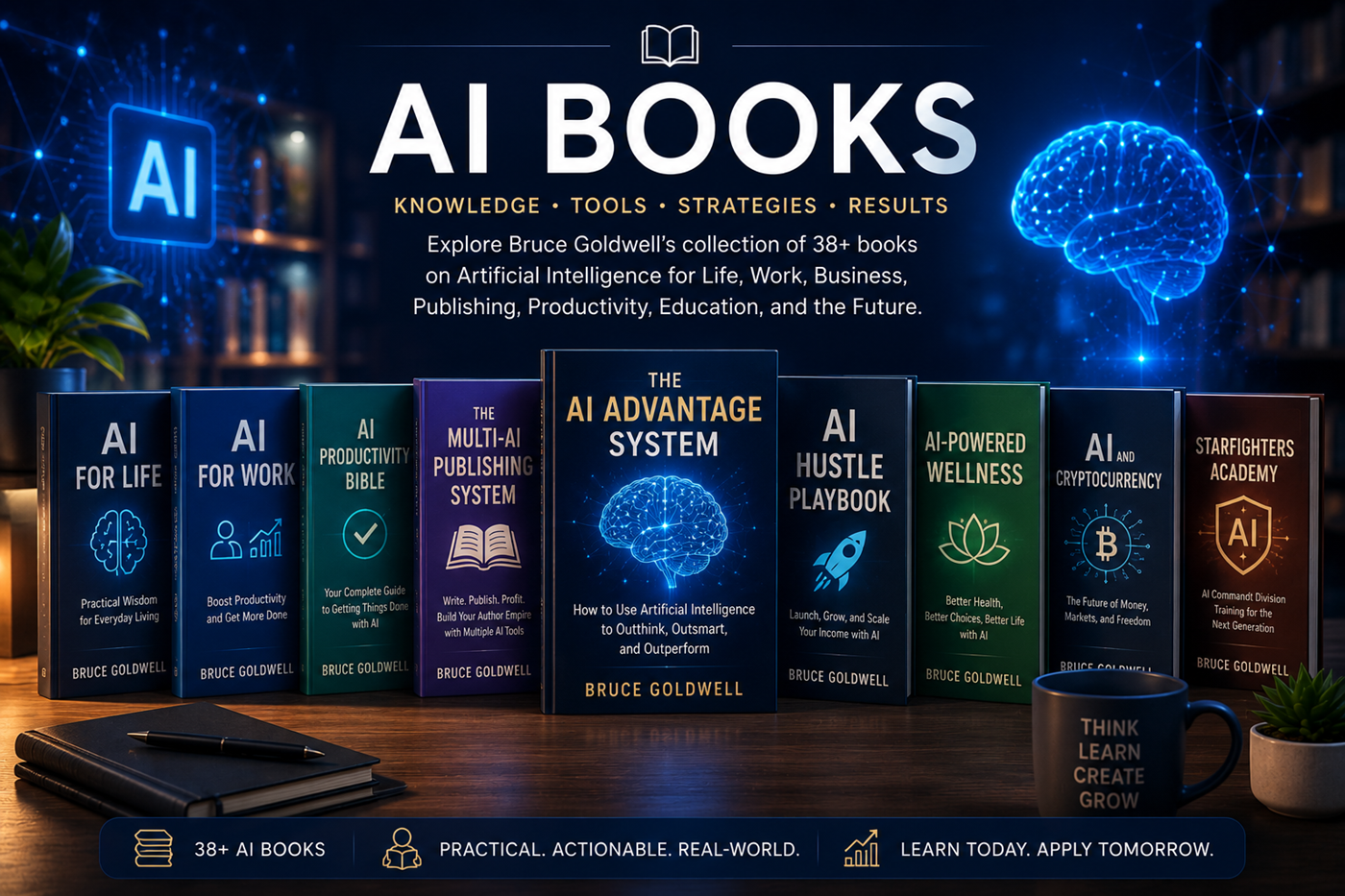
Bruce Goldwell’s AI books explore artificial intelligence for writing, publishing, productivity, business, education, research, and building interconnected systems of knowledge.
The books are designed to help readers move beyond experimentation and begin using AI with greater purpose, structure, responsibility, and confidence.
Start with one real book idea. Define the reader, clarify the promise, organize the research, build the outline, and use AI as a partner under your direction.