AI Foundations

What Is Artificial Intelligence?

Artificial intelligence allows computer systems to recognize patterns, understand instructions, generate content, make predictions, and assist people with tasks that once required human intelligence.

A Simple Explanation

Artificial Intelligence Is Software That Can Recognize Patterns and Produce Useful Results

Artificial Intelligence Defined

Artificial intelligence is a broad term for computer systems designed to perform tasks that normally involve human intelligence, including understanding language, recognizing images, identifying patterns, learning from data, generating content, making predictions, and helping people solve problems.

Traditional computer programs follow rules written directly by a programmer. Artificial intelligence systems can often analyze large amounts of information, recognize patterns within that information, and use those patterns to generate answers, classifications, recommendations, or predictions.

This does not mean the machine thinks exactly like a person. Most modern AI systems do not possess consciousness, emotions, personal beliefs, lived experience, or human understanding. They process information according to mathematical models, training data, system instructions, and the prompts people provide.

In everyday language: AI is technology that helps computers perform intelligent-looking tasks by identifying patterns, processing information, and producing responses or actions.
AI Compared with Traditional Software

What Makes Artificial Intelligence Different?

The distinction is not always absolute, but this comparison shows the basic difference.

Traditional Software

Traditional software normally follows explicitly programmed instructions.

  • Uses fixed rules and predefined steps
  • Produces expected outputs from known inputs
  • Changes only when programmers update it
  • Works best for structured and predictable tasks
  • Examples include calculators, basic forms, and simple databases

Artificial Intelligence

AI systems use models and patterns learned from data to produce outputs.

  • Recognizes patterns across large amounts of information
  • Handles language, images, audio, and complex data
  • Can generate new responses rather than selecting one fixed answer
  • Adapts outputs according to context and instructions
  • Examples include chatbots, image generators, recommendation systems, and voice assistants
AI Is Already Around You

Common Examples of Artificial Intelligence

Many people use artificial intelligence every day without thinking of it as AI.

Text and Conversation

Systems such as ChatGPT, Claude, Gemini, and Grok can answer questions, draft content, explain concepts, and assist with planning.

Image Recognition

AI can identify faces, objects, handwriting, medical images, road signs, products, and patterns within photographs.

Recommendations

Streaming services, online stores, search engines, and social platforms use AI to recommend content and products.

Voice Assistants

AI helps digital assistants recognize spoken language, interpret requests, and produce spoken responses.

Creative Generation

Generative AI can help create images, stories, songs, videos, computer code, presentations, and marketing materials.

Prediction and Analysis

AI can help identify fraud, forecast demand, analyze trends, detect unusual activity, and organize complex information.

The Main Idea

AI Learns Patterns Rather Than Human Wisdom

Modern AI systems become useful by identifying relationships and patterns within enormous collections of data.

A language model, for example, learns relationships between words, sentences, concepts, formats, and styles. When a person enters a prompt, the system uses those learned patterns to generate a response that fits the instruction and context.

This can look remarkably intelligent. However, producing a convincing response is not the same as possessing human understanding. AI can still misunderstand a request, miss important context, reflect bias, or generate information that sounds correct but is not.

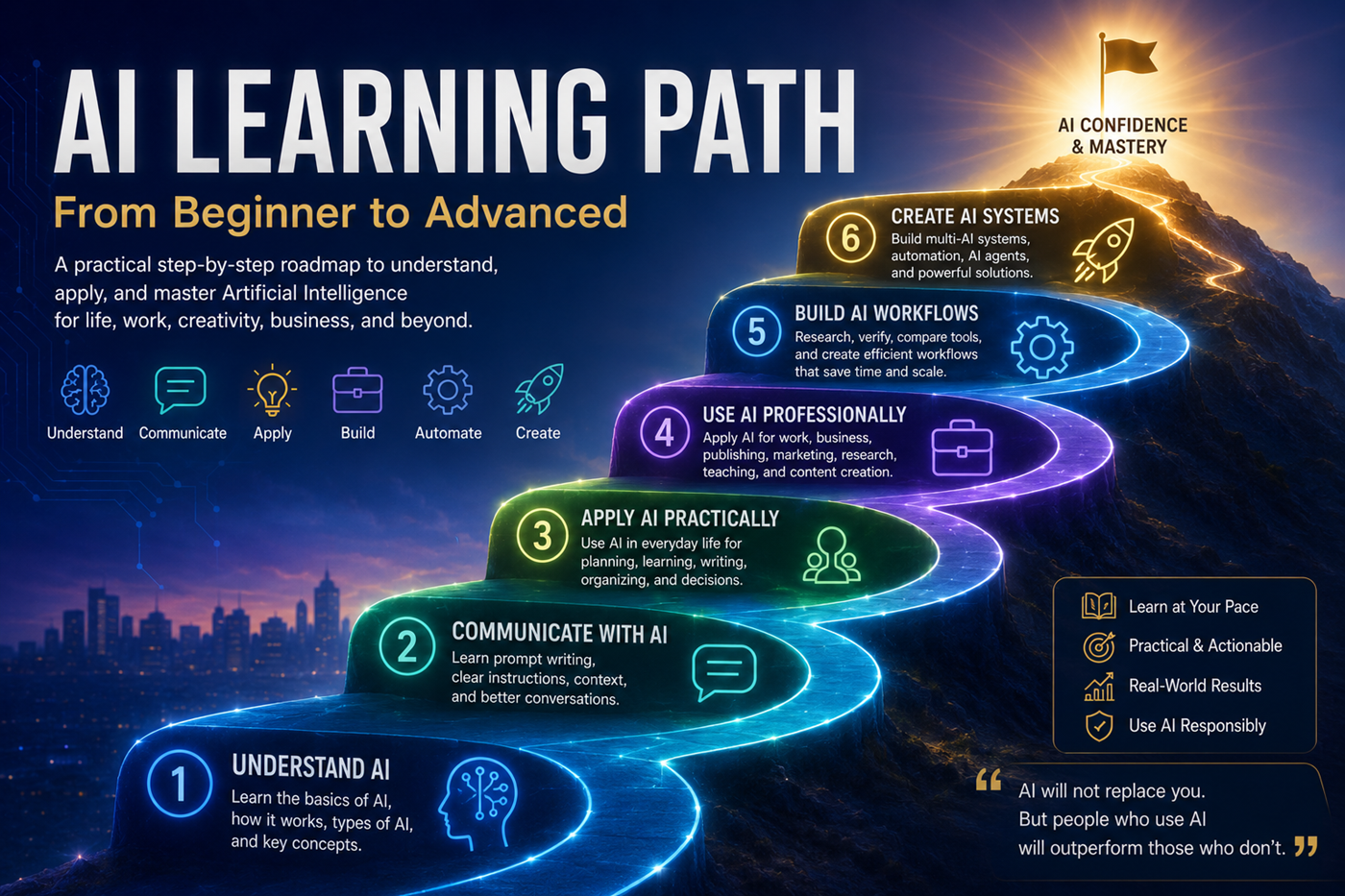
A visual learning path showing progression from basic artificial intelligence concepts to advanced AI systems
Major Categories

Artificial Intelligence Is Not Just One Technology

AI includes several related fields and capabilities.

Machine Learning

Computer systems identify patterns in data and use those patterns to make classifications, predictions, or recommendations.

Compare AI and machine learning

Generative AI

AI systems generate new text, images, audio, video, code, designs, and other forms of content.

Explore generative AI

Language Models

Large language models process and generate language for conversation, writing, summarization, translation, and analysis.

Learn about language models

Computer Vision

Computer vision systems analyze photographs, video, scans, documents, faces, objects, and visual environments.

Speech and Audio AI

AI can recognize speech, create voices, translate spoken language, generate music, and analyze audio.

AI Agents

AI agents can plan tasks, use tools, complete multiple steps, and operate within defined goals and limits.

Explore AI agents
What AI Can and Cannot Do

Powerful Does Not Mean Perfect

Artificial intelligence can be highly useful while still requiring careful human review.

What AI Can Do Well

  • Generate ideas and first drafts
  • Summarize and organize information
  • Recognize patterns across large datasets
  • Create multiple options quickly
  • Assist with writing, coding, images, audio, and video
  • Help people learn unfamiliar concepts
  • Automate repeatable digital tasks

What AI Cannot Guarantee

  • Perfect accuracy
  • Complete understanding of human context
  • Current information without reliable access to updated sources
  • Freedom from bias
  • Professional judgment in high-impact decisions
  • Human consciousness, empathy, values, or responsibility
  • Truth simply because an answer sounds confident
The Best Partnership

Human Intelligence Plus Artificial Intelligence

Artificial Intelligence

Speed, pattern recognition, organization, generation, analysis, and automation.

Human Intelligence

Experience, judgment, purpose, empathy, values, creativity, and responsibility.

Better Results

Faster work guided by human review, verification, insight, and meaningful goals.

The strongest approach is not to surrender every task to AI. It is to let AI assist with speed, structure, options, and repetitive work while the human remains responsible for the goal, interpretation, quality, ethics, and final decision.

A practical rule: Let AI help you think, but do not let it do all of your thinking for you.
Practical Uses

How People Are Using AI

Everyday Life

Planning, organization, learning, travel, household projects, comparison, brainstorming, and personal productivity.

Explore everyday AI

Work

Emails, documents, meeting notes, project plans, research, presentations, analysis, and task automation.

Explore AI for work

Writing and Publishing

Research, outlining, drafting, editing, book descriptions, keywords, marketing, and content ecosystems.

Explore AI for authors

Business

Market research, business planning, marketing, customer communication, digital products, and workflow development.

Explore AI for entrepreneurs

Creativity

Stories, images, video, music, websites, presentations, social media, and multimedia projects.

Explore AI for creators

Education

Study guides, tutoring support, lesson planning, homeschool activities, explanations, quizzes, and learning resources.

Explore AI for education
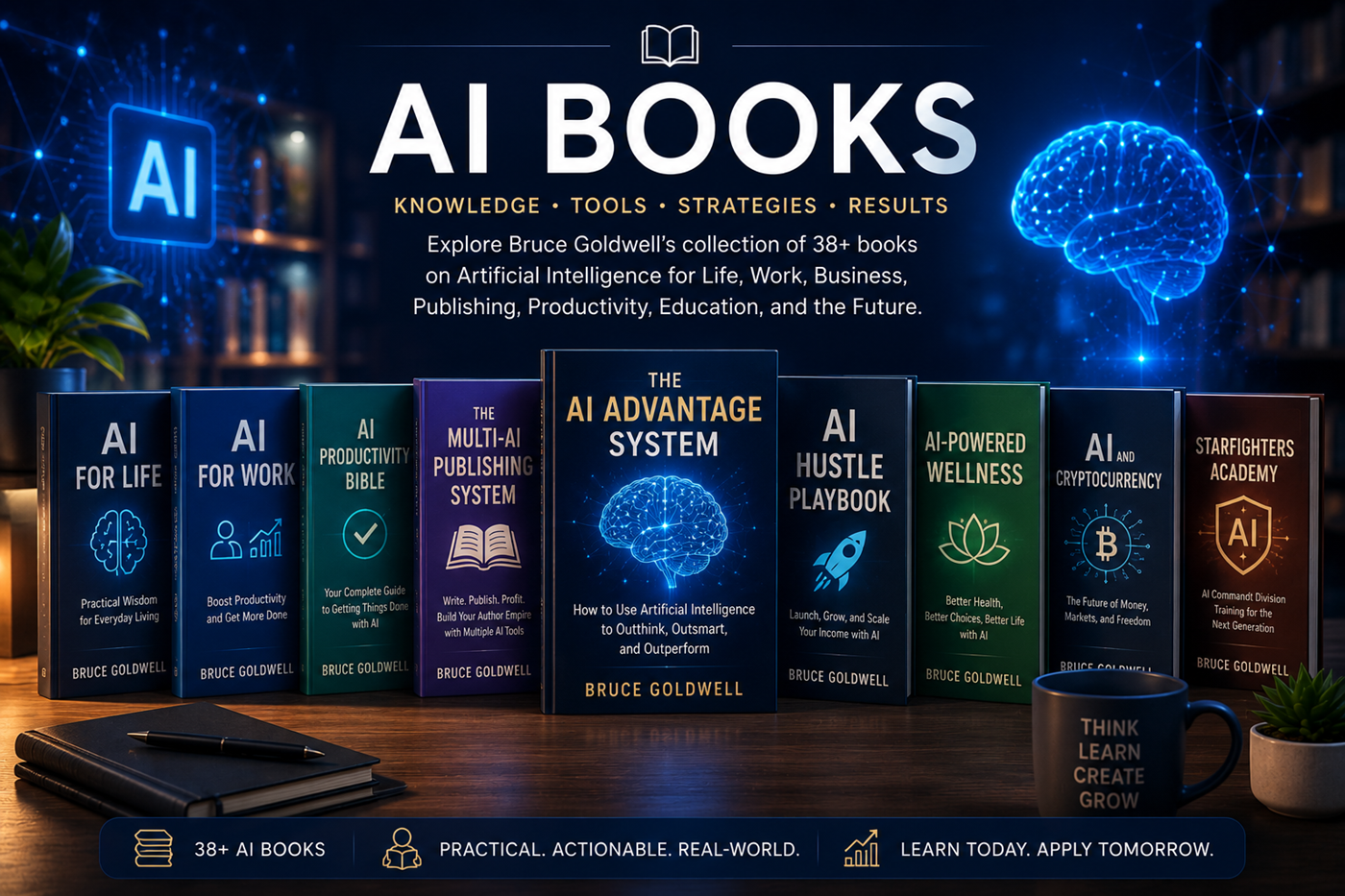
Bruce Goldwell's collection of practical artificial intelligence books
Continue Learning

Explore 38+ AI-Related Books by Bruce Goldwell

The Bruce Goldwell AI library explores artificial intelligence for life, work, publishing, productivity, entrepreneurship, education, wellness, finance, creativity, and future technologies.

These books expand the concepts introduced in the AI Knowledge Center and provide practical systems, prompts, examples, and learning paths for readers at different experience levels.

Frequently Asked Questions

Questions About Artificial Intelligence

What is artificial intelligence in simple terms?

Artificial intelligence is technology that allows computers to perform tasks that appear intelligent, such as understanding language, recognizing images, learning patterns, making predictions, and generating content.

Is AI the same as a human mind?

No. AI can process data and produce convincing responses, but it does not possess human consciousness, emotions, lived experience, moral values, or personal responsibility.

Does AI actually learn?

AI systems can be trained to identify patterns within data. The word learning describes the mathematical adjustment of a model based on examples. It does not necessarily mean learning in the same way a human learns through awareness and experience.

Can artificial intelligence make mistakes?

Yes. AI can misunderstand prompts, generate invented facts, overlook context, reflect bias, or rely on outdated information. Important answers should be reviewed and verified.

Do I need technical skills to use AI?

No. Many AI tools are designed for ordinary conversation. Clear goals, good questions, relevant context, and careful review are often more important than programming knowledge.

Continue Stage One

Now Learn How Artificial Intelligence Works

Explore how data, algorithms, training, models, prompts, and predictions work together to produce AI responses.

Educational disclaimer: This page provides general educational information about artificial intelligence. AI tools, models, capabilities, terms, policies, and availability change over time. Verify current platform details and important factual claims through authoritative sources.