Beginner to Advanced

Your AI Learning Path

Follow a clear, practical roadmap from understanding artificial intelligence to using AI for daily life, work, creativity, publishing, business, research, automation, and advanced multi-AI systems.

Learn in the Right Order

Build Skills One Level at a Time

You do not need to learn everything about artificial intelligence before you begin using it. A better approach is to build a foundation, practice with meaningful tasks, and gradually advance into more powerful tools and workflows.

This learning path is organized into six stages. Each stage develops skills that prepare you for the next. You can follow the entire roadmap or focus on the sections most relevant to your goals.

Someone who wants to use AI for everyday planning may stop after the first three stages. An author, entrepreneur, educator, or creator may continue into professional applications. Those who want to build systems, automate tasks, or combine several AI platforms can continue through the advanced stages.

Recommended approach: Begin with AI foundations, learn how to write clear prompts, practice with one useful task, and expand only after you understand how to review and verify AI-generated information.
Six Stages of Learning

The Complete AI Roadmap

Progress from basic understanding to confident, responsible, and productive AI use.

1 Understand AI
2 Communicate with AI
3 Apply AI Practically
4 Use AI Professionally
5 Build AI Workflows
6 Create AI Systems
38+ AI-Related Books
1 Connected Ecosystem
Stage One

Understand Artificial Intelligence

Begin by learning what artificial intelligence is, how it works, and how modern AI systems differ from traditional computer programs.

  • Learn the basic definition of artificial intelligence
  • Understand data, algorithms, models, and training
  • Explore the major types of AI
  • Learn what generative AI can create
  • Understand large language models
  • Recognize AI limitations and hallucinations
Stage Two

Learn How to Communicate with AI

AI responses depend heavily on the quality of your instructions. Learn how to provide context, define goals, request formats, and improve results through conversation.

  • Understand what a prompt is
  • Write clear instructions
  • Provide useful background and context
  • Request examples, formats, and step-by-step answers
  • Use follow-up prompts to improve results
  • Build reusable prompt templates
Stage Three

Apply AI to Everyday Life

Practice with useful, low-risk tasks that help you build confidence while improving planning, organization, learning, communication, and decision support.

  • Organize ideas, tasks, and schedules
  • Draft messages and everyday documents
  • Create learning plans and study guides
  • Compare choices and explore alternatives
  • Plan meals, trips, projects, and activities
  • Use AI while protecting private information
Stage Four

Use AI for Professional Goals

Apply artificial intelligence to writing, publishing, work, business, education, creativity, research, marketing, and content development.

  • Use AI for work and productivity
  • Write and publish books with AI assistance
  • Build business plans and marketing content
  • Create blogs, videos, music, images, and courses
  • Support teaching and independent learning
  • Develop repeatable professional processes
Stage Five

Research, Verify, and Compare

Move beyond accepting the first AI response. Learn how to compare systems, check claims, evaluate sources, recognize uncertainty, and improve factual reliability.

  • Recognize AI hallucinations
  • Ask AI to identify assumptions and uncertainties
  • Compare answers from multiple AI systems
  • Verify information using authoritative sources
  • Separate facts, opinions, and predictions
  • Use human judgment for important decisions
Stage Six

Build Multi-AI Systems and Automation

Combine AI tools, reusable prompts, automation, AI agents, no-code platforms, and structured workflows to complete larger projects.

  • Choose the right AI tool for each task
  • Combine research, writing, design, and coding tools
  • Build multi-step AI workflows
  • Use AI agents and automation responsibly
  • Create websites, applications, and digital products
  • Build interconnected knowledge ecosystems
Specialized Learning Paths

Choose the Path That Matches Your Goals

After completing the foundations, continue into one or more specialized areas.

AI for Authors

Research, outline, write, edit, publish, market, and expand books into connected intellectual-property ecosystems.

Follow the author path

AI for Work

Improve communication, documents, meetings, planning, organization, analysis, and everyday productivity.

Follow the work path

AI for Entrepreneurs

Use AI for opportunity research, planning, marketing, digital products, automation, and business development.

Follow the business path

AI for Creators

Develop stories, images, videos, music, blogs, websites, presentations, and multimedia projects.

Follow the creator path

AI for Education

Explore responsible AI use for teachers, students, homeschool families, classrooms, and lifelong learning.

Follow the education path

AI for Research

Compare systems, discover sources, verify claims, organize findings, and develop stronger research methods.

Follow the research path
The Human-AI Partnership

Advanced AI Use Requires Better Judgment

The more powerful the tools become, the more important human responsibility, verification, ethics, and critical thinking become.

Ask Clearly

State the goal, provide context, define the audience, and explain the desired format.

Review Carefully

Examine the response for errors, missing context, weak assumptions, and unsupported claims.

Verify Important Facts

Check high-impact information against authoritative and current sources.

Add Human Value

Apply experience, empathy, ethics, creativity, purpose, and personal responsibility.

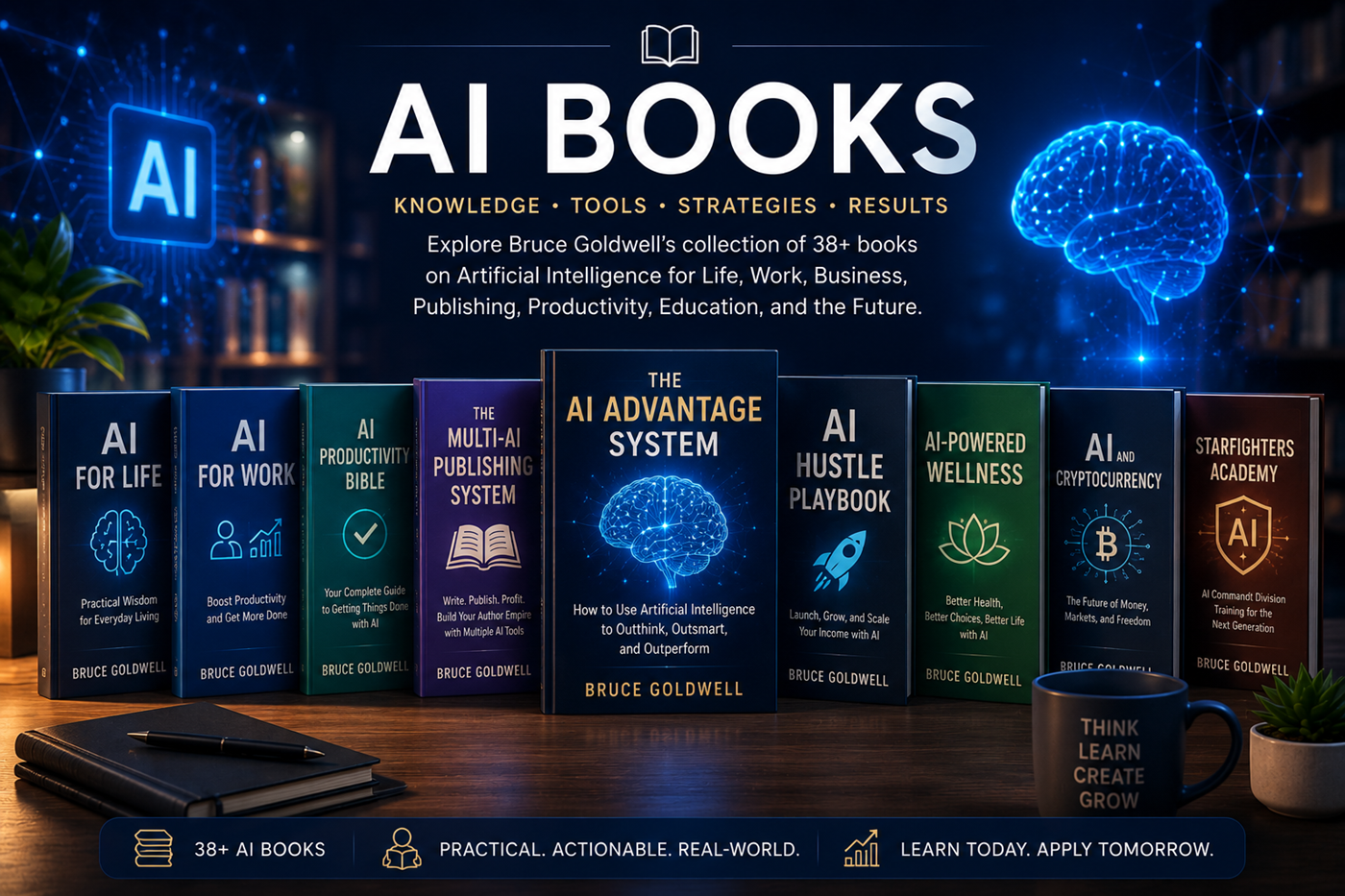
Bruce Goldwell artificial intelligence book library
Continue Through Books

Expand Your Learning with 38+ AI-Related Books

Bruce Goldwell's growing AI library explores artificial intelligence across work, life, publishing, productivity, business, education, wellness, finance, and future technologies.

The books can support each stage of this learning path, from beginner understanding to advanced publishing and business systems.

  • AI for Life and better decisions
  • AI for Work and productivity
  • The Multi-AI Publishing System
  • AI Productivity Bible
  • AI Hustle Playbook
  • Starfighters Academy AI Command Division
Begin with Stage One

Start by Understanding What AI Really Is

Build your foundation before moving into tools, prompts, workflows, automation, and advanced applications.

Educational disclaimer: The AI Knowledge Center provides general educational information. AI tools, capabilities, platform features, pricing, policies, and availability may change. Verify current information with the relevant provider or authoritative source before making important decisions.