Invented Facts
The AI may provide names, dates, places, statistics, events, product features, or technical details that are incorrect or do not exist.
Artificial intelligence can produce clear, detailed, and confident answers that contain incorrect facts, invented sources, false quotations, or misleading conclusions. Learn why this happens and how to protect yourself from unreliable AI information.
An AI hallucination occurs when an artificial intelligence system generates information that appears believable but is incorrect, unsupported, misleading, or completely invented.
The word hallucination does not mean that the AI experiences images, thoughts, or confusion as a human might. It is a technical metaphor used to describe generated content that does not accurately match reality.
An AI system may invent a source, provide the wrong date, misidentify a person, combine separate events, create a quotation that was never spoken, describe a feature that does not exist, or present speculation as established fact.
The danger is not simply that AI can be wrong. Human beings are also capable of mistakes. The special danger is that an AI-generated mistake may be presented with professional language, detailed explanations, and complete confidence.
AI hallucinations are not limited to one kind of error. They can affect facts, sources, reasoning, summaries, instructions, and creative content.
The AI may provide names, dates, places, statistics, events, product features, or technical details that are incorrect or do not exist.
An AI system may create the title of a study, article, book, court case, report, or website that appears authentic but cannot be located.
The AI may attribute words to a person who never said them or combine several ideas into a quotation that has no original source.
Generated URLs may lead to missing pages, unrelated content, or websites that never contained the claimed information.
Details from separate people, products, legal cases, scientific findings, or historical events may be combined into one inaccurate account.
An answer may once have been accurate but no longer reflects current laws, prices, software features, leadership, research, policies, or public events.
The AI may reach a confident conclusion without sufficient evidence or may treat correlation, possibility, or opinion as proof.
A summary may omit exceptions, reverse the meaning, exaggerate the findings, or claim that a document says something it does not.
Generative AI systems are designed to predict and produce useful sequences of language based on patterns learned from large amounts of information.
The system does not automatically pause after every sentence to confirm that each statement is supported by an authoritative source.
When information is incomplete, uncertain, unavailable, ambiguous, or outside the system's reliable knowledge, the model may still generate an answer that fits the expected pattern.
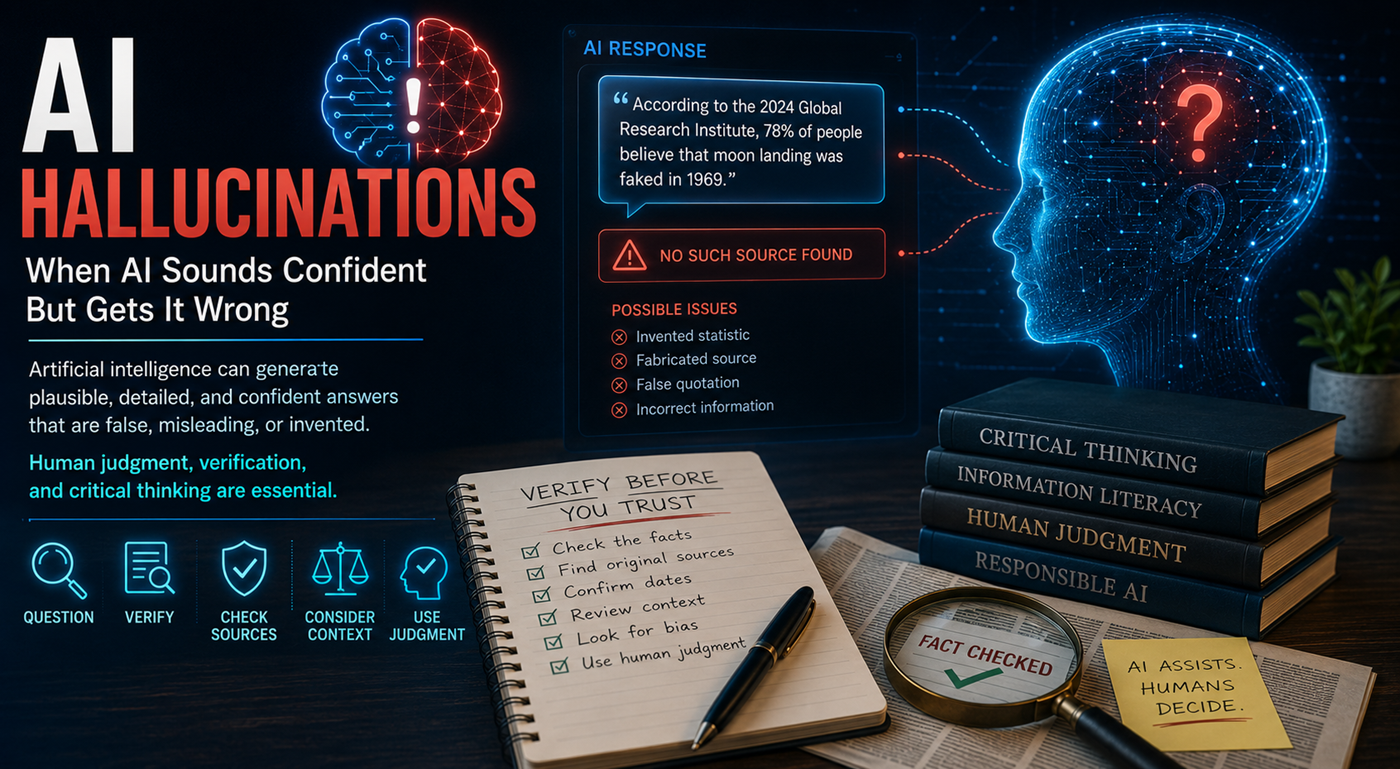
No single warning sign proves that an answer is false, but several signals should cause you to pause and verify the information.
The answer provides precise percentages, dates, quotations, or names but does not identify where the information came from.
A cited report, article, legal case, study, book, or webpage does not appear in reliable search results or official records.
The link exists, but the page does not contain the information the AI attributed to it.
The AI presents a disputed, uncertain, predictive, or rapidly changing issue as if no disagreement or limitation exists.
Different parts of the answer provide conflicting dates, definitions, totals, explanations, or conclusions.
The answer names a professional organization, technical standard, product, program, or law that you cannot independently confirm.
A person is credited with an event before their career began, a product uses technology that did not yet exist, or dates occur in the wrong order.
Rephrasing the same question causes the system to provide incompatible factual answers without explaining the difference.
The response perfectly confirms the user's assumption without considering contrary evidence, uncertainty, or alternative explanations.
This statement sounds believable because it includes a year, an organization, a specific percentage, and a research conclusion.
Before accepting the statement, you would need to verify that the organization exists, locate the original study, identify the researchers, examine the sample size, review the methodology, and confirm that the conclusion was represented accurately.
Verification should become part of the normal AI workflow whenever the information matters.
Separate the exact factual statement from the surrounding explanation, opinion, or recommendation.
Determine which official organization, original document, research paper, court record, company, or qualified authority should be able to confirm it.
Find the primary source instead of relying only on summaries, reposts, generated citations, or secondhand interpretations.
Check when the information was published and whether newer events, laws, research, prices, leadership, or platform changes have replaced it.
Make sure the source actually supports the claim and that the AI did not remove qualifications, exceptions, limitations, or opposing findings.
Use more than one trustworthy source when the issue is important, disputed, technical, or changing rapidly.
Save the source, date, relevant quotation or data, and any limitations so the claim can be checked again later.
No prompt can guarantee perfect accuracy, but clearer instructions can encourage the AI to identify uncertainty and avoid inventing unsupported details.
If you are uncertain, say so clearly. Do not guess or invent missing information.
Separate verified facts, general knowledge, assumptions, predictions, and recommendations.
Answer only from the documents or information I provide. Identify anything that is not supported by those materials.
For each important factual claim, identify the original or authoritative source that should be consulted.
Review your previous response and identify any statements that may be inaccurate, outdated, unsupported, or overly confident.
Before answering, tell me what additional context you need to avoid making unsupported assumptions.
The importance of verification increases when an AI-generated mistake could affect a person's health, safety, rights, money, reputation, or future.
AI may invent symptoms, misunderstand test results, provide unsafe treatment advice, or fail to recognize an emergency.
AI may cite nonexistent court cases, misstate a law, ignore jurisdiction, or provide information that is no longer current.
AI may produce incorrect prices, fabricated market statistics, unsupported forecasts, or misleading investment conclusions.
AI may generate fictional journal articles, authors, publication details, studies, quotations, or scientific conclusions.
AI may combine events, misidentify people, create quotations, or describe fictional details as historical fact.
Incorrect instructions involving electricity, machinery, software security, chemicals, construction, or transportation can create real danger.
Asking several AI systems the same question can reveal disagreements, missing perspectives, and claims that require more investigation.
Look for differences in dates, names, definitions, totals, sources, and conclusions.
When systems disagree, locate the original source rather than choosing the answer that sounds most persuasive.
Several AI systems may repeat the same incorrect information because they rely on similar training material or internet sources.
AI can help authors research, outline, draft, edit, and develop ideas. Publishing false information can still damage readers, credibility, reputation, and long-term authority.
Confirm the exact wording, speaker, original source, date, and context before including a quotation in a book or article.
Open the study, book, report, or article and verify that it exists and supports the statement being made.
Confirm names, locations, dates, titles, timelines, relationships, and descriptions through reliable historical sources.
Software capabilities, laws, platform rules, medical guidance, and financial data may change between drafting and publication.
Save source links, publication details, screenshots, notes, and verification dates for important claims.
The author remains responsible for every factual statement included in the final work, even when AI assisted with the research or drafting.
Do not continue copying, sharing, publishing, or acting on information once its accuracy is in question.
Find the original or authoritative source and document what the accurate information should be.
Update published pages, books, reports, posts, presentations, databases, or communications where the incorrect statement appeared.
When the error could affect decisions or public understanding, clearly state what was wrong and what has been corrected.
Identify why the error passed review and add a verification step that reduces the chance of repeating it.
Correcting an error honestly strengthens trust more than hiding or ignoring it.
Artificial intelligence can help people gather information, organize research, generate possibilities, and ask better questions. It should not become the unquestioned source of truth.
It produces possible answers, explanations, drafts, summaries, predictions, and recommendations.
People compare evidence, understand context, recognize consequences, and determine what information is trustworthy.
The human user remains responsible for what is accepted, rejected, published, recommended, or acted upon.
An AI hallucination is generated information that appears believable but is inaccurate, unsupported, misleading, or fabricated.
An AI system may sometimes identify uncertainty when asked, but it cannot be relied upon to recognize every false statement it generates.
Better prompts can reduce the risk by requiring uncertainty, sources, and clearer boundaries. They cannot guarantee that every answer will be correct.
More advanced systems may perform better on many tasks, but no generative AI platform should be assumed to be perfectly accurate.
No. Several systems may repeat the same mistake. Important claims still need to be confirmed through authoritative evidence.
Verification is especially important for medical, legal, financial, scientific, academic, historical, technical, political, safety-related, and rapidly changing information.
AI can become a powerful research and creative partner when users understand its limitations. Ask better questions, identify uncertainty, verify important claims, compare reliable sources, and keep human judgment responsible for the final result.