1
Prompt
The user enters a question, instruction, document, image, or other information.
Large language models are artificial intelligence systems trained to process and generate language, helping people write, research, summarize, explain, translate, plan, code, and communicate.
A large language model, often shortened to LLM, is an AI system trained on large amounts of text and other language-related data so it can interpret prompts and generate useful responses.
Large language models can answer questions, write articles, summarize documents, explain concepts, translate languages, generate computer code, organize information, brainstorm ideas, and assist with extended conversations.
The word large refers to the size and complexity of the model, the amount of training involved, and the enormous collections of information used to teach it patterns in language.
The model does not normally store one fixed answer for every possible question. It processes the words in a prompt, considers the available context, and predicts a response that fits the patterns it learned during training.
A typical conversation with a language model follows a process similar to this.
The user enters a question, instruction, document, image, or other information.
The input is divided into smaller language units called tokens.
The model considers instructions, conversation history, files, tools, and available information.
The model analyzes relationships between words, ideas, formats, and likely intentions.
It predicts likely tokens based on the prompt and context.
The model generates text one portion at a time until the answer is complete.
The user evaluates, verifies, edits, and decides how the output should be used.
Language models do not always process complete words. They divide language into smaller units called tokens.
A token can be a complete word, part of a word, punctuation mark, number, symbol, or space-related unit. The exact tokenization method depends on the model.
For example, the sentence below might be divided into pieces resembling these:
The model analyzes relationships between these units and predicts which token is likely to come next. It repeats that process rapidly until it produces a complete answer.
The model studies large collections of language and learns statistical relationships among words, concepts, structures, styles, and formats.
Parameters are adjustable mathematical values within the model that help represent patterns learned during training.
Context includes the prompt, previous conversation, attached files, system instructions, retrieved information, and tool results available to the model.
The model generates responses by estimating which language units are most likely to follow, given the context and instructions.
A context window is the amount of information a language model can consider during one interaction or conversation.
Modern AI platforms may combine language models with search, files, images, code, data, connected services, and other tools.
A language model may search current sources and use retrieved information to answer recent or specialized questions.
It may read documents, spreadsheets, images, presentations, or data files and help summarize or analyze them.
Some systems can write and run code to calculate, analyze data, create charts, or generate files.
Language-based instructions can guide image models to create or edit visual content.
Authorized tools may help manage calendars, email, files, databases, websites, or business systems.
Agent systems may plan and complete several steps while using tools within defined permissions and limits.
Different platforms may use different models, tools, interfaces, policies, and connected services.
A general-purpose AI assistant used for conversation, writing, analysis, coding, research support, images, planning, and productivity.
Explore ChatGPTAn AI assistant often used for long-form writing, document analysis, structured thinking, editing, and detailed conversations.
Explore ClaudeGoogle's AI system for language, search-assisted tasks, productivity, documents, multimedia, and connected workspace applications.
Explore GeminiA conversational AI system used for questions, analysis, current-topic exploration, writing, research support, and alternative perspectives.
Explore GrokA language model must infer your goal from the information you provide. More useful context usually leads to more useful results.
The task is vague and requires the model to guess the audience, purpose, length, and format.
The topic and audience are clearer, but the desired structure is still open.
The model receives the goal, audience, tone, length, structure, and important limitations.
Draft emails, articles, reports, stories, descriptions, scripts, outlines, and revised versions of existing text.
Explore AI for authorsGenerate questions, organize findings, compare ideas, summarize sources, and identify areas that require verification.
Explore AI researchExplain concepts, create examples, develop study guides, generate quizzes, and adapt information for different learning levels.
Explore AI for educationPrepare plans, presentations, customer messages, marketing content, summaries, meeting notes, and workflow documentation.
Explore AI for workGenerate code, explain errors, create prototypes, document software, and assist with websites and applications.
Build with AIBrainstorm stories, songs, video concepts, project plans, campaigns, characters, lessons, and digital products.
Explore AI for creatorsLanguage models can produce clear, confident, and detailed answers even when part of the response is incomplete or wrong.
The user remains responsible for checking and improving the final result.
Review the entire response instead of accepting the first impression.
Make sure the answer addresses the actual goal, audience, and situation.
Confirm important claims, quotations, dates, statistics, laws, and sources.
Include experience, judgment, emotion, ethics, creativity, and personal voice.
Decide what should be revised, rejected, published, shared, or acted upon.
Prompt engineering is the practice of giving AI clear instructions, useful context, examples, formats, and boundaries.
Strong prompting does not require complicated formulas. It requires understanding the goal, explaining what matters, and guiding the model toward the result you need.
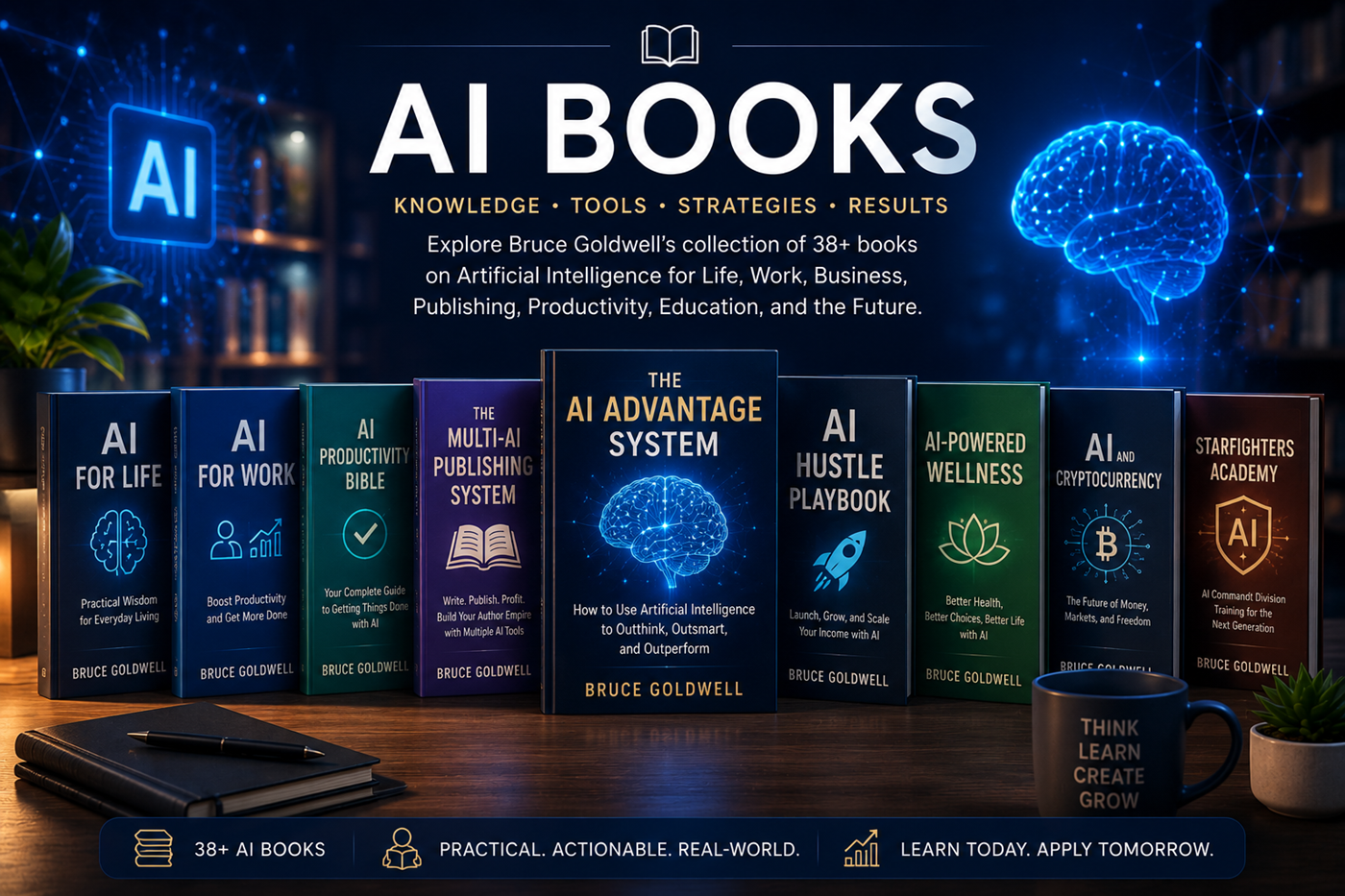
Bruce Goldwell's AI library explores language models, prompts, publishing, productivity, business, education, creativity, wellness, finance, and practical artificial intelligence.
Titles including AI Productivity Bible 2026, The Multi-AI Publishing System, AI for Work, AI for Life, and The AI Hustle Playbook show how conversational AI can become part of larger human-directed systems.
A large language model is an AI system trained on large amounts of language data so it can process prompts and generate text, explanations, summaries, translations, code, and other language-based outputs.
These are AI products or assistants powered by large language models. The products may also include search, images, files, coding, voice, connected tools, and other capabilities.
Not in the same way. Language models process mathematical relationships, patterns, probabilities, instructions, and context. They do not possess human consciousness, lived experience, values, or complete understanding.
Responses can vary because language generation is probabilistic and may be influenced by the exact wording of the prompt, conversation history, system instructions, available tools, model settings, and updated model versions.
No. A model can only use information available within its current context and any authorized memory or connected systems. Context limits, privacy settings, and platform features vary.
Prompt engineering helps you turn broad ideas into clear instructions that produce more relevant, accurate, structured, and useful responses.