AI Frequently Asked Questions
Find practical answers about artificial intelligence, machine learning, generative AI, prompts, tools, agents, privacy, accuracy, work, publishing, safety, and the future.
Understand AI Without the Confusion
These questions cover the subjects people most often encounter when they begin using artificial intelligence.
Find Your Question
Questions filter automatically as you type.
Artificial Intelligence Basics
Foundational questions for readers who are new to AI.
What is artificial intelligence?
Artificial intelligence is the broad field of creating computer systems that perform tasks associated with intelligence. These tasks can include understanding language, recognizing images, identifying patterns, making predictions, generating content, planning actions, and assisting with decisions.
How does AI work?
AI systems process information using algorithms, models, rules, training data, prompts, and sometimes connected tools. A model may learn patterns from examples and then use those patterns to process new information.
Different AI systems work in different ways. A spam filter, image generator, voice assistant, recommendation system, and AI agent may all use different combinations of technology.
Is AI the same as a robot?
No. AI is software or computational intelligence. A robot is a physical machine. Some robots use AI, but many AI systems have no physical form.
A chatbot is an AI system without a robot body. A warehouse robot may combine sensors, software, mechanical movement, and artificial intelligence.
Is AI conscious or self-aware?
Current AI systems generate outputs by processing patterns, instructions, data, probability, and available context. They do not possess human consciousness, lived experience, emotions, personal beliefs, or human self-awareness.
What is narrow AI?
Narrow AI is designed to perform one task or a limited group of related tasks. Most current AI systems are forms of narrow AI.
Examples include spam filters, language generators, recommendation systems, translation tools, image recognition, and voice assistants.
What is artificial general intelligence?
Artificial general intelligence, often called AGI, is a theoretical system capable of learning and performing across a broad range of intellectual tasks at or near human ability.
AGI remains a debated future concept rather than a universally agreed current capability.
What is generative AI?
Generative AI is artificial intelligence designed to create new content such as text, images, music, video, computer code, voices, designs, and plans.
Models, Machine Learning, and Language Systems
Questions about how modern AI learns and generates responses.
What is machine learning?
Machine learning is a branch of artificial intelligence in which systems identify patterns from data and improve through examples.
Instead of programmers writing every possible rule, the model learns relationships from training information.
What is the difference between AI and machine learning?
Artificial intelligence is the broader field. Machine learning is one method used within AI.
AI describes the goal of creating intelligent systems. Machine learning describes a way for those systems to learn patterns from data.
What is deep learning?
Deep learning is a type of machine learning that uses layered artificial neural networks to identify complex patterns in large collections of data.
What is an AI model?
An AI model is a trained mathematical system that processes input and produces an output such as a prediction, answer, recommendation, classification, image, or action.
What is a large language model?
A large language model is an AI model trained on large amounts of language-related information so it can process prompts and generate text, explanations, summaries, translations, code, and conversations.
What is a token?
A token is a small unit of language processed by a model. It may be a complete word, part of a word, punctuation mark, number, or symbol.
What is a context window?
A context window is the amount of information a language model can consider during one interaction. It may include the current prompt, earlier messages, files, system instructions, and retrieved information.
Does AI remember everything I tell it?
No. What an AI remembers depends on the platform, context limits, account settings, authorized memory features, and connected systems.
Users should not assume that information will always be remembered or forgotten automatically.
Prompts and Communicating with AI
Questions about getting clearer and more useful responses.
What is an AI prompt?
A prompt is the question, instruction, description, file, example, or command given to an AI system.
What is prompt engineering?
Prompt engineering is the practice of giving AI clear instructions, useful context, examples, requested formats, requirements, and limits.
How can I write a better prompt?
Define the task, provide relevant context, identify the audience, request a format, list important requirements, set limits, and review the first response.
Do AI prompts need to be long?
No. A prompt should contain enough information to guide the AI, but not irrelevant details that distract from the task.
Clarity matters more than length.
Why do I receive generic AI answers?
Generic answers often result from broad instructions, missing context, an undefined audience, no requested format, or no quality standard.
Can I ask AI to rewrite its answer?
Yes. Follow-up prompts can request a different tone, length, format, audience, level of detail, structure, or perspective.
Can I save and reuse prompts?
Yes. Successful prompts can become reusable templates. Update the topic, audience, facts, requirements, examples, and limits for each project.
Should I tell AI to act as an expert?
Assigning a role can help establish perspective or tone, but it does not make the AI a licensed professional or guarantee accuracy.
Important medical, legal, financial, technical, and scientific claims still require verification.
AI Tools and Agents
Questions about choosing platforms, workflows, and automation.
What are AI tools?
AI tools are applications and services that use artificial intelligence to help people write, research, create images, generate music or video, analyze data, build software, automate tasks, and complete digital work.
Which AI tool should a beginner use first?
A general-purpose conversational assistant is often the easiest starting point because it can help with writing, explanations, planning, brainstorming, simple research, and document work.
Do I need several AI subscriptions?
No. Begin with one useful tool. Add specialized research, image, music, video, coding, or automation tools only when they provide a clear benefit.
Are free AI tools useful?
Yes. Free plans can be useful for learning and basic tasks, but they may have limits on usage, speed, models, file sizes, output quality, privacy controls, or commercial rights.
What is an AI agent?
An AI agent is a system that works toward a goal by planning steps, using tools, taking actions, checking progress, and adjusting when needed.
How is an AI agent different from a chatbot?
A chatbot usually responds to a prompt and waits for the next instruction. An agent may complete several connected steps, use tools, track progress, and continue toward a goal.
Can AI agents use email, calendars, or websites?
Some agents can use connected tools such as email, calendars, documents, databases, websites, code, and search when they receive appropriate permissions.
Are AI agents safe?
Safety depends on the design, permissions, monitoring, tools, approval rules, and task. Agents should not receive unnecessary access or permission to perform high-impact actions without human review.
Accuracy, Sources, and Hallucinations
Questions about deciding when an AI answer can be trusted.
Can AI make mistakes?
Yes. AI can misunderstand the task, use outdated information, overlook context, reflect bias, or generate false details.
What is an AI hallucination?
An AI hallucination is false, invented, unsupported, or misleading information generated in a way that may sound believable.
Examples include fake quotations, nonexistent sources, incorrect dates, invented statistics, or descriptions of events that never happened.
Why does AI sound confident when it is wrong?
Language models generate fluent responses by predicting likely language. Fluency and confidence are not proof that a statement is accurate.
How should I verify an AI answer?
Identify the important claims, check dates and quotations, use authoritative sources, compare multiple reliable references, and confirm current information directly with the responsible provider or institution.
Can AI provide fake sources?
Yes. AI may invent book titles, articles, links, authors, court cases, quotations, or studies. Verify that every cited source actually exists and supports the claim.
Is AI good for research?
AI can help develop questions, organize findings, summarize supplied documents, compare ideas, and identify knowledge gaps.
It should support research rather than replace authoritative sources and careful verification.
Is newer information always available to AI?
No. Access to current information depends on the model, platform, browsing tools, connected sources, and date of the available information.
Privacy, Copyright, and Responsible Use
Questions about protecting information and using generated content safely.
Is it safe to share personal information with AI?
Avoid sharing passwords, Social Security numbers, banking information, private health records, confidential contracts, account credentials, or sensitive information about another person.
Review the provider's privacy settings, retention policies, memory controls, and data-use terms.
Does AI save my conversations?
This depends on the platform, account type, settings, memory features, retention policies, and provider terms. Users should review the current privacy information for the service they use.
Can AI-generated content be copyrighted?
Copyright treatment may depend on the country, level of human authorship, creative contribution, editing, source material, and current legal guidance.
Legal standards continue to develop, so creators should review current rules and seek qualified legal advice when needed.
Can I use AI-generated images commercially?
Commercial use depends on the provider, plan, licensing terms, source material, trademarks, recognizable people, and current policies.
Review the platform's terms before using an image in books, products, advertising, or client work.
What is AI bias?
AI bias refers to unequal, distorted, or unfair patterns in outputs caused by training information, system design, evaluation methods, human assumptions, or missing perspectives.
What is responsible AI?
Responsible AI emphasizes accuracy, fairness, transparency, privacy, security, accountability, human control, and careful review of real-world effects.
Should AI make important decisions without people?
High-impact medical, legal, financial, employment, safety, and rights-related decisions should include appropriate human judgment, accountability, review, and professional expertise.
AI for Work, Business, and Everyday Life
Questions about practical use, productivity, and automation.
How can AI help in everyday life?
AI can help with planning, learning, organization, writing, travel preparation, household projects, comparisons, creativity, and decision support.
How can AI help at work?
AI can assist with emails, reports, meeting summaries, presentations, plans, research, organization, customer communication, document preparation, and repeatable workflows.
Can AI automate my entire job?
AI may automate individual tasks, but most jobs involve context, judgment, relationships, accountability, quality control, and decisions that cannot be reduced to one automated process.
Can small businesses use AI?
Yes. Small businesses can use AI for planning, research, marketing, customer messages, social content, product ideas, documentation, websites, and workflow support.
Can AI help create income?
AI can support products, services, applications, books, content, research, marketing, and business systems. It does not guarantee sales, profits, or business success.
Can AI write computer code?
Yes. AI can generate, explain, debug, and document code, but generated code should be tested for security, reliability, compatibility, and accuracy.
Can people build apps without coding?
No-code platforms and AI coding tools can help people build prototypes and simple applications without traditional programming experience.
More advanced products may still require technical review, security testing, maintenance, and professional development.
AI for Authors, Creators, and Publishing
Questions about books, creative work, and content ecosystems.
Can authors use AI to write books?
Authors can use AI for brainstorming, research support, outlines, draft development, editing, summaries, descriptions, keywords, marketing, and related website content.
The author should remain responsible for accuracy, voice, originality, quality, rights, and the final published work.
Can AI replace an author's voice?
AI can imitate patterns and assist with drafts, but an author's voice also reflects lived experience, beliefs, memories, emotion, judgment, purpose, and creative choices.
Can AI help with book descriptions and keywords?
Yes. AI can generate options based on the book's subject, audience, benefits, tone, and market positioning.
Authors should verify that the final description is accurate and that keywords comply with the publishing platform's rules.
Can AI create book covers?
AI image tools can create cover concepts, backgrounds, illustrations, characters, and visual themes.
Final covers still require correct dimensions, readable typography, commercial-use review, branding, and professional-quality layout.
What is a multi-AI publishing system?
A multi-AI publishing system combines different tools for research, writing, editing, images, coding, metadata, marketing, indexing, and website development.
Can one book become a larger AI-powered ecosystem?
Yes. A book can become the foundation for articles, knowledge-center pages, courses, workbooks, videos, songs, applications, tools, brands, newsletters, and educational programs.
Where can I find Bruce Goldwell's AI books?
Bruce Goldwell's AI-related books are organized in the AI Book Library and through his Amazon AI author-search page.
The Future of Artificial Intelligence
Questions about jobs, agents, education, change, and preparation.
Will AI replace human workers?
AI may automate parts of many jobs and change how work is organized. Human judgment, leadership, accountability, creativity, empathy, trust, relationships, and professional expertise will remain important.
What jobs are most likely to change?
Jobs involving repetitive writing, data entry, scheduling, document preparation, customer communication, basic analysis, or repeatable digital workflows may change quickly.
The effect on any occupation will depend on the industry, technology, regulation, customer expectations, and how organizations choose to use AI.
What human skills will matter most?
Critical thinking, creativity, communication, leadership, empathy, judgment, adaptability, information verification, privacy awareness, and the ability to work effectively with AI systems will remain valuable.
How might AI change education?
AI may provide personalized explanations, tutoring, practice questions, feedback, accessibility support, lesson planning, and learning paths.
Educators will still be important for human connection, motivation, evaluation, ethics, social learning, and guidance.
What is the greatest risk of future AI?
Major risks include misinformation, deepfakes, privacy loss, security failures, bias, unsafe automation, job disruption, excessive concentration of power, and actions taken without human accountability.
Should people be afraid of AI?
People should be informed rather than blindly fearful or blindly trusting.
AI offers major benefits, but responsible use requires education, safeguards, verification, limited permissions, and human control.
How can I prepare for an AI-powered future?
Learn the basics, practice writing prompts, test useful tools, verify information, protect privacy, understand AI limitations, and continue strengthening human skills.
A Five-Step AI Answer Review
Use this process before publishing, sharing, purchasing, or acting on AI-generated information.
Check Relevance
Does the answer address your actual goal and situation?
Identify Claims
Which facts, dates, statistics, quotations, and rules need checking?
Verify Sources
Confirm important information through reliable and current sources.
Add Human Judgment
Consider context, ethics, experience, risk, and real-world effects.
Make the Decision
Decide what should be used, revised, rejected, or reviewed professionally.
Continue Through the AI Knowledge Center
Start Here
Follow the beginner learning sequence from basic definitions to practical AI use.
Begin the learning pathAI Glossary
Review clear definitions of prompts, tokens, agents, models, hallucinations, machine learning, and more.
Browse AI termsAI Tools Guide
Explore tools for writing, research, images, video, music, coding, publishing, and automation.
Explore AI toolsPrompt Engineering
Learn how to give clear instructions, useful context, examples, formats, and limits.
Learn promptingAI Agents Explained
Understand how AI agents plan, use tools, take actions, and operate under human oversight.
Explore AI agentsAI Book Library
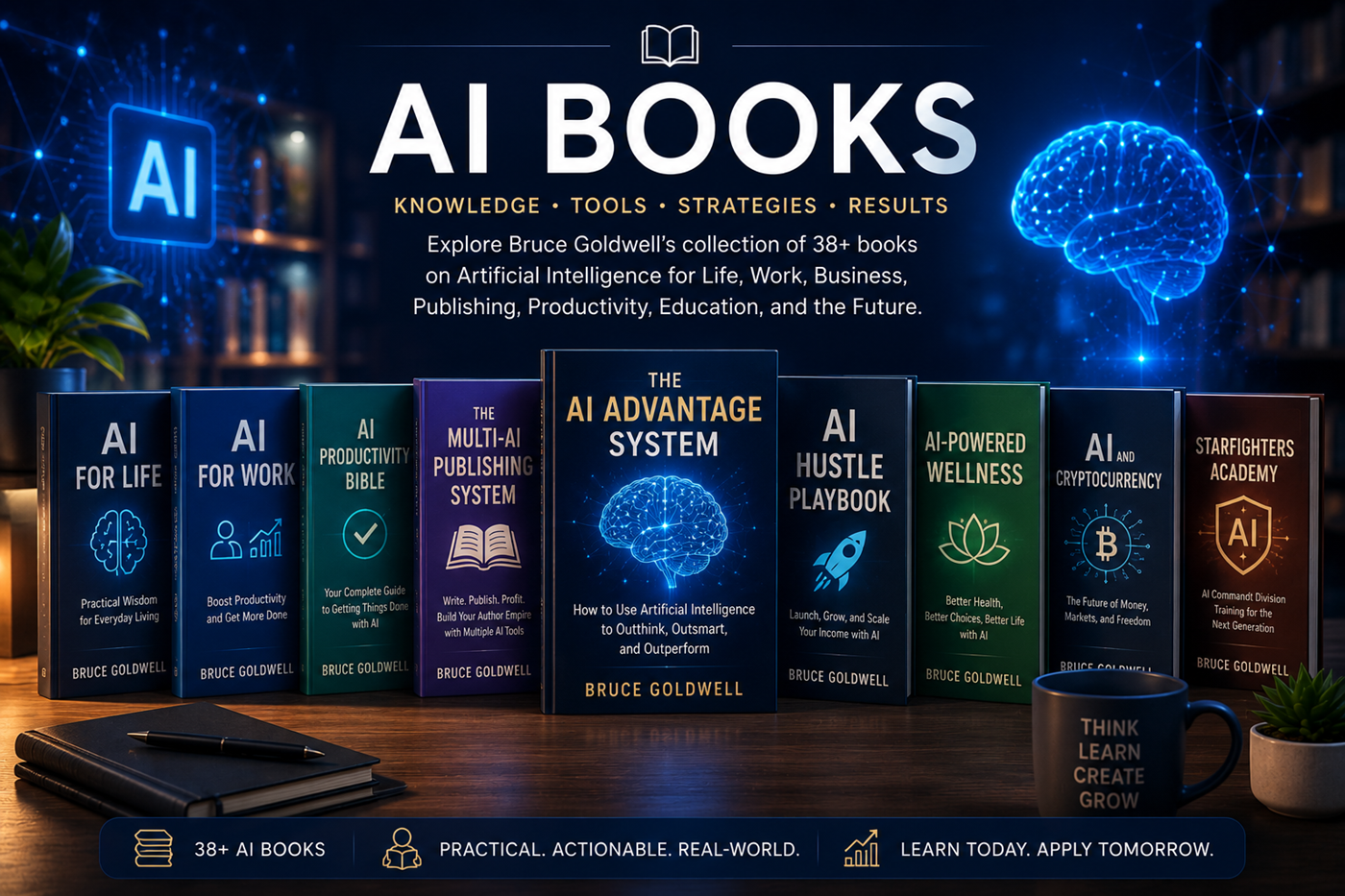
Explore Bruce Goldwell's growing collection of books about AI for life, work, publishing, business, wellness, and the future.
Explore AI booksExplore More Than 38 AI-Related Titles
Bruce Goldwell's growing AI library connects artificial intelligence with daily life, work, publishing, productivity, business, education, wellness, finance, creativity, and future technology.
The books are supported by the free AI Knowledge Center, learning paths, glossaries, FAQs, tools, and related educational resources.
Return to the AI Knowledge Center
Continue through the foundation guides, practical AI applications, tools, glossary, books, learning paths, and future expansion pages.