1
Data
The system receives examples such as text, images, audio, numbers, or labeled records.
Artificial intelligence works by processing data, identifying patterns, training mathematical models, interpreting prompts, and generating predictions, answers, recommendations, or new content.
Most modern artificial intelligence systems become useful by studying examples, adjusting a mathematical model, and using that model to respond to new information.
A traditional computer program may contain a clear rule such as: if a customer enters the correct password, allow access. An AI system may instead examine thousands or millions of examples, discover patterns, and estimate which result is most likely or useful.
For example, an image-recognition system can be trained with many labeled pictures of cats and dogs. Over time, it learns visual patterns associated with each animal. When shown a new picture, it estimates whether the image is more likely to contain a cat or a dog.
Different AI systems work differently, but many follow a process similar to this.
The system receives examples such as text, images, audio, numbers, or labeled records.
The model repeatedly analyzes examples and adjusts its internal mathematical relationships.
The trained model stores learned patterns rather than a simple list of fixed answers.
A user provides a prompt, image, question, file, command, or other new information.
The model estimates the most likely classification, answer, word, action, or output.
The system produces text, images, recommendations, code, analysis, or another result.
The user checks accuracy, relevance, quality, safety, and whether the result meets the goal.
Nearly every AI interaction can be understood through these three parts.
A question, prompt, image, file, audio clip, data record, or command enters the system.
The model processes the input using patterns, probabilities, instructions, and context learned during training.
The system produces an answer, classification, prediction, recommendation, action, or generated content.
Data provides examples from which an AI system can identify patterns. Data may include text, images, audio, transactions, measurements, or human feedback.
Algorithms are mathematical procedures that help a system analyze data, measure errors, adjust relationships, and improve performance.
A model is the trained mathematical structure that uses learned patterns to process new input and produce an output.
Powerful processors and large computing systems help train complex models and generate results quickly.
Training is the process of adjusting a model so that it becomes better at producing the desired result.
During training, an AI system analyzes examples and makes predictions. Those predictions are compared with expected results. The system measures the difference, adjusts its internal relationships, and tries again.
This process may happen millions or billions of times. Over time, the model becomes better at recognizing patterns and generating useful outputs.
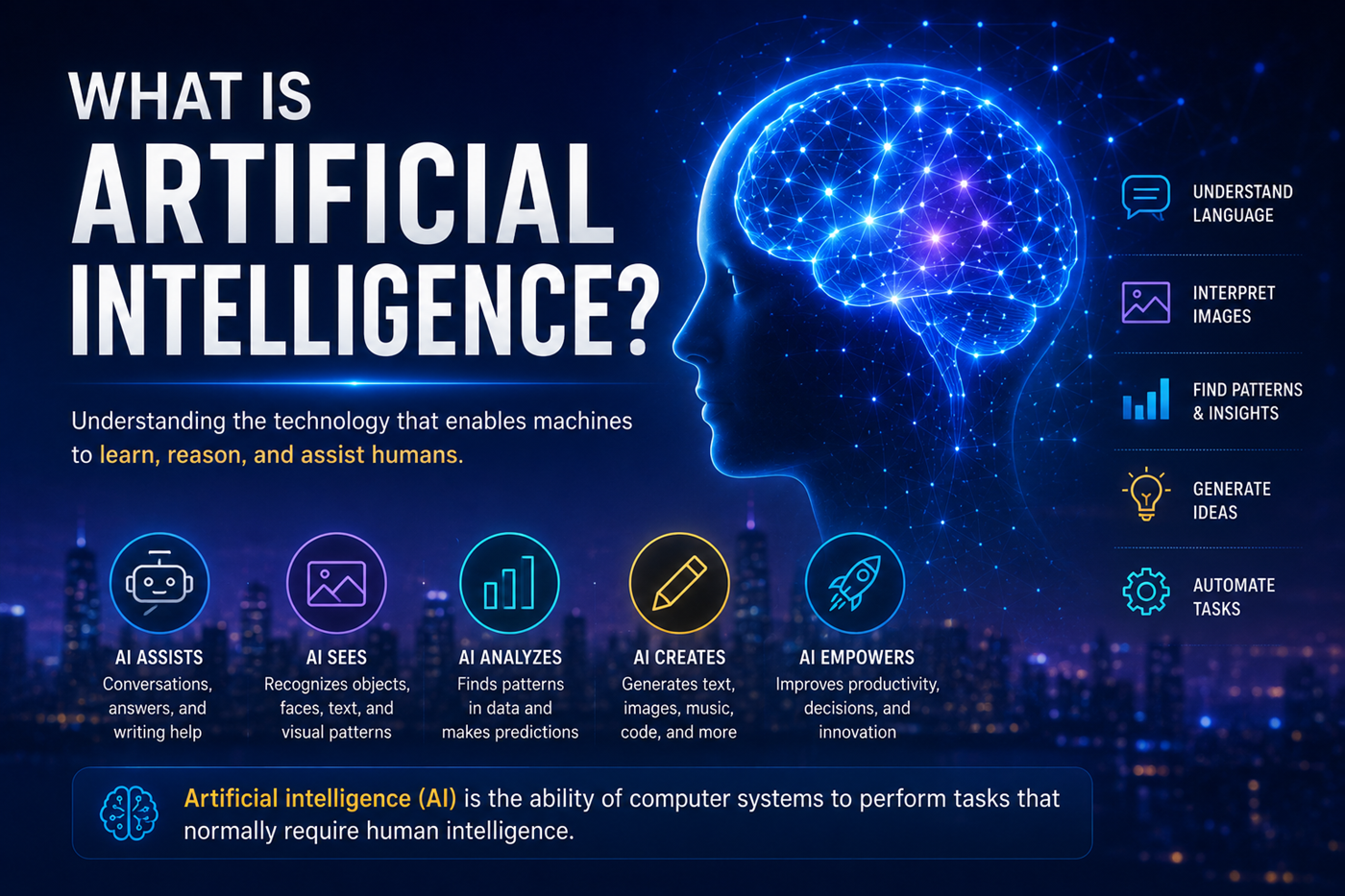
Large language models generate responses by predicting language based on patterns learned from enormous collections of text and other information.
The model receives your words, instructions, previous conversation, system rules, and available context.
It analyzes relationships between words, ideas, formats, instructions, and likely intentions.
The model generates a response one portion at a time by estimating which words or tokens are most likely to follow.
Tone, format, length, audience, examples, and constraints can shape the answer.
The same question may produce different wording or examples because the model generates probabilistic outputs.
The user must decide whether the response is useful, accurate, responsible, and appropriate.
AI does not automatically know your goal, audience, preferred style, or desired format. Clear context helps the system produce a more useful answer.
The request is vague and leaves the AI to guess the goal, audience, tone, and format.
The request provides a goal, audience, tone, length, and specific points to include.
AI systems can produce impressive results while still misunderstanding context or generating false information.
The model may not have enough examples or current information about a topic.
Vague instructions may cause the AI to guess what the user intended.
A response may sound plausible because it matches language patterns even when the details are inaccurate.
The system may not know important background, personal circumstances, or recent developments.
Patterns in training material can reflect cultural, historical, or statistical biases.
Some systems may not have live internet access, complete files, reliable citations, or the ability to perform a requested action.
Artificial intelligence can save time, organize information, generate options, and assist with complex projects. However, the user remains responsible for choosing the goal, protecting private information, reviewing the output, checking facts, correcting errors, and deciding whether the result should be used.
This is especially important when AI is used in health, education, finance, employment, public policy, publishing, or other areas where errors can affect real people.
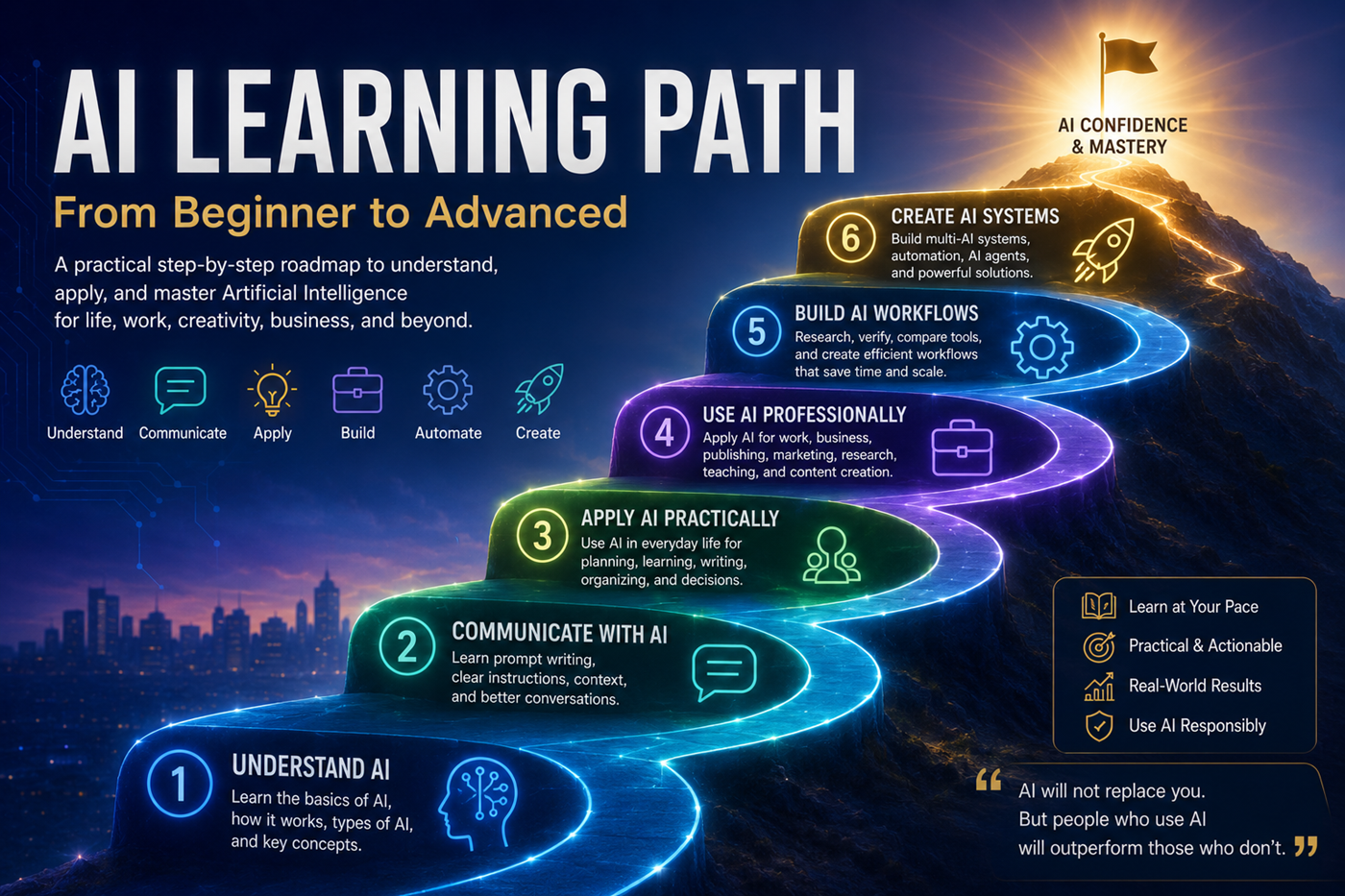
Now that you understand the basic process, the next step is to learn how different forms of AI perform different kinds of work.
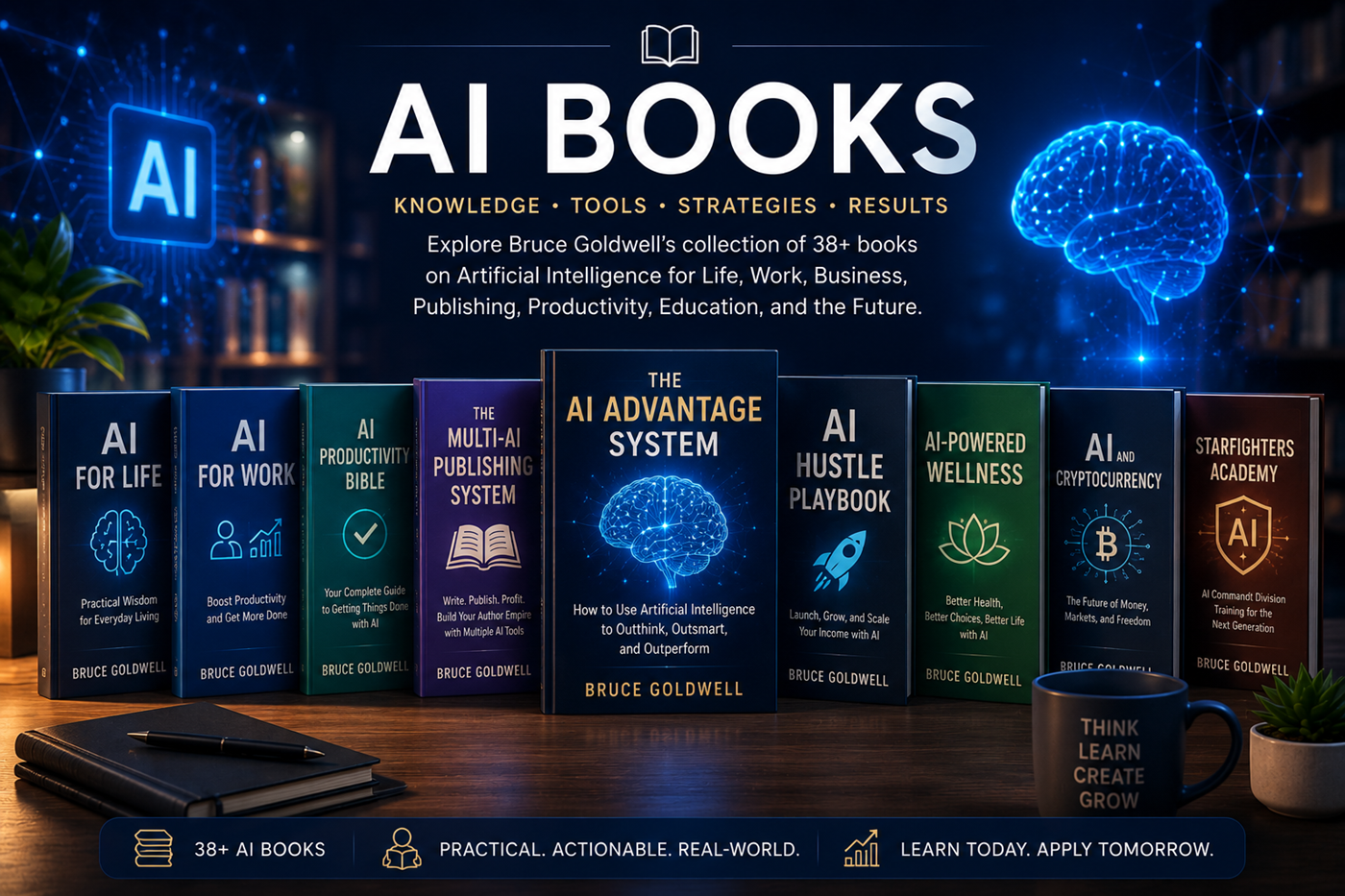
Bruce Goldwell's growing library of more than 38 AI-related books explores how artificial intelligence can be applied to life, work, business, publishing, productivity, education, wellness, creativity, and future technologies.
These books expand the ideas presented in the AI Knowledge Center with practical prompts, workflows, examples, systems, and real-world applications.
AI analyzes information, identifies patterns, and uses a trained mathematical model to generate a prediction, classification, recommendation, answer, or piece of content.
No. AI processes data, probabilities, patterns, and instructions. It does not possess human consciousness, lived experience, values, emotion, or personal responsibility.
An AI model is a trained mathematical system that uses learned patterns to process new input and generate an output.
Large and varied datasets help AI systems identify more patterns and perform across a wider range of situations. Data quality is often as important as data quantity.
AI generates outputs from learned patterns and probabilities. It may misunderstand context, rely on incomplete information, reflect bias, or create details that sound plausible but are false.
Learn how machine learning, generative AI, language models, computer vision, robotics, recommendation systems, and AI agents perform different kinds of tasks.