Research Assistant
Finds current information, identifies sources, locates trends, compares viewpoints, and reveals questions that require further investigation.
Combine research, planning, writing, editing, verification, design, metadata, marketing, websites, and connected content into one organized publishing workflow guided by human creativity and judgment.
A multi-AI publishing system is a structured process that uses several artificial intelligence tools to support the complete publishing journey—from the first idea and research through book creation, production, promotion, and long-term content expansion.
Traditional publishing workflows often treat the book as the final product. A connected publishing system treats the book as the foundation of a larger intellectual property ecosystem.
The research may become articles. The chapters may become lessons. The lessons may become videos, podcasts, courses, newsletters, social posts, knowledge-center pages, apps, worksheets, or future books.
AI makes it easier to organize and develop these connected assets, but the author remains responsible for the ideas, purpose, voice, facts, ethics, final decisions, and value delivered to readers.
The most effective system does not expect one AI platform to handle every stage. Each tool should have a defined responsibility.
Finds current information, identifies sources, locates trends, compares viewpoints, and reveals questions that require further investigation.
Helps define the reader, promise, purpose, positioning, title direction, chapter sequence, and overall structure.
Assists with brainstorming, outlines, examples, transitions, explanations, first drafts, and expansion of the author's original ideas.
Identifies repetition, weak organization, unclear language, pacing problems, missing explanations, inconsistencies, and opportunities to improve the reader experience.
Isolates factual claims, identifies what requires verification, compares competing answers, and helps organize authoritative sources.
Develops concepts for covers, illustrations, diagrams, hero images, advertisements, social media graphics, and promotional visuals.
Helps prepare descriptions, keywords, categories, back-cover copy, author biographies, acknowledgments, and launch materials.
Converts the finished book into webpages, courses, articles, videos, tools, email content, worksheets, social posts, and future publishing opportunities.
This system can support nonfiction, fiction, educational books, workbooks, reference guides, short books, course materials, and interconnected publishing projects.
Clarify what the book is about, who it serves, what problem it solves, what transformation it offers, and why the author is qualified to write it.
Investigate the topic, reader questions, competing books, changing trends, terminology, authoritative sources, market expectations, and gaps that the new book can fill.
Create one master document containing the book's purpose, intended audience, promise, tone, scope, chapter goals, approved terminology, source requirements, and publishing format.
Organize the book into a logical sequence that moves the reader from their current understanding to the intended result.
Combine research, personal experience, original ideas, stories, examples, and AI assistance to create each chapter according to the approved outline.
Review the manuscript for structure, chapter order, logic, missing content, repetition, pacing, clarity, reader value, and whether the book fulfills its promise.
Confirm statistics, quotations, dates, technical claims, scientific findings, laws, product features, historical events, financial information, and other statements presented as fact.
Improve grammar, sentence flow, word choice, transitions, formatting, punctuation, tone, consistency, and readability while preserving the author's voice.
Develop a visual direction that communicates genre, subject, emotional promise, audience, and professional quality.
Create the title, subtitle, description, keywords, category ideas, back-cover copy, author biography, series information, and supporting sales language.
Build a launch system that includes webpages, email content, social posts, videos, press materials, author-group announcements, reader questions, and promotional graphics.
Turn the book's ideas into a growing network of articles, videos, courses, knowledge-center pages, tools, workbooks, apps, newsletters, social content, and future books.
A master brief helps every AI platform understand the same audience, message, voice, scope, and publishing standards.
The completed manuscript is not the end of the creative process. It becomes the central source for an interconnected publishing and educational system.
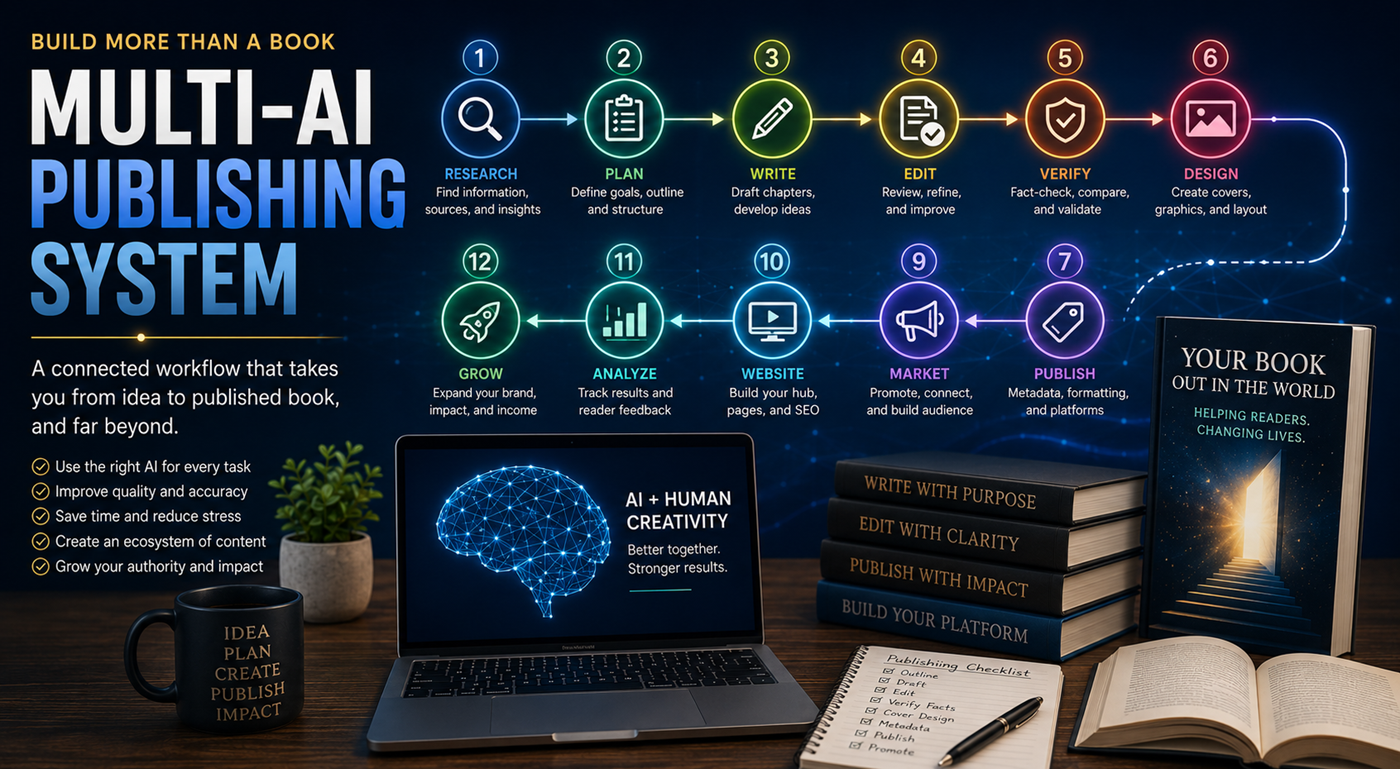
The exact tools may change, but the underlying roles remain useful.
Use research-focused systems to identify current events, reader questions, recent studies, official sources, competing viewpoints, and market gaps.
Use a general-purpose AI assistant to clarify the concept, audience, promise, title direction, chapter sequence, and overall publishing plan.
Develop each chapter from verified research, original ideas, personal knowledge, stories, examples, and guided AI assistance.
Ask another system to identify missing perspectives, repetition, weak logic, poor transitions, unclear explanations, and factual risks.
Develop the cover concept, illustrations, diagrams, hero images, social graphics, advertisements, and website visuals.
Transform the book into a website hub, lessons, articles, videos, promotional content, downloadable resources, and future publishing projects.
Readers connect with perspective, experience, conviction, personality, storytelling, emotion, and human meaning. These qualities should remain at the center of the book.
Give AI your concepts, research, stories, opinions, observations, goals, and intended message instead of asking it to invent the entire project.
Include lessons, failures, discoveries, turning points, examples, and memories that cannot be copied from general training data.
Revise generated passages until the language sounds natural, consistent, and recognizable as your own.
Remove repetitive introductions, vague encouragement, empty claims, predictable conclusions, and phrases that could appear in any book.
Choose what belongs in the manuscript, what should be removed, what requires evidence, and what best serves the reader.
The author remains accountable for the accuracy, originality, fairness, legality, usefulness, and quality of the completed book.
Strong metadata explains what the book is, who it serves, what questions it answers, and why it deserves attention.
Communicate the subject, promise, audience, or distinctive angle without unnecessary repetition.
Open with the reader's problem, present the solution, explain the benefits, and show what the book includes.
Use phrases that reflect reader intent, topic language, common questions, and practical outcomes.
Select categories that accurately represent the content and connect the book with the correct audience.
Connect the book with relevant author pages, related books, knowledge centers, interviews, videos, and educational content.
Create dedicated webpages with descriptive titles, summaries, internal links, schema markup, FAQs, and supporting articles.
A connected website can help readers, search engines, and AI retrieval systems understand the relationship between the author, books, subjects, projects, and supporting educational content.
Include the title, subtitle, description, cover, topics, reader benefits, author information, purchase links, related pages, and frequently asked questions.
Build pages around the major questions, concepts, problems, definitions, and lessons addressed by the book.
Show how books support one another through series pages, topic hubs, learning paths, and recommended reading sequences.
Provide worksheets, checklists, glossaries, timelines, tools, courses, videos, certificates, and downloadable materials.
Connect every page with related topics so readers and automated systems can follow the larger knowledge structure.
Add new research, revised editions, supporting pages, new books, videos, and answers as the subject continues to grow.
This often creates shallow content, repetition, inconsistent terminology, weak progression, and little connection to the author's experience.
AI output requires development, editing, fact-checking, personalization, proofreading, and human review.
AI may provide false citations, inaccurate quotations, nonexistent studies, or links that do not support the claim.
Excessive automation can produce writing that feels generic, emotionally distant, repetitive, or disconnected from the author's identity.
Publishing platforms, marketplaces, schools, contests, and organizations may have specific policies concerning AI-generated or AI-assisted work.
A book gains greater long-term value when it becomes part of an interconnected system of pages, resources, promotion, education, and future projects.
AI-assisted publishing should remain accurate, transparent, lawful, original, and guided by human responsibility.
Do not upload confidential manuscripts, contracts, customer data, private correspondence, or personal information without understanding the platform's privacy practices.
Do not use AI to reproduce protected books, courses, distinctive creative work, or another author's voice for unauthorized publication.
Medical, legal, financial, historical, technical, scientific, and safety-related information should be checked through authoritative sources.
Never publish invented testimonials, fabricated credentials, false expert quotations, nonexistent studies, or misleading claims of certainty.
Review the current requirements of publishing platforms regarding content, disclosure, metadata, images, intellectual property, and reader experience.
The author and publisher remain responsible for the final manuscript, design, claims, marketing, reader impact, and published product.
Artificial intelligence can help organize large amounts of information, generate alternatives, identify weaknesses, produce drafts, develop visuals, and connect one publishing asset to another.
It cannot replace the author's lived experience, creative purpose, values, responsibility, emotional understanding, relationship with readers, or final judgment.
A well-designed multi-AI publishing system turns one idea into a book, then transforms that book into an interconnected world of educational content, searchable authority, creative products, reader resources, and future opportunities.