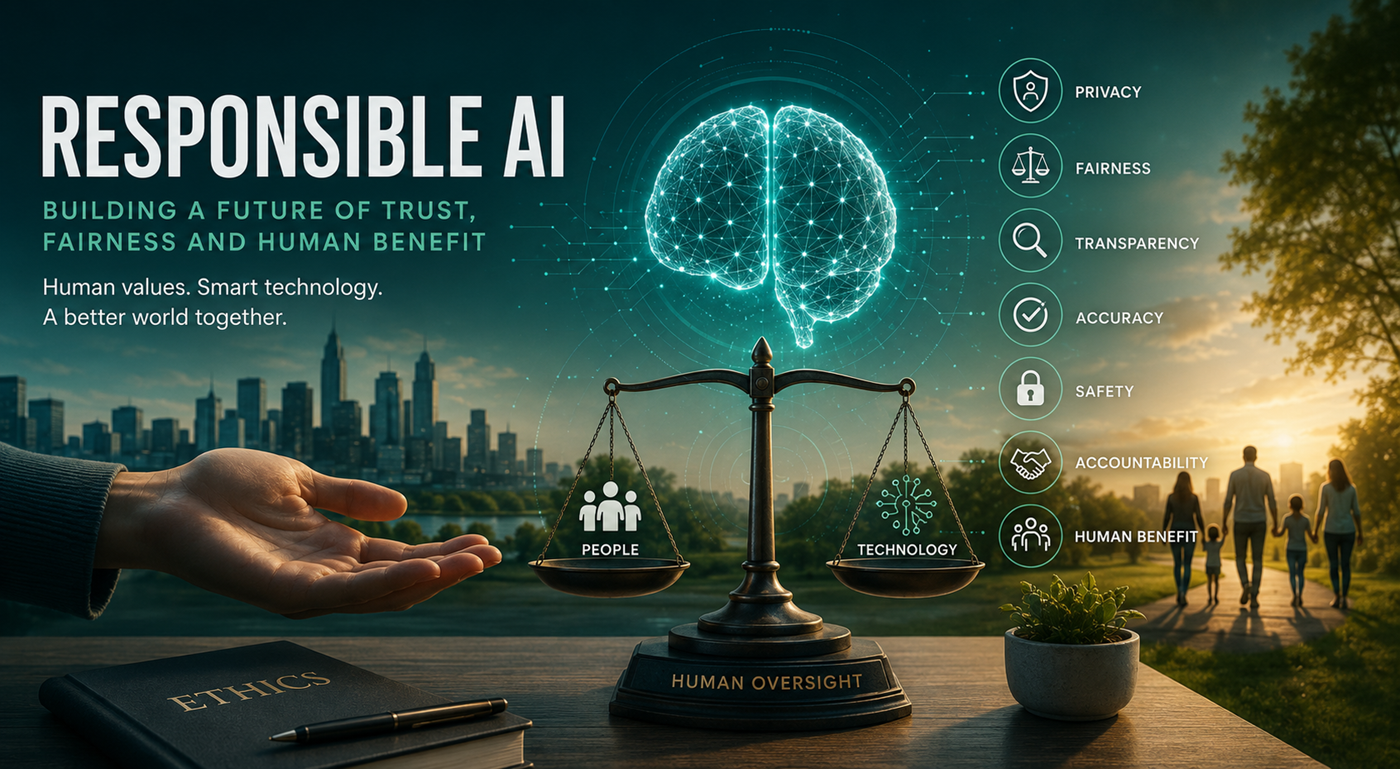
Human Oversight
People should remain responsible for important decisions, especially when AI affects health, safety, employment, education, finances, legal rights, or access to essential services.
Artificial intelligence can help people learn, create, communicate, research, solve problems, and build new systems. Responsible AI means using that power with care, fairness, transparency, privacy, verification, and human accountability.
Responsible AI is the development and use of artificial intelligence in ways that protect people, reduce avoidable harm, respect rights, support fairness, communicate limitations, and preserve meaningful human control.
Responsible AI is not only the responsibility of technology companies, programmers, governments, or researchers. It also applies to individuals, businesses, educators, authors, creators, employers, and organizations that use AI-generated information or automated systems.
Every person who uses AI makes decisions about what information to enter, what results to trust, what content to publish, what tasks to automate, and when human judgment or professional expertise is still required.
These principles provide a practical framework for evaluating how artificial intelligence should be selected, used, reviewed, and governed.
People should remain responsible for important decisions, especially when AI affects health, safety, employment, education, finances, legal rights, or access to essential services.
Personal, private, confidential, financial, medical, business, and identifying information should be protected and shared only when appropriate.
AI systems and their users should avoid unfairly disadvantaging people because of race, gender, age, disability, religion, location, income, or other personal characteristics.
People should understand when AI is being used, what role it played, what information influenced the result, and what important limitations remain.
AI-generated information should be reviewed and verified before it is used for decisions, published as fact, or presented as authoritative.
AI should not be used in ways that create unnecessary danger, encourage harmful behavior, weaken security, or replace qualified assistance in high-risk situations.
The person or organization using AI remains responsible for the decisions, communications, content, and actions produced with its assistance.
AI should be used to improve human capability, access, learning, creativity, opportunity, safety, productivity, and well-being rather than reducing people to data points.
Human-centered AI begins with the needs, rights, goals, safety, dignity, and experiences of the people affected by the technology.
AI may offer recommendations, identify patterns, generate possible answers, and automate parts of a process. However, people should still be able to understand what is happening, question the result, correct errors, and appeal important decisions.
AI systems often depend on information supplied by users. Responsible use begins by deciding what information should never be entered into an AI platform.
Do not casually enter Social Security numbers, passwords, banking information, private health details, legal documents, identification numbers, or information that could expose another person.
Business plans, unpublished manuscripts, customer information, employee records, contracts, internal reports, and trade secrets may require special protection.
When possible, replace names, addresses, account numbers, dates, and unique personal details with neutral descriptions before asking AI for assistance.
Review how an AI provider stores, processes, retains, shares, or uses submitted information before entering sensitive material.
Do not upload another person's private messages, photographs, records, creative work, or personal information without proper permission.
Organizations handling confidential or regulated information should use approved tools, access controls, security procedures, and professional guidance.
AI systems generate responses by recognizing patterns and predicting likely outputs. They can provide useful information, but they can also produce mistakes, false claims, incorrect dates, nonexistent sources, and misleading explanations.
An AI system may confidently combine accurate facts with inaccurate details. It may misunderstand the question, rely on incomplete information, or provide an answer that sounds reasonable without being supported by evidence.
Responsible users distinguish between brainstorming and verification. An AI response can help you identify ideas, organize questions, compare possibilities, and prepare research. It should not automatically become the final authority.
Artificial intelligence learns from human-created information. That information may contain historical inequality, cultural assumptions, incomplete representation, stereotypes, and errors.
Some communities, languages, experiences, and viewpoints may appear more often in training data than others.
As a result, an AI system may perform better for some people than for others or overlook perspectives that are less represented.
If an AI system learns from past decisions involving hiring, lending, housing, policing, education, or healthcare, it may reproduce patterns that were already unfair.
A user's prompt may frame a person, group, culture, or issue unfairly. Responsible prompting avoids stereotypes and asks the AI to consider several perspectives.
Review AI-generated recommendations for missing perspectives, unequal treatment, stereotypes, unsupported generalizations, and different effects on different groups.
People should not be misled into believing that AI-generated content, communication, decisions, or media were created entirely by a human when that distinction matters.
Explain when AI played an important role in producing educational, professional, commercial, journalistic, scientific, or creative work.
AI-generated or heavily altered images, audio, and video should not be presented in ways that deceive people about real events or real individuals.
When an AI system influences an important decision, affected people should understand the role it played and how the outcome can be questioned.
Clearly distinguish verified information from AI-generated suggestions, predictions, fictional scenarios, and unconfirmed interpretations.
Never present fabricated citations, false expert statements, invented testimonials, or unsupported claims as genuine evidence.
Let readers and users know when information may be incomplete, uncertain, outdated, generated from limited data, or still awaiting verification.
AI can help people brainstorm, outline, draft, edit, design, compose, and experiment. Responsible creators still need to consider ownership, originality, permission, attribution, and platform policies.
Use AI-generated material as a starting point. Add your own experience, ideas, structure, judgment, emotional insight, research, and individual voice.
Do not use AI to reproduce a living creator's distinctive voice, visual identity, performance, or recognizable style in a deceptive or exploitative way.
Do not paste protected books, paid courses, private documents, or copyrighted material into an AI tool for unauthorized reproduction or redistribution.
Publishers, schools, competitions, workplaces, platforms, and marketplaces may have different rules for AI-generated or AI-assisted content.
Make sure generated images do not falsely depict real people, copy protected branding, misrepresent historical events, or create misleading evidence.
The person who publishes or distributes AI-assisted work remains responsible for accuracy, legality, originality, fairness, and possible harm.
Some decisions require qualified professionals, authoritative evidence, direct examination, legal responsibility, or personal knowledge that an AI system does not possess.
AI may help explain general health information or prepare questions, but it should not diagnose conditions, prescribe treatment, or replace a qualified healthcare professional.
Laws vary by jurisdiction and change over time. Important legal matters should be reviewed by an appropriately qualified legal professional.
AI-generated financial explanations, market predictions, valuations, and investment ideas may be incomplete, outdated, or unsuitable for an individual's circumstances.
AI should not become an unquestioned authority for hiring, promotion, discipline, scheduling, evaluation, or termination decisions.
AI can support learning, but educators should review its accuracy, age suitability, accessibility, fairness, and effect on genuine student development.
Construction, transportation, emergency response, machinery, electrical work, security, and physical safety require authoritative instructions and qualified oversight.
Artificial intelligence can explain difficult ideas, generate practice questions, provide feedback, support accessibility, and help students explore subjects more deeply.
Businesses and organizations should define which AI tools employees may use, what information may be entered, how results must be reviewed, and who remains responsible for decisions.
Identify which AI platforms have been evaluated and approved for professional or organizational use.
Define what confidential, private, regulated, customer, employee, or company information may not be entered.
Require qualified people to review AI-generated analysis, communications, recommendations, code, and decisions.
Explain when employees must disclose that AI assisted with content, communication, evaluation, or decision-making.
Create a process for reporting inaccurate, biased, unsafe, misleading, or unexpected AI behavior.
Teach employees how to use AI effectively while protecting privacy, security, fairness, accuracy, and public trust.
Pause before acting on an AI answer. A short review can prevent misinformation, privacy problems, reputational damage, and avoidable mistakes.
Saying that an AI system produced an answer does not remove responsibility from the person who chose to use, publish, distribute, or act on that answer.
The human user decides what to ask, what information to provide, what result to accept, what claims to verify, what edits to make, and whether the final output is safe, accurate, fair, and appropriate.
AI can become a powerful partner for learning, creativity, research, communication, business, and problem-solving. Its greatest value will come when people combine technological capability with wisdom, compassion, transparency, fairness, and responsibility.