Context
Humans understand personal history, relationships, local conditions, cultural meaning, timing, and circumstances that may never appear in the data.
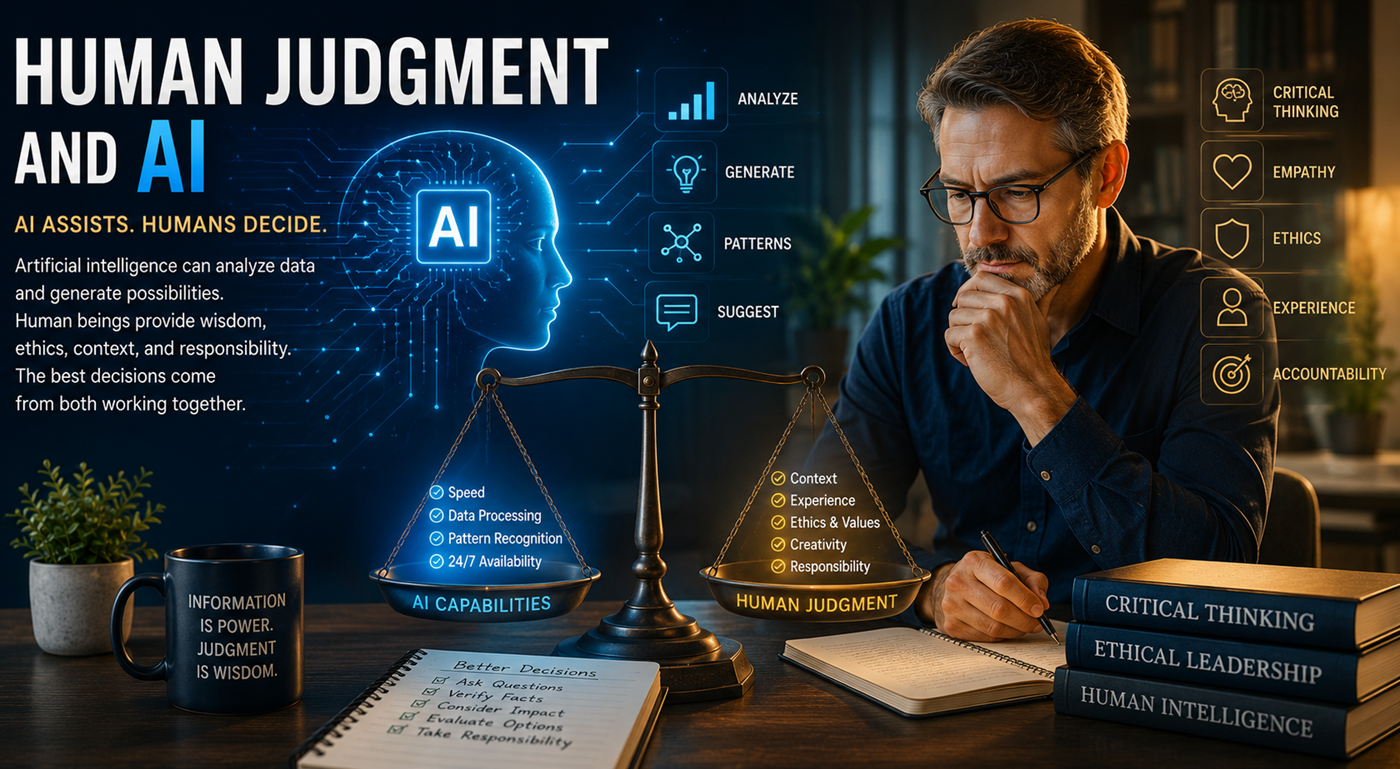
AI can analyze information, generate ideas, recognize patterns, and help people work faster. Human beings must still provide context, values, critical thinking, experience, responsibility, and the final decision.
Artificial intelligence can produce answers that appear complete, confident, and highly organized. That does not mean the answer is correct, appropriate, fair, safe, or wise.
AI systems work by processing information, identifying patterns, and generating likely results. They do not possess human life experience, personal responsibility, moral understanding, emotional awareness, or complete knowledge of every situation.
A human decision-maker understands goals, relationships, history, consequences, timing, values, and circumstances that may not be included in the prompt or available to the AI system.
Human judgment is the ability to evaluate information, consider context, question assumptions, weigh risks, understand people, and decide what should happen next.
Artificial intelligence can extend human ability, but several essential qualities remain deeply connected to human experience and responsibility.
Humans understand personal history, relationships, local conditions, cultural meaning, timing, and circumstances that may never appear in the data.
People decide what matters, what is acceptable, what should be protected, and what kind of future they want to create.
Human beings draw from memories, hardship, relationships, success, failure, intuition, physical experience, and lessons learned over time.
Humans can recognize grief, fear, trust, love, dignity, embarrassment, hope, motivation, and the emotional consequences of a decision.
A person or organization must accept responsibility for decisions and actions. An AI system cannot take moral or legal accountability.
AI can generate possibilities. Humans decide which ideas have meaning, originality, emotional value, and a purpose worth pursuing.
People often recognize when an answer may be technically possible but impractical, inappropriate, unsafe, insensitive, or inconsistent with reality.
The human user chooses what to trust, what to publish, what to reject, what to verify, and what action to take.
Human judgment and artificial intelligence do not have to compete. They can strengthen one another when each is used for the role it handles best.
AI contributes speed, organization, pattern recognition, comparison, drafting, and the ability to produce many possible approaches.
Humans contribute purpose, values, context, experience, emotional intelligence, creativity, and responsibility.
AI-generated answers can sound polished even when important facts are missing, the reasoning is weak, or the conclusion is incorrect.
Ask what evidence supports the answer and whether the conclusion depends on assumptions that have not been proven.
Locate the original report, law, study, document, official announcement, or primary source behind an important claim.
Look for missing viewpoints, unanswered questions, exceptions, limitations, and details that could change the conclusion.
Determine whether the AI is describing a confirmed fact, offering an interpretation, making a prediction, or generating a possibility.
Ask whether the conclusion actually follows from the evidence or whether the answer simply sounds persuasive.
Ask for opposing viewpoints, different explanations, risks, and reasons the first answer may be incomplete.
Instead of asking only for the answer, ask the AI to show what it may not know, what requires verification, and what could change the result.
The greater the possible harm, the more carefully the AI result should be reviewed by qualified people.
AI may explain general information or help prepare questions, but diagnosis, treatment, medication, and emergency decisions require qualified healthcare professionals.
Laws vary by location and change over time. Important legal matters require current authoritative information and professional legal judgment.
AI-generated forecasts, valuations, investment suggestions, and financial plans may be incomplete or unsuitable for a person's situation.
Hiring, promotion, evaluation, discipline, scheduling, and termination should not be determined by an automated recommendation alone.
Teachers and parents should review AI-generated feedback, grading, learning recommendations, and age suitability.
Construction, machinery, electrical work, transportation, emergency response, security, and physical safety require qualified oversight.
Artificial intelligence can produce stories, images, music, outlines, scripts, designs, and ideas. Human creators decide what is worth expressing and why it matters.
The human creator decides the purpose, audience, emotional direction, values, and central meaning of the work.
Personal memories, beliefs, hardship, discovery, love, humor, grief, and transformation give creative work its human depth.
Human judgment identifies predictable language, weak imagery, false emotion, repetition, and ideas that lack originality.
Authors, artists, musicians, and creators should revise generated material until it reflects their identity and intention.
Human creators understand how language, imagery, tone, and cultural context may affect real people.
The person who publishes the work remains responsible for its originality, accuracy, fairness, legality, and impact.
AI can help researchers locate questions, summarize documents, compare arguments, and organize large amounts of information.
Use AI to identify keywords, possible sources, major debates, related topics, and gaps in your understanding.
A human researcher must determine whether a source is original, current, relevant, authoritative, independent, and properly interpreted.
Ask several AI systems to explain an issue and compare where their answers agree, disagree, or rely on different assumptions.
Important information should be traced to official documents, original studies, recognized institutions, direct statements, or qualified experts.
Businesses can use AI to support analysis, planning, communication, and productivity. Important actions should still be reviewed by people who understand the organization, customers, risks, and consequences.
AI-generated messages may sound correct while failing to understand the customer's frustration, history, or emotional state.
Scores and rankings may reflect incomplete data, biased assumptions, or measurements that do not represent real value.
AI may recommend strategies without understanding available resources, local conditions, brand values, or customer relationships.
Summaries can omit exceptions, reduce complex issues, or give too much importance to easily measured information.
Decisions affecting employees, customers, finances, privacy, safety, and reputation require accountable human review.
Organizations should identify who approves AI-assisted decisions and who responds when the result causes harm.
Use this six-step method before acting on an important AI-generated recommendation.
Read the complete answer and identify exactly what the AI is recommending, predicting, or claiming.
Identify what information, definitions, priorities, and unstated beliefs the recommendation depends on.
Examine the quality, relevance, date, completeness, and authority of the supporting evidence.
Consider who may benefit, who may be harmed, what could go wrong, and whether the decision can be reversed.
Identify the person who has the authority, expertise, and accountability to make the final decision.
Record the final choice, the evidence considered, the limitations, and the reason for accepting or rejecting the AI recommendation.
AI-generated claims are accepted because they sound confident or appear in a polished format.
No follow-up questions are asked, no alternatives are considered, and no missing information is identified.
You are prepared to use a recommendation without understanding how or why it was produced.
A generated answer is accepted even when it conflicts with direct knowledge or obvious practical concerns.
Mistakes are blamed on the AI instead of recognizing that a human chose to use the result.
AI is used to replace learning, practice, judgment, creativity, or professional development rather than strengthen them.
Human oversight should not be added only after the AI has completed the work. It should guide the entire process.
Decide the goal, audience, values, boundaries, risks, and standards before asking AI to assist.
Review drafts, ask questions, correct errors, provide missing context, and challenge weak reasoning.
Verify important claims, consider the impact, make final edits, and accept responsibility before acting or publishing.
The goal is not to surrender decisions to artificial intelligence. The goal is to use AI to see more possibilities, organize more information, ask better questions, and make more thoughtful human decisions.