Define the Book
Identify the reader, problem, central promise, purpose, format, tone, scope, and result the book should provide.
Learn how to use artificial intelligence as a research, planning, writing, and revision partner while protecting your ideas, voice, creativity, judgment, and responsibility as an author.
Artificial intelligence can help authors develop ideas, organize research, build outlines, draft sections, revise language, and examine a manuscript from different perspectives.
Writing a book is a process of thinking, choosing, organizing, explaining, storytelling, and revising. AI can assist with many of these activities, but it does not replace the author’s purpose, knowledge, imagination, values, experience, or final judgment.
The strongest AI-assisted books begin with a human idea and remain under human direction. The author defines the reader, decides what the book should accomplish, provides the important knowledge, verifies factual claims, revises the writing, and accepts responsibility for the published result.
A structured process helps authors use AI purposefully instead of generating disconnected pages without a clear direction.
Identify the reader, problem, central promise, purpose, format, tone, scope, and result the book should provide.
Develop questions, locate reliable sources, compare viewpoints, organize notes, and identify facts requiring verification.
Arrange the material into a logical sequence of chapters, lessons, examples, action steps, and reader outcomes.
Expand the author’s ideas, stories, research, examples, instructions, and explanations into complete chapters.
Improve clarity, structure, accuracy, consistency, pacing, transitions, voice, usefulness, and reader experience.
Finalize the manuscript, description, keywords, cover direction, front matter, back matter, and promotional materials.
Authors can lose control of a project when they begin asking AI to write chapters before deciding what the book is supposed to accomplish.
Before drafting, create a clear book definition. This becomes the guide for every later prompt, outline, chapter, revision, and marketing decision.
AI can help authors identify research questions and organize findings, but it can also produce false, outdated, or unsupported information.
Ask AI to identify the questions readers are likely to ask and the claims each chapter should be able to support.
Determine which claims require official documents, original research, professional guidance, historical records, or expert sources.
Examine competing explanations, areas of disagreement, uncertain evidence, changing information, and possible reader objections.
Sort research by chapter, theme, claim, chronology, source, supporting example, or question still requiring an answer.
Maintain a list of statistics, dates, quotations, names, studies, legal claims, and other facts that must be checked.
Save the original title, author, publisher, date, page, web address, and access information for every important source.
A book outline is more than a list of topics. It should guide the reader from a starting problem toward greater understanding or action.
AI can help compare different chapter orders, identify missing steps, remove repetition, and create a more logical progression.
Create three possible chapter structures for this book. For each structure, explain the reader journey, the purpose of every chapter, the key question answered, the main lesson, and the transition to the next chapter.
AI produces stronger and more authentic material when the author supplies the ideas, experiences, conclusions, examples, and desired lesson.
Provide your observations, stories, research, arguments, lessons, examples, questions, and desired chapter outcome.
Work in manageable sections so that you can guide the direction, review the language, and correct problems early.
Tell AI what the reader already knows, what may confuse them, and what tone will help them remain engaged.
List the facts, stories, lessons, warnings, examples, quotations, and action steps that must appear in the section.
Instruct AI not to invent statistics, sources, testimonials, case studies, quotations, or factual details.
Replace generic wording, add personal detail, change the rhythm, strengthen examples, and ensure the final passage sounds like you.
A detailed prompt helps AI support the author’s intentions instead of inventing a direction of its own.
Help me develop Chapter [number], titled “[chapter title].” The chapter is for [reader]. Its purpose is to [goal]. The reader should understand or accomplish [outcome].
Use the following author notes: [notes]. Include these required points: [points]. Use these examples or stories: [examples]. Maintain a [tone] tone and a [reading level] reading level.
Do not invent facts, statistics, quotations, sources, personal stories, or case studies. Clearly mark any statement that requires verification. End with [summary, exercise, action step, or transition].
Review the proposed section structure before allowing AI to expand it into a complete draft.
Ask for several openings, examples, transitions, or explanations and choose the option that best fits the book.
Ask AI to identify vague statements, unsupported claims, clichés, repetition, and language that sounds generic.
Clearly identify quotations, facts, names, phrases, or personal language that must not be changed.
AI-generated writing can become repetitive, overly polished, vague, predictable, and emotionally distant unless the author actively revises it.
Include experiences only you can provide, along with the lesson, emotion, mistake, discovery, or turning point behind them.
Replace generic phrases with expressions, rhythms, comparisons, and explanations that reflect how you normally communicate.
Explain what you believe, why you believe it, what experience shaped that conclusion, and where uncertainty remains.
Replace abstract explanations with specific situations, realistic choices, practical applications, and memorable illustrations.
Look for repeated introductions, conclusions, phrases, warnings, lists, definitions, and restatements of the same lesson.
Honest uncertainty, struggle, surprise, humor, humility, and reflection can make a book more believable and relatable.
AI can generate smooth language quickly, but polished sentences do not guarantee that a manuscript is accurate, useful, original, or well organized.
Revision should examine the book at several levels, beginning with the overall reader journey and ending with individual sentences.
AI can accelerate book development, but speed can also allow errors and weak writing habits to spread throughout a manuscript.
Generating chapters before defining the audience, promise, scope, and outline often creates a disconnected manuscript.
The first response may contain weak structure, invented claims, generic language, repetition, or an unsuitable tone.
Asking for an entire book in one request reduces the author’s ability to guide individual chapters and correct problems.
AI can confidently produce incorrect dates, studies, statistics, quotations, names, and sources.
A manuscript built mostly from generic AI language may sound polished but lack personality, authority, warmth, and originality.
AI frequently repeats themes, phrases, warnings, summaries, and conclusions in slightly different language.
Every manuscript requires careful review for accuracy, clarity, copyright, privacy, formatting, and reader safety.
AI should not present fabricated personal experiences, case studies, testimonials, or expert endorsements as real.
Publishing platforms may have current rules concerning AI-generated or AI-assisted content, disclosure, quality, and ownership.
The author or publisher is responsible for reviewing the manuscript, verifying information, respecting intellectual property, protecting privacy, and preventing harmful or misleading claims.
A finished book can become the foundation for additional resources that help readers discover, understand, and apply its ideas.
Develop advanced books, beginner editions, workbooks, guided journals, updated editions, and related series.
Turn chapters and concepts into educational web pages that answer questions and connect readers to related resources.
Transform lessons into structured learning paths, exercises, quizzes, certificates, and educational programs.
Create interviews, tutorials, short lessons, presentations, narrated summaries, songs, and multimedia resources.
Build calculators, generators, checklists, planners, interactive lessons, and practical reader tools.
Create clear, connected, authoritative resources that can strengthen visibility in search engines and AI answer systems.
Continue learning how artificial intelligence can support authors before, during, and after the writing process.
Explore the complete author workflow from idea development through publishing, marketing, and ecosystem building.
Visit AI for authorsUse AI to examine structure, clarity, consistency, pacing, repetition, grammar, and reader experience.
Explore AI editingDevelop book descriptions, promotional content, campaigns, articles, reader resources, and long-term discovery systems.
Explore AI book marketingLearn how context, requirements, examples, restrictions, and follow-up questions improve AI output.
Learn prompt engineeringExplore artificial intelligence tools for writing, research, planning, editing, images, coding, video, and music.
Explore AI toolsExplore Bruce Goldwell’s growing library of books about artificial intelligence, publishing, productivity, and business.
Visit the AI book library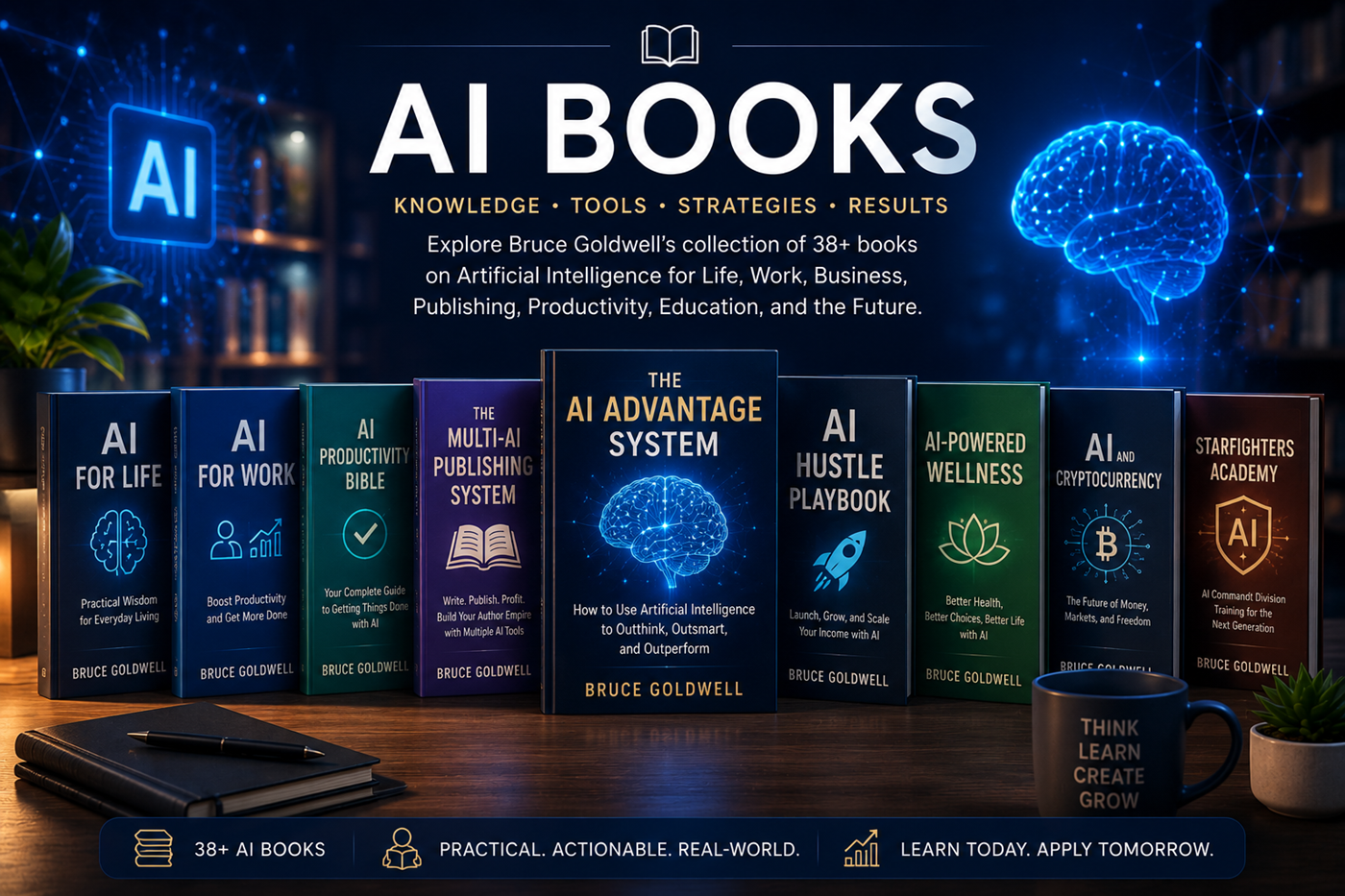
Bruce Goldwell’s books explore practical artificial intelligence for writing, publishing, business, productivity, education, research, wellness, creativity, and digital systems.
The collection is designed to help readers use AI with greater purpose, structure, realism, creativity, and responsibility.
Define your reader, clarify your purpose, organize your knowledge, build the outline, and use artificial intelligence as a partner under your direction.