Define the Reader
Identify who the book serves, what that reader wants, what problem they face, and what language they use when seeking help.
Learn how to use artificial intelligence to understand readers, position books clearly, create marketing content, plan launches, build author websites, strengthen discoverability, and develop long-term systems that keep books visible.
Effective marketing is not simply posting a purchase link after publication. It begins with understanding the reader, clarifying the book’s promise, and creating useful connections between the book and the audience it was written to serve.
Artificial intelligence can help authors research reader questions, compare positioning ideas, draft descriptions, organize campaigns, create content, prepare emails, develop website pages, and turn one book into many educational resources.
AI does not guarantee attention or sales. It cannot replace a useful book, a clear audience, honest communication, consistent effort, or a trustworthy author platform. It works best when it helps the author explain real value more clearly and build sustainable systems over time.
A structured process helps authors move beyond random promotion and create a marketing system connected to the book’s purpose.
Identify who the book serves, what that reader wants, what problem they face, and what language they use when seeking help.
Explain what the book is about, why it matters, how it is different, and what result or understanding it offers.
Develop the description, title presentation, keywords, categories, author information, supporting images, and purchase links.
Organize announcements, email messages, social posts, website updates, reader outreach, promotional content, and follow-up activities.
Turn the book into articles, videos, questions, quotes, lessons, checklists, interviews, and educational pages.
Build internal links, topic authority, search visibility, AI discoverability, reader pathways, and connections to related books.
Marketing becomes more effective when the author understands the reader’s situation, questions, language, hopes, and objections.
AI can help organize what you already know about the reader and identify additional questions worth researching. It can also help distinguish between a broad audience and the primary reader most likely to benefit from the book.
Good positioning helps a reader understand what the book offers, who it is for, and why it may be worth their time.
Identify the person most likely to benefit from the book and the situation that brings them to it.
Describe the question, challenge, frustration, desire, or knowledge gap the book addresses.
Explain what the reader will understand, discover, improve, create, avoid, or accomplish.
Clarify what makes the book’s method, perspective, structure, experience, or supporting system distinctive.
Identify the author experience, research, examples, case material, credentials, or practical results supporting the book.
Tell the reader what to do after understanding the book’s value, whether that means reading, downloading, subscribing, or exploring more.
A book description should help the right reader recognize the problem, understand the book’s value, and decide whether it matches their needs.
AI can help authors create and compare several description structures, improve clarity, remove repetition, strengthen benefits, and adapt the language for different marketplaces or audiences.
Keywords help describe the book and connect it to reader searches, but they should accurately represent the book’s subject and audience.
Identify the main subject, related concepts, methods, industries, genres, and areas of reader interest.
Explore phrases readers may use when describing the challenge, frustration, question, or need addressed by the book.
Identify the result, skill, understanding, transformation, or improvement the reader hopes to achieve.
Include reader roles, experience levels, professions, age groups, interests, or situations when genuinely relevant.
Describe the type of resource, such as guide, workbook, handbook, introduction, reference, course companion, or step-by-step plan.
Explore common questions readers ask before buying or when searching for information related to the book.
A launch gives authors a reason to communicate clearly and consistently, but the goal should be more than repeating the same sales message.
AI can help organize launch tasks, draft announcements, create content variations, prepare interview questions, build email sequences, and develop a schedule for before, during, and after release.
Prepare the book page, author page, description, keywords, graphics, announcements, email drafts, sample content, and launch calendar.
Share the book’s purpose, reader benefits, behind-the-scenes story, excerpts, interviews, educational content, and purchase information.
Continue with articles, videos, questions, reader resources, interviews, updated pages, related books, and long-term topic authority.
Examine which messages, pages, channels, topics, questions, and formats created meaningful reader attention or engagement.
Email allows authors to communicate directly with readers who have chosen to receive updates, resources, or news.
Introduce the author, explain what subscribers can expect, and provide a useful resource or clear next step.
Discuss a real reader challenge connected to the book and provide useful insight before mentioning the book.
Share the experience, discovery, question, or event that inspired the book or one of its central lessons.
Announce availability, explain the book’s purpose, identify the intended reader, and provide a direct purchase link.
Answer questions, address objections, share an excerpt, highlight benefits, or remind readers before a promotion ends.
Share related articles, worksheets, videos, lessons, tools, or additional books that deepen the reader experience.
Social media works best when authors share ideas, lessons, stories, and questions rather than posting only repeated sales messages.
AI can help transform a book’s themes into different content formats while preserving the author’s message and voice.
Social media posts disappear quickly. A dedicated website page gives the book a stable location that can be indexed, linked, updated, cited, and discovered over time.
Explain the title, subtitle, topic, intended reader, central problem, book promise, and reason the book was created.
Show what readers will learn, understand, improve, explore, avoid, create, or accomplish.
Explain the experience, knowledge, research, purpose, or personal story connecting the author to the subject.
Link to articles, videos, tools, workbooks, courses, glossaries, frequently asked questions, and related books.
Provide clear links to available formats and authorized retailers without overwhelming visitors with unnecessary choices.
Use descriptive headings, metadata, internal links, image alt text, canonical URLs, and appropriate structured data.
Articles and educational pages can help readers discover a book through the questions, problems, and topics connected to it.
Turn individual chapters into focused articles that answer one important question without reproducing the entire book.
Address a specific reader problem, explain why it happens, and introduce practical ideas connected to the book.
Create clear answers to the questions readers ask before buying, while reading, or after completing the book.
Compare methods, viewpoints, tools, formats, or approaches when the comparison genuinely helps the reader make a decision.
Create entry-level resources that introduce the subject and guide new readers toward more detailed books and materials.
Expand selected ideas for experienced readers who want deeper examples, advanced strategies, or specialized applications.
Video helps readers connect with the author’s personality, voice, experience, and enthusiasm for the subject.
AI can help create video outlines, hooks, titles, descriptions, short scripts, talking points, interview questions, and content variations for different platforms.
Create a 60-second video script based on this book idea. Begin with a clear hook, identify one reader problem, provide one useful insight, explain how the book explores the subject, and end with a simple invitation to learn more.
Visual content can help a book attract attention, communicate its subject, and remain recognizable across websites and social platforms.
Create promotional images using the real book cover, title, author name, short message, and purchase information.
Turn selected quotations or lessons into readable graphics that include enough context to remain meaningful.
Transform processes, lists, comparisons, timelines, or frameworks into visual educational resources.
Create clear thumbnails with readable text, strong visual focus, and accurate representation of the video topic.
Adapt graphics for each platform while maintaining consistent colors, book branding, and author identity.
Create wide images that communicate the subject, support the page headline, and remain readable on different screen sizes.
Reader magnets work best when they provide genuine value and naturally connect to the subject of the book.
AI can help organize bonus materials, but the author should ensure that every resource is accurate, practical, well designed, and worth the reader’s time.
Suggest ten useful reader magnets connected to this book. For each one, explain the reader problem it solves, what it should contain, how long it should be, and how it naturally leads to the book without feeling like an advertisement.
Reviews can help future readers understand how others experienced the book, but authors should never invent, purchase, pressure, or manipulate reviews.
AI can help draft polite review requests, organize reader feedback, identify recurring questions, and summarize patterns across legitimate reviews.
Invite readers to leave an honest review after they have had enough time to read and evaluate the book.
Ask for an honest review rather than requesting a positive rating or suggesting what the reader should say.
Provide a direct link when allowed and explain briefly how reviews help other readers make informed decisions.
Look for repeated questions, confusion, praise, criticism, missing material, and ideas for future editions or companion books.
Generative Engine Optimization focuses on creating clear, useful, trustworthy, and interconnected information that AI systems may understand, retrieve, summarize, and cite.
Create multiple useful pages covering the definitions, questions, applications, comparisons, risks, and advanced ideas connected to the book.
Organize pages with descriptive titles, headings, summaries, definitions, lists, examples, and direct answers to important questions.
Use meaningful internal links that help readers and retrieval systems understand how books, topics, pages, and resources relate.
Connect the page to a clear author profile, biography, books, expertise, publishing history, and related work.
Use reliable sources, accurate dates, transparent explanations, and appropriate disclaimers when discussing consequential subjects.
Update pages when facts, tools, policies, links, products, or recommendations change.
An author with several books has more than a catalog. Those books can become an interconnected system of ideas, audiences, pages, products, and learning paths.
AI can help identify relationships between books, locate shared themes, plan reader journeys, and create pages that guide people from one subject to the next.
A second book, a workbook, an online course, a knowledge hub, an article series, a video playlist, an email series, a reader tool, and a new pathway into the author’s larger body of work.
Data can help authors understand what is working, but not every number represents meaningful reader interest or long-term value.
Track which book pages, articles, and resources attract attention and where visitors enter the author ecosystem.
Review which buttons, purchase links, related-book links, and calls to action readers use.
Examine opens, clicks, replies, unsubscribes, and the types of messages that create genuine reader response.
Observe which questions, topics, and pages appear in search results and attract relevant visitors.
Pay attention to reviews, messages, questions, shares, comments, recommendations, and requests for more information.
Evaluate whether the system continues bringing readers to books, resources, and related pages after the launch period ends.
Broad language often weakens the message. Focus first on the reader most likely to need the book.
Constant sales posts without useful content can cause readers to ignore the author’s messages.
Overly polished but vague marketing may lack the author’s real voice, story, authority, and connection to the reader.
Do not promise guaranteed results, instant success, bestseller status, professional outcomes, or transformations the book cannot prove.
Never invent reviews, testimonials, endorsements, awards, rankings, expert praise, or reader experiences.
Depending entirely on social platforms leaves authors vulnerable to changing algorithms, policies, reach, and account access.
A short launch cannot replace long-term content, internal links, reader resources, and ongoing discovery.
AI may invent statistics, market facts, platform rules, keywords, competitor details, or marketing claims.
Constantly changing strategy can weaken branding, waste time, and prevent authors from building durable systems.
Authors remain responsible for the claims, images, endorsements, emails, promotions, advertisements, and public statements used to market their books.
Continue learning how artificial intelligence can support book creation, editing, publishing, and long-term discovery.
Learn how to move from idea and research to outline, draft, revision, and finished manuscript.
Explore AI-assisted writingImprove structure, clarity, consistency, repetition, grammar, accuracy, and reader experience.
Explore AI editingExplore the complete author workflow from ideas and research through publishing, marketing, and ecosystem development.
Visit AI for authorsLearn how context, instructions, examples, restrictions, and follow-up questions improve AI output.
Learn prompt engineeringExplore AI tools for writing, research, editing, images, video, planning, coding, productivity, and music.
Explore AI toolsExplore Bruce Goldwell’s growing library of practical books about artificial intelligence, publishing, productivity, business, and creativity.
Visit the AI book library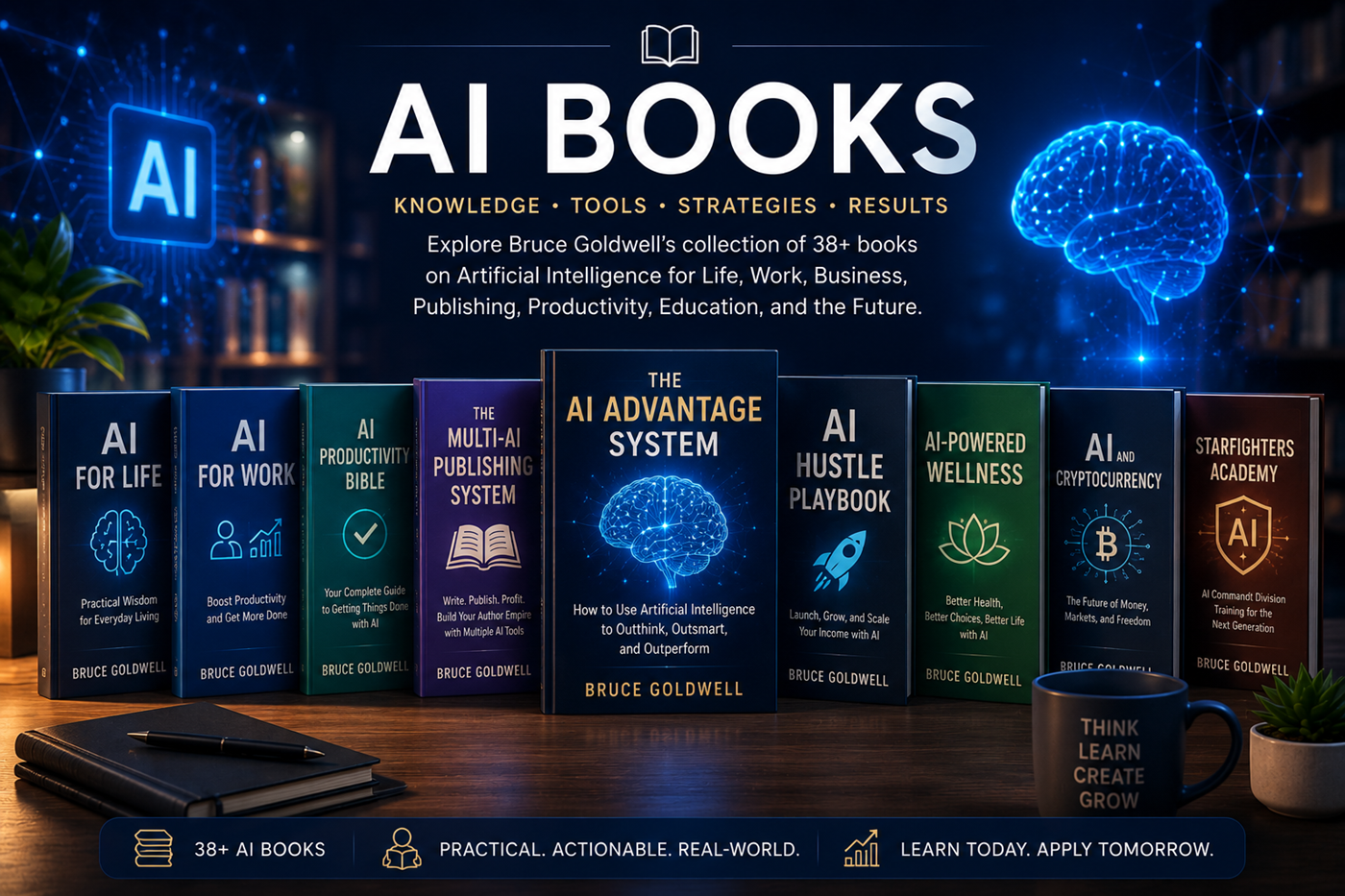
Bruce Goldwell’s AI books explore writing, editing, marketing, publishing, business, productivity, research, creativity, education, and responsible AI use.
The collection helps readers move from basic experimentation toward practical, structured, and responsible artificial intelligence systems.
Define the reader, clarify the book’s promise, create useful content, build a permanent book page, and use AI to support a marketing system that continues beyond launch week.