Purpose and Promise
Confirm that the book serves the intended reader, addresses the central problem, and fulfills the promise made at the beginning.
Learn how to use artificial intelligence to review structure, strengthen clarity, reduce repetition, improve consistency, polish sentences, check details, and create a better reader experience.
After spending weeks or months with a manuscript, authors often become too familiar with the material to notice missing explanations, repeated ideas, weak transitions, or inconsistent language.
Artificial intelligence can help examine a manuscript from several perspectives. It can identify structural weaknesses, unclear passages, repeated themes, inconsistent terminology, grammar problems, and areas where the reader may need more context.
AI editing is most useful when it supports a deliberate revision process. It should not automatically rewrite the entire manuscript or replace the author’s judgment, voice, knowledge, or responsibility.
Editing becomes more manageable when the manuscript is reviewed in stages instead of trying to fix every problem at once.
Confirm that the book serves the intended reader, addresses the central problem, and fulfills the promise made at the beginning.
Review chapter order, missing material, repeated sections, transitions, pacing, and the overall reader journey.
Check facts, dates, names, quotations, statistics, claims, examples, references, and information that may have changed.
Improve explanations, terminology, tone, style, headings, formatting patterns, and consistency across chapters.
Refine grammar, punctuation, word choice, sentence length, readability, transitions, and unnecessary repetition.
Search for missing words, duplicated text, incorrect headings, formatting errors, spelling mistakes, and final production problems.
Perfect punctuation cannot repair a manuscript with missing chapters, weak organization, an unclear purpose, or a broken reader journey.
Developmental editing examines whether the book works as a complete experience. AI can help identify gaps, misplaced chapters, repeated lessons, abrupt transitions, and sections that do not support the central promise.
Authors often understand their own subject so well that they may leave out information a new reader needs.
Find words such as “it,” “this,” “they,” or “things” when the meaning is not clear from the surrounding passage.
Break overloaded sentences into clearer statements without removing important meaning or changing the author’s voice.
Identify concepts that may require definitions, examples, comparisons, or simpler language for the intended reader.
Improve the connection between paragraphs, sections, and chapters so the reader understands why the next idea follows.
Identify places where the author assumes knowledge that a beginner or unfamiliar reader may not possess.
Replace abstract explanations with specific, realistic, and relevant illustrations that make the lesson easier to understand.
Long manuscripts often develop inconsistencies because chapters are written at different times or revised in different ways.
AI can help compare sections and identify changes in terminology, tone, capitalization, formatting, names, timelines, point of view, and repeated definitions.
A manuscript style sheet records important editing decisions so they remain consistent throughout the book.
AI-assisted manuscripts can become repetitive because similar prompts often produce similar introductions, explanations, warnings, summaries, and conclusions.
Find lessons that appear in several chapters without adding a new perspective, example, or application.
Identify expressions, transitions, sentence openings, motivational lines, and conclusions used too frequently.
Decide whether a concept needs one full definition and shorter reminders later instead of repeated explanations.
Combine similar cautions when repetition slows the book or weakens their impact.
Avoid beginning every chapter with the same pattern, question, statement, or summary of what came before.
Ensure each chapter ends with a distinct insight, action step, reflection, or transition instead of generic encouragement.
Copyediting should make the writing clearer and more consistent while preserving the author’s personality, rhythm, and intended meaning.
Review sentence construction, agreement, verb tense, pronouns, modifiers, punctuation, and common usage problems.
Replace vague, repetitive, overly formal, or inaccurate words while protecting the author’s natural vocabulary.
Vary sentence length and structure so the writing does not sound mechanical, monotonous, or artificially uniform.
Remove filler, repetition, inflated language, excessive qualifiers, and sentences that do not advance the idea.
Check whether the language remains appropriate for the subject, audience, emotional purpose, and author identity.
Improve paragraph length, sentence complexity, headings, lists, white space, and the visual flow of information.
A sentence can be grammatically correct and still contain false, outdated, misleading, or unsupported information.
AI can help identify claims that may require verification, but it should not be trusted to verify its own output without checking authoritative sources.
Proofreading is the final review for small errors that remain after the manuscript’s content, structure, and wording are settled.
Check ordinary words, names, locations, technical terms, branded terms, and words that are valid but incorrect in context.
Review quotation marks, commas, apostrophes, dashes, colons, semicolons, parentheses, and end punctuation.
Confirm chapter numbers, titles, subtitles, heading levels, capitalization, and table-of-contents consistency.
Check paragraph breaks, indentation, spacing, lists, page breaks, italics, bold text, tables, and special elements.
Verify footnotes, endnotes, bibliography entries, cross-references, chapter references, links, and page references.
Look for repeated paragraphs, missing sentences, incomplete lists, broken transitions, and accidental copy-and-paste errors.
AI changes are recommendations, not commands. Some revisions may weaken the voice, alter the meaning, or remove necessary nuance.
Large automatic rewrites can introduce new errors, remove important information, and make the manuscript sound generic.
A passage may appear repetitive or incomplete when viewed alone but make sense within the full chapter or book.
Over-editing can replace natural personality with polished but predictable language that sounds like everyone else.
AI may confirm false claims or create supporting details that do not exist. Verify through original sources.
AI cannot fully judge emotional impact, cultural context, legal risk, reader expectations, or the author’s deeper intentions.
Editing involves access to manuscripts, personal stories, unpublished ideas, research, and potentially confidential information. Use AI systems carefully and understand how submitted material may be processed or stored.
Continue learning how AI can support book creation, revision, publishing, and discovery.
Learn how to move from idea and research to outline, draft, revision, and finished manuscript.
Explore AI-assisted writingExplore research, writing, editing, descriptions, keywords, marketing, and author ecosystem development.
Visit AI for authorsCreate promotional content, book descriptions, campaigns, reader resources, and long-term discovery systems.
Explore AI book marketingLearn how clear instructions, context, examples, restrictions, and follow-up questions improve AI output.
Learn prompt engineeringExplore AI tools for writing, editing, research, planning, images, coding, video, productivity, and music.
Explore AI toolsExplore Bruce Goldwell’s library of books about artificial intelligence, publishing, productivity, and business.
Visit the AI book library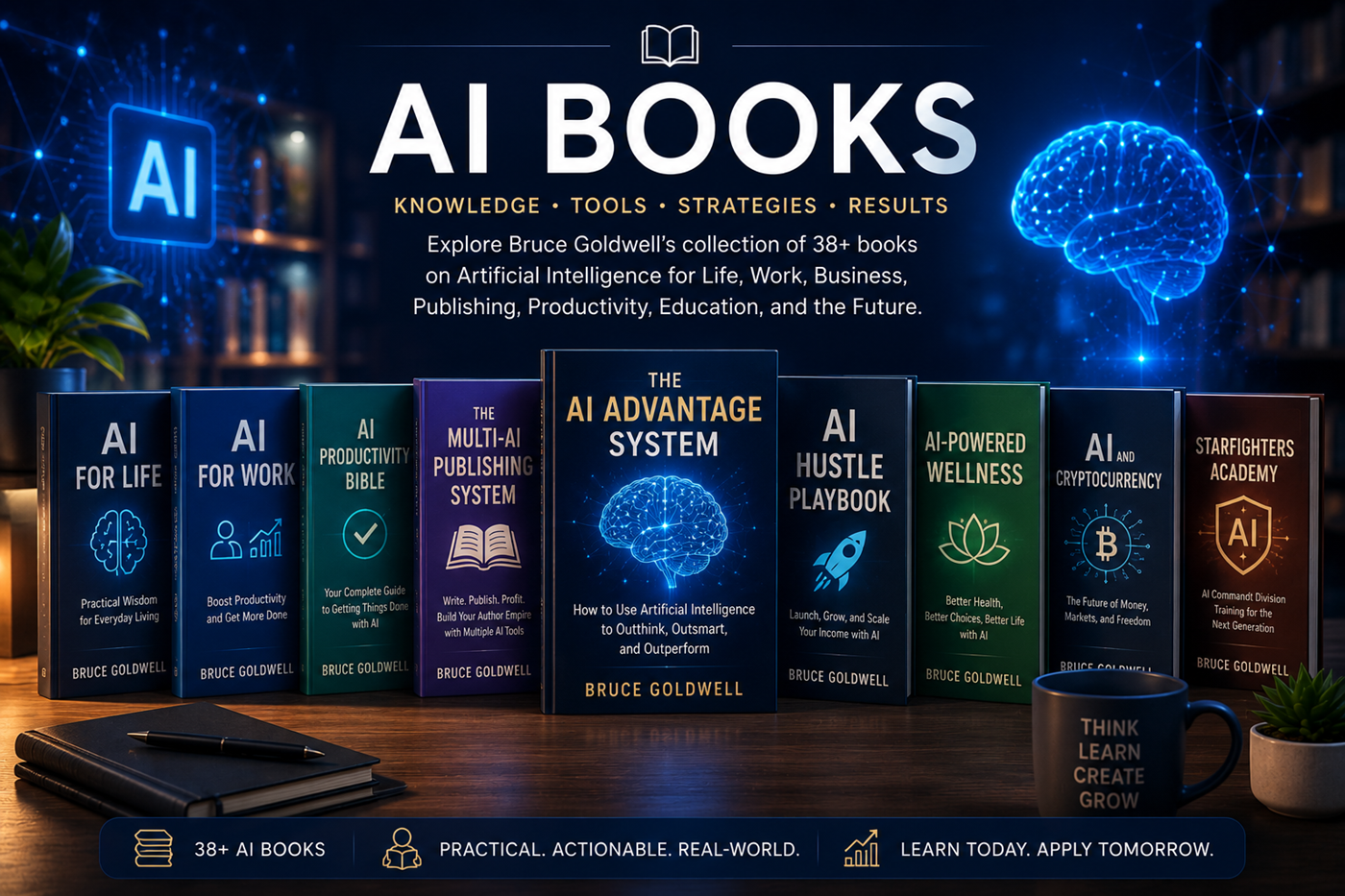
Bruce Goldwell’s AI books explore writing, editing, publishing, business, productivity, research, creativity, education, and responsible AI use.
The collection helps readers move from basic experimentation toward structured, practical, and responsible artificial intelligence workflows.
Review the big picture first, improve clarity and consistency second, polish sentences last, and verify every important claim before publication.