Core Books
The books contain the main ideas, stories, methods, research, lessons, and intellectual property that support the ecosystem.
An author ecosystem is an interconnected network of books, web pages, programs, media, tools, and reader pathways built around a shared body of knowledge.
Many authors treat each book as a separate product. They write it, publish it, promote it briefly, and then move on to the next project. Over time, they may build a large catalog without creating clear connections between the books or helping readers understand where to begin and what to explore next.
An author ecosystem takes a different approach. Each book becomes part of a larger structure. One book may lead to a companion workbook, a knowledge center, an online course, a video series, an interactive tool, a glossary, a frequently asked questions page, or another book that expands the subject.
A strong ecosystem connects the author’s knowledge, publications, online presence, educational resources, audience, and future opportunities.
The books contain the main ideas, stories, methods, research, lessons, and intellectual property that support the ecosystem.
Websites and topic pages make important ideas easier to discover, understand, link, update, and share.
Courses, lessons, workbooks, quizzes, certificates, and learning paths help readers apply the knowledge.
Videos, podcasts, articles, interviews, graphics, music, presentations, and social posts extend the message.
Calculators, generators, templates, planners, checklists, apps, and printable resources help readers take action.
Internal links, reading orders, recommendations, calls to action, and related resources guide readers through the system.
Authors often possess far more intellectual property than they realize because important ideas are spread across chapters, series, articles, notes, videos, and older publications.
AI can help examine a body of work, identify recurring themes, group related subjects, locate missing connections, and reveal opportunities for new resources.
Readers and search systems understand an author more easily when related books and resources are grouped into clear areas of expertise.
Identify the main subject that connects a group of books, pages, tools, courses, and reader questions.
Create introductory resources that explain the essential ideas, terminology, history, and first steps.
Show how readers can use the knowledge in everyday life, work, business, creativity, education, or specialized situations.
Develop deeper material for readers who want strategy, analysis, complex systems, or specialized knowledge.
Build content around the real questions, concerns, mistakes, myths, and obstacles readers encounter.
Connect the primary topic to neighboring subjects without weakening the clarity or purpose of the main hub.
A knowledge center provides a structured online home for a subject that may otherwise be scattered across many books and pages.
The central page introduces the subject and links to foundational lessons, practical applications, definitions, frequently asked questions, books, tools, and related resources.
Readers should not have to guess which book comes first, which book goes deeper, or which resource supports the next stage of their journey.
Identify the best entry point for readers who are completely new to the subject.
Recommend the book or resource that naturally follows the reader’s current level or goal.
Connect introductory books to advanced, specialized, historical, or strategic resources.
Connect informational books to workbooks, courses, checklists, challenges, or practical tools.
Introduce neighboring subjects when they genuinely support the reader’s interests or development.
Guide readers toward newsletters, videos, updated resources, communities, or future projects.
The same central knowledge can serve different readers when it is adapted into formats designed for different purposes.
Convert lessons into exercises, questions, worksheets, trackers, action steps, and reflection pages.
Organize the content into lessons, objectives, assignments, quizzes, milestones, and certificates.
Turn major ideas into explanations, demonstrations, interviews, short lessons, and reader-question videos.
Create focused pages that answer individual questions and naturally connect back to the book.
Build a calculator, generator, planner, assessment, decision guide, or learning application.
Develop narration, guided exercises, interviews, podcasts, songs, meditations, or audio lessons.
AI is especially useful for examining large amounts of material and revealing relationships that may be difficult to see manually.
Authors can use AI to compare books, identify shared concepts, create content maps, organize reading paths, suggest internal links, and develop project roadmaps.
Act as an author ecosystem strategist. Review these books, pages, courses, tools, and project ideas. Create a connected map showing the main hubs, supporting pages, reader pathways, internal links, missing resources, and recommended development order.
Generative Engine Optimization supports visibility in AI-driven search and answer systems by creating clear, useful, well-connected, and trustworthy information.
Connect books and pages to a consistent author profile, biography, publishing history, areas of expertise, and related projects.
Cover definitions, history, applications, questions, risks, comparisons, and advanced ideas across connected pages.
Use clear headings and concise explanations that answer important reader questions without unnecessary confusion.
Link related books, articles, tools, courses, author pages, glossaries, and frequently asked questions.
Use reliable evidence, accurate dates, careful language, appropriate citations, and transparent disclaimers.
Review links, policies, facts, product information, software details, and time-sensitive content regularly.
A large ecosystem can take months or years to build. Progress becomes manageable when development follows a clear order.
Random pages and projects can create confusion when they are not connected to a clear subject, reader, or purpose.
Starting many incomplete ecosystems can weaken quality and make it difficult to finish useful reader pathways.
Repeating identical material across books and pages provides less value than adapting it for a distinct purpose.
Valuable pages remain isolated when readers have no clear path to related books, tools, lessons, or resources.
Existing books may contain valuable ideas that can support new hubs, series, courses, and updated resources.
An ecosystem built entirely around purchase links may fail to educate, build trust, or provide reasons for readers to return.
Incorrect paths, moved pages, missing images, and outdated URLs weaken both usability and authority.
AI can create false claims, invented sources, repeated language, and inaccurate connections that require human review.
Large ecosystems require periodic review for outdated information, broken links, missing pages, and new opportunities.
An interconnected system can spread useful knowledge quickly, but it can also spread errors, outdated information, and misleading claims across many pages if the original material is not reviewed carefully.
Continue building your publishing system with the main AI for Authors resources.
Explore the complete author workflow from research and writing through publishing, marketing, and ecosystem development.
Visit AI for authorsMove from idea and research to outline, draft, revision, and completed manuscript.
Explore AI-assisted writingImprove structure, clarity, consistency, accuracy, repetition, grammar, and reader experience.
Explore AI editingDevelop book pages, audience research, launch plans, content systems, and long-term discovery.
Explore AI book marketingExplore AI tools for writing, research, planning, editing, images, video, coding, productivity, and music.
Explore AI toolsExplore Bruce Goldwell’s growing library of books about artificial intelligence, publishing, business, and creativity.
Visit the AI book library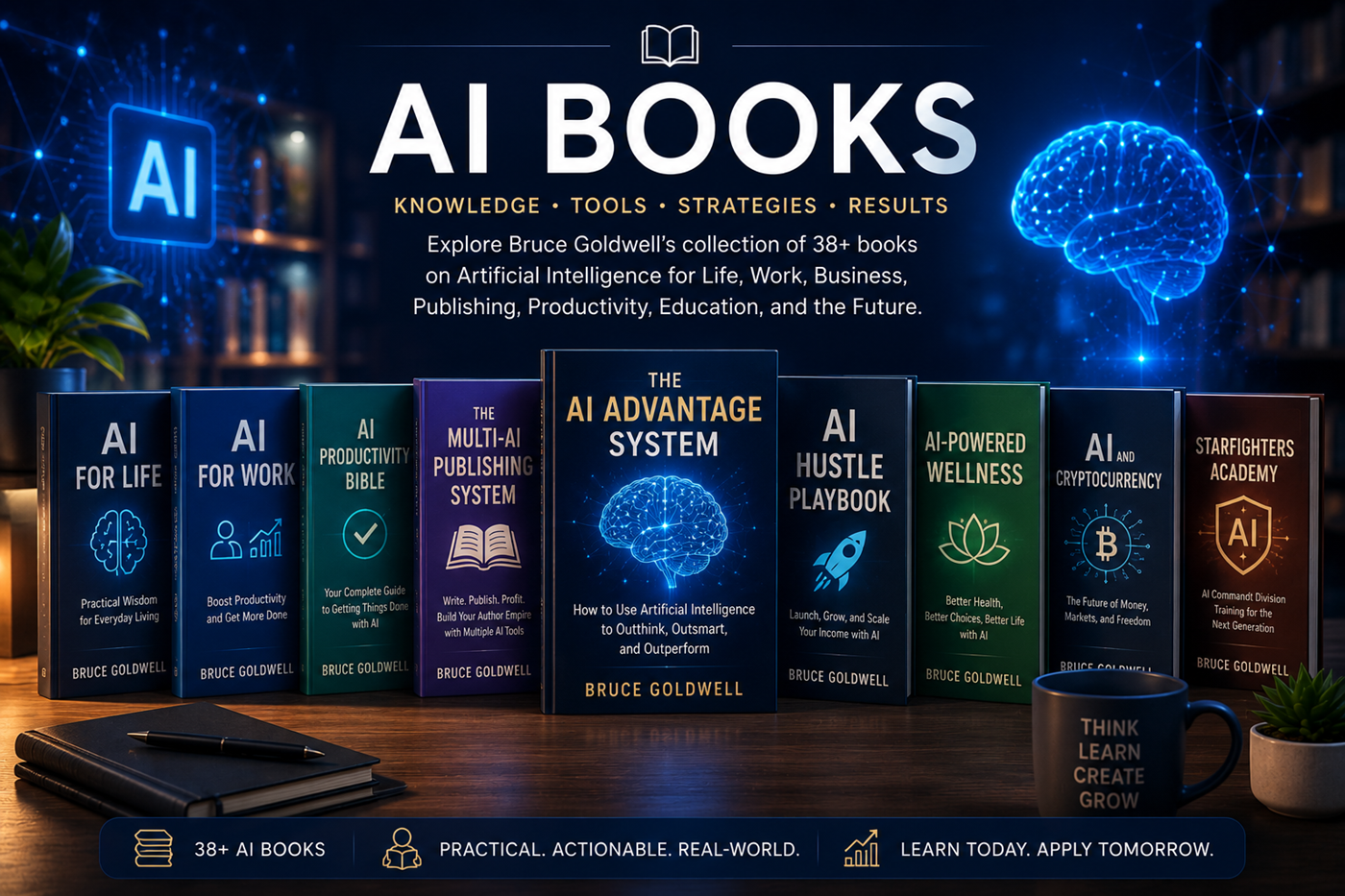
Bruce Goldwell’s AI books explore publishing, productivity, business, creativity, education, research, digital systems, and the expanding role of artificial intelligence.
Each book can become part of a larger learning system that connects readers to additional knowledge, tools, courses, resources, and future ideas.
Begin with one book, identify its most important ideas, create a clear knowledge hub, and guide readers toward the next useful resource.