Milestones That Changed the World

The History and Evolution of Artificial Intelligence

Follow the major discoveries, setbacks, breakthroughs, and public turning points that transformed artificial intelligence from a theoretical idea into a practical technology used around the world.

From Imagination to Everyday Tool

The Long Road to Modern Artificial Intelligence

Artificial intelligence did not appear overnight. It developed through centuries of ideas about logic and reasoning, followed by decades of mathematical research, computing breakthroughs, failed predictions, renewed investment, and rapid technological progress.

The history of artificial intelligence is the story of people asking whether machines could reason, learn, recognize patterns, communicate, solve problems, and create.

Each generation of researchers built on earlier discoveries. Some ideas appeared long before computers were powerful enough to make them practical. Other breakthroughs became possible only when researchers gained access to larger datasets, faster processors, improved algorithms, and worldwide digital networks.

Key idea: AI progress is rarely a straight line. Major advances usually happen when better ideas, larger collections of data, more computing power, improved software, and practical demand come together.
The Foundations of AI

Before Artificial Intelligence Had a Name

Early logic, mathematics, statistics, philosophy, and mechanical computation created the intellectual foundation for intelligent machines.

Ancient World–1800s

Logic and Mechanical Reasoning

Philosophers and mathematicians developed formal logic, rules of reasoning, probability, and mechanical methods for completing calculations.

These ideas introduced the possibility that thought and problem-solving might be represented through structured rules.

1930s–1940s

The Foundations of Computing

Advances in mathematical computation, information theory, electronic circuits, and programmable machines created the foundations of modern computer science.

Machines could now follow stored instructions and process symbolic information at increasing speed.

1950

The Machine Intelligence Question

Alan Turing helped frame the modern question of whether a machine could demonstrate behavior that people would recognize as intelligent.

His work helped move the discussion of intelligent machines from philosophy toward practical scientific investigation.

The Artificial Intelligence Timeline

Major Eras and Turning Points in AI History

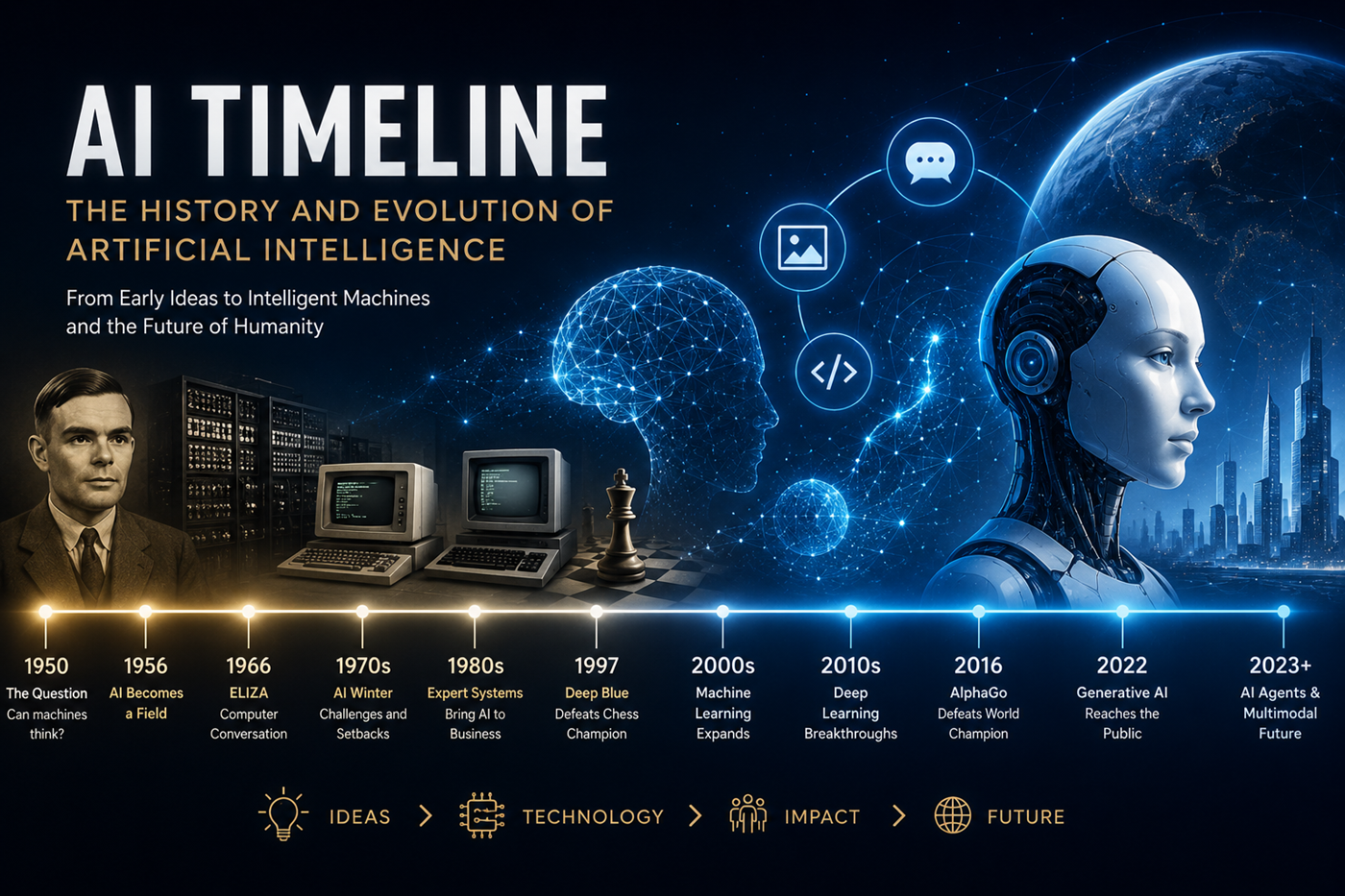
These milestones show how artificial intelligence progressed from early research experiments to widely available generative and multimodal systems.

1956

Artificial Intelligence Becomes a Field

The Dartmouth Summer Research Project helped establish artificial intelligence as the name of a new academic discipline.

Researchers gathered to explore whether learning, reasoning, language, and other aspects of intelligence could be described precisely enough for machines to reproduce them.

1950s–1960s

Early Symbolic Artificial Intelligence

Researchers developed programs for theorem proving, game playing, language experiments, planning, and rule-based problem-solving.

These systems manipulated symbols according to instructions designed by human programmers. Early success created enormous optimism about the future of AI.

1966

ELIZA Demonstrates Computer Conversation

ELIZA was an early computer program designed to imitate conversation by matching patterns in a user's statements and returning programmed responses.

Although ELIZA did not understand language as a human does, it demonstrated how easily people could perceive personality and intelligence in a conversational machine.

1970s

The First AI Winter

Early AI systems struggled with limited computing power, small amounts of digital data, narrow programming rules, and tasks outside their original design.

Expectations had risen faster than the technology could deliver. Funding and public enthusiasm declined during a period later called an AI winter.

1980s

Expert Systems Enter Business

Expert systems used large collections of rules to imitate the decision-making processes of specialists in technical, medical, financial, and industrial fields.

Commercial interest returned, but these systems were expensive to build, difficult to update, and unable to adapt easily when conditions changed.

Late 1980s–1990s

A Second Period of Disappointment

The limitations and cost of maintaining expert systems caused another decline in AI investment and enthusiasm.

However, research continued. Scientists increasingly focused on statistical methods and systems capable of learning patterns from data.

1997

Deep Blue Defeats a Chess Champion

IBM's Deep Blue defeated world chess champion Garry Kasparov in a highly publicized match.

The event demonstrated the growing power of computers to analyze enormous numbers of possible moves and apply specialized strategic evaluation.

1990s–2000s

Machine Learning Expands

AI research increasingly shifted from manually written rules toward systems that learned patterns from examples and data.

Machine learning improved search engines, speech recognition, recommendations, fraud detection, advertising, translation, and statistical language processing.

2010s

Deep Learning Breakthroughs

Large datasets, graphics processors, neural networks, cloud computing, and improved training methods accelerated progress.

Deep learning produced major improvements in image recognition, speech processing, translation, games, medical analysis, and predictive systems.

2011

AI Wins on Jeopardy!

IBM Watson defeated leading contestants on the television quiz show Jeopardy!

Watson demonstrated the ability of a specialized system to process natural-language questions, search large information collections, evaluate possible answers, and respond quickly.

2012

Image Recognition Accelerates Deep Learning

A major neural-network victory in an image-recognition competition showed how effectively deep learning could identify patterns in very large collections of images.

This milestone helped accelerate investment and research in deep neural networks.

2016

AlphaGo Defeats a World Go Champion

DeepMind's AlphaGo defeated leading Go player Lee Sedol in a five-game match.

Go had long been considered extremely difficult for computers because of its enormous number of possible moves and reliance on intuition and long-term strategy.

2017

The Transformer Era Begins

The transformer architecture introduced a more effective method for recognizing relationships and context across large amounts of language.

Transformers became a foundation for many modern large language models and generative AI systems.

2018–2021

Large Language Models Grow

Language models became larger, more capable, and better at generating text, answering questions, summarizing information, translating language, and completing writing tasks.

Researchers discovered that increasing model size, data, and computing resources could produce unexpected new abilities.

2022

Generative AI Reaches the Public

Conversational AI and image-generation systems brought generative artificial intelligence to a worldwide public audience.

Millions of people could now create text, images, plans, computer code, summaries, and other content using ordinary language.

2023–Present

Multimodal AI and AI Agents

Modern AI systems increasingly work with combinations of text, images, audio, video, software, documents, and real-time information.

AI agents are also emerging as systems capable of planning multi-step tasks, using digital tools, retrieving information, and carrying work forward under human supervision.
The Public AI Era

AI Moves from Research Laboratories into Daily Life

Conversational interfaces made advanced artificial intelligence accessible to people who did not know how to program or build computer systems.

Instead of communicating with a computer through technical commands, people could describe what they needed in ordinary language.

  • Natural-language assistants became practical for writing, planning, research, organization, and learning.
  • Image, audio, music, video, and computer-code generation expanded creative possibilities.
  • AI became integrated into search engines, office software, education, healthcare, customer service, and business operations.
  • People began building personalized AI workflows involving several specialized tools.
  • New concerns emerged involving accuracy, bias, copyright, employment, privacy, security, safety, and concentrated technological power.
Visual timeline showing the evolution of artificial intelligence from early computing to modern generative AI
Why AI Progress Accelerated

Five Forces Behind the Modern AI Revolution

Modern AI became possible because several technological and social developments advanced together.

More Computing Power

Faster processors, graphics processing units, cloud computing, and specialized AI chips made it possible to train increasingly complex models.

Larger Digital Datasets

The growth of the internet, digital media, sensors, scientific databases, and business systems created enormous collections of machine-readable information.

Better Algorithms

Improved neural networks, training methods, transformers, reinforcement learning, and optimization techniques increased AI performance.

Global Connectivity

The internet and cloud platforms allowed AI tools, research, datasets, and computing resources to reach users and developers around the world.

Practical Demand

Businesses, researchers, educators, creators, governments, and consumers found valuable uses for prediction, automation, generation, and analysis.

Natural-Language Interfaces

Conversational systems allowed people to use sophisticated AI by writing or speaking instructions instead of learning technical commands.

What Comes Next

The Next Chapter Is Still Being Written

Artificial intelligence is moving toward more capable assistants, agents, robotics, scientific discovery, personalized education, and systems that work across text, images, sound, video, software, and physical environments.

AI Agents

AI systems are becoming more capable of planning multi-step assignments, using tools, retrieving information, and completing connected tasks under human direction.

Human-AI Collaboration

The most valuable future may not be humans competing against AI, but people using AI to extend creativity, judgment, learning, analysis, and productivity.

Robotics and Physical AI

AI is becoming increasingly connected to robots, vehicles, manufacturing systems, medical devices, and machines operating in the physical world.

Personalized Learning

AI may provide more individualized explanations, exercises, feedback, tutoring, and learning pathways for students of different ages and abilities.

Scientific Discovery

Researchers are using AI to examine complex information, model biological systems, discover materials, analyze space, and identify promising research directions.

Governance and Responsibility

AI progress will also be shaped by laws, standards, public trust, safety research, transparency, human rights, and decisions about who receives its benefits.

Lessons from AI History

What the Timeline Teaches Us

Artificial intelligence has experienced repeated cycles of excitement, disappointment, renewed research, and unexpected breakthroughs.

History teaches us to avoid assuming that every new AI announcement will transform the world immediately. It also teaches us not to dismiss an important technology simply because early versions are limited.

A useful historical perspective: Evaluate new AI claims by examining what the system can demonstrate, what evidence supports the claim, what limitations remain, and whether the technology delivers meaningful results outside controlled demonstrations.
Remember: AI systems may appear confident and capable while still making factual errors, misunderstanding context, reproducing bias, or failing when a task moves beyond familiar patterns.
A Living Timeline

AI History Helps Us Understand the Future

Every modern AI breakthrough rests on earlier discoveries. Understanding that history makes it easier to evaluate new claims, separate lasting change from temporary hype, and use emerging tools with greater perspective.

Educational disclaimer: This timeline provides a general educational overview of artificial intelligence history. Technologies, capabilities, platform features, policies, and accepted interpretations continue to change. Important historical or technical information should be verified through authoritative sources.