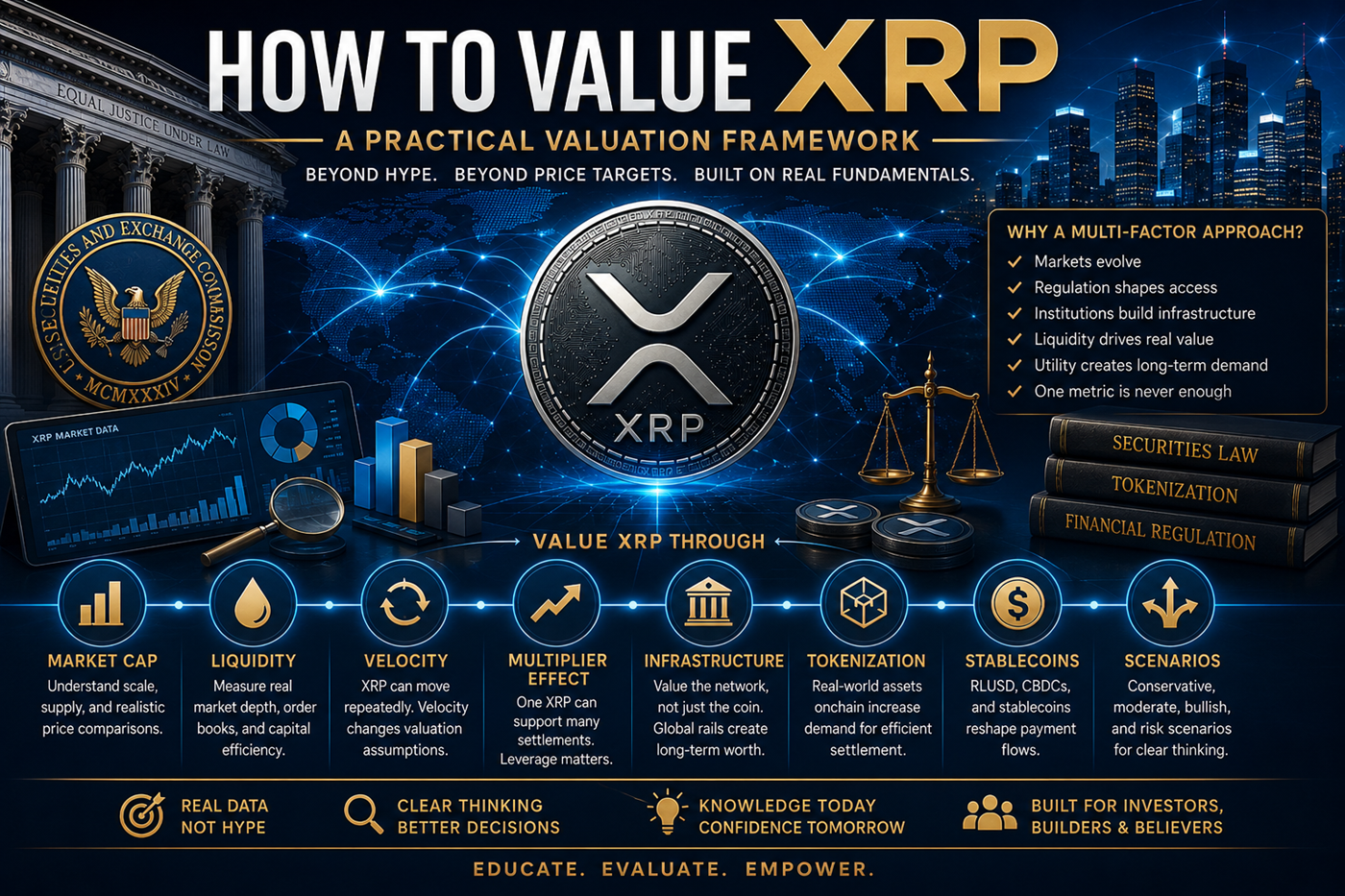
Valuing XRP is not as simple as choosing a price target and working backward. A serious XRP valuation needs to consider market cap, liquidity, velocity, institutional adoption, regulation, infrastructure, tokenization, stablecoins, exchange order books, and real-world utility.
This page introduces a practical framework inspired by the deeper analysis in XRP Reality Check: Beyond the Hype — Practical Valuation in 2026 and Beyond. The goal is not to predict the future with certainty. The goal is to help readers ask better questions.
XRP valuation should not depend on one metric alone. Market cap is useful, but incomplete. Liquidity matters, but it must be real. Institutional adoption can help, but only if it creates meaningful demand or infrastructure. Stablecoins may reshape payment flows. Tokenization may increase settlement needs. Regulation may open or restrict access.
A better approach is to use multiple valuation lenses together.
Understand what market cap measures, why it matters, and where it can mislead XRP investors.
Study how liquidity, market depth, exchange order books, and payment corridors affect valuation.
Learn why the same XRP can move repeatedly through settlement systems and how velocity changes assumptions.
Explore how liquidity reuse, capital efficiency, and institutional settlement may influence valuation models.
Think beyond coin price and ask what a global settlement and liquidity network could be worth.
Explore how tokenized assets and real-world assets may increase demand for digital settlement rails.
Understand how RLUSD and stablecoins may complement, compete with, or reshape XRP use cases.
Compare conservative, moderate, bullish, and risk scenarios without relying on hype-based predictions.
Market cap is one of the first tools people use to judge whether a price target sounds realistic. It is useful because it shows price multiplied by circulating supply. But market cap does not measure liquidity depth, payment velocity, utility demand, institutional usage, order book strength, or the value of infrastructure.
That is why XRP requires more than a simple market cap conversation.
Valuation begins with utility. XRP must be evaluated by whether it supports settlement, liquidity, payment movement, tokenized assets, or other real financial infrastructure needs.
Speculation can move price quickly, but utility-based demand may create a stronger long-term valuation argument if real usage develops.
Liquidity matters because large-scale value movement requires buyers, sellers, market depth, reliable corridors, exchange access, and institutional-grade infrastructure.
Stablecoins such as RLUSD may change how digital value moves. They may complement XRP, compete with certain use cases, or create new liquidity pathways.
| Valuation Lens | Main Question |
|---|---|
| Market Cap | What does the current or projected price imply when multiplied by supply? |
| Liquidity | Is there enough market depth and access to support meaningful use? |
| Velocity | How often can the same XRP be reused in settlement activity? |
| Infrastructure | What is the value of a network that can move and settle value globally? |
| Tokenization | Could tokenized assets increase demand for fast settlement and liquidity rails? |
| Risk | What assumptions could fail? |
The key book for practical valuation, liquidity, RLUSD, tokenization, Shane Ellis Theory, risk management, and realistic scenarios.
Explores XRP value drivers beyond simple targets and emotional market expectations.
Supports the liquidity and multiplier-effect framework behind deeper XRP valuation thinking.
Connects valuation thinking to institutional adoption, market structure, and investor strategy.
XRP should not be valued through hype alone or dismissed through market cap alone. The stronger approach is to study utility, liquidity, velocity, infrastructure, tokenization, stablecoins, regulation, market psychology, and risk together.