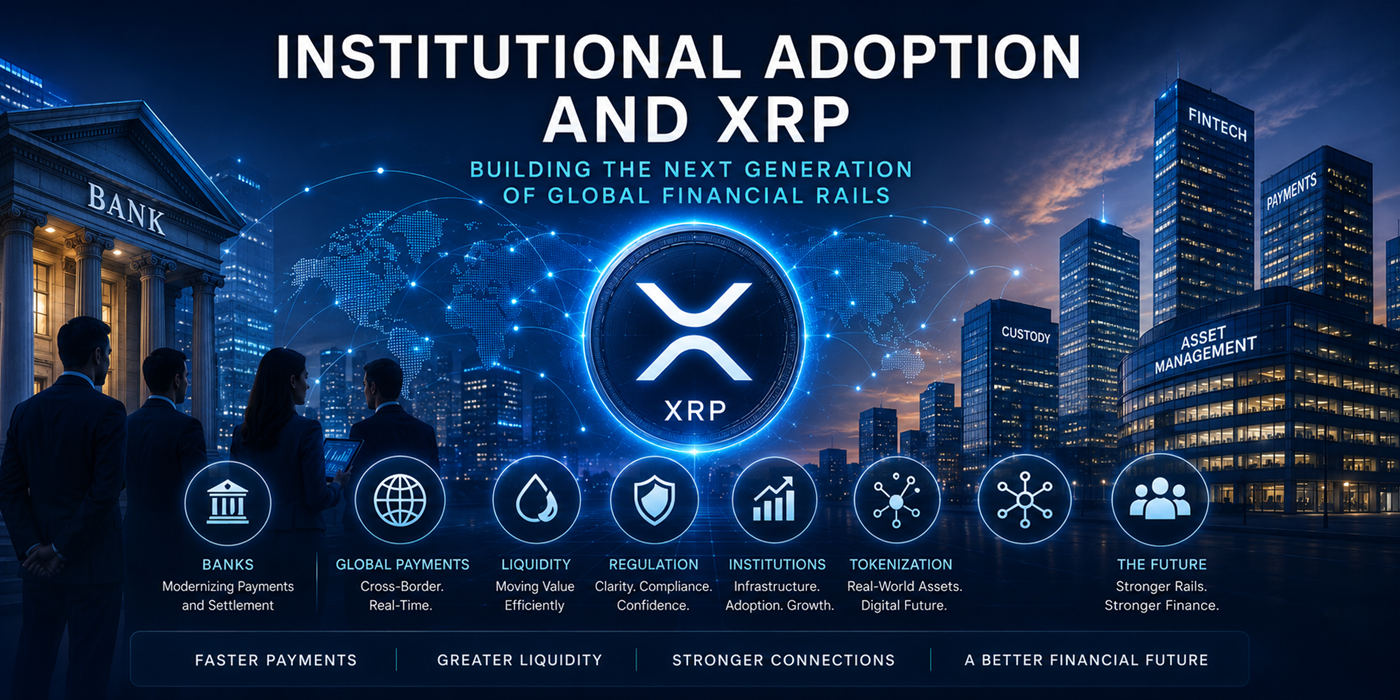
Institutional adoption is one of the biggest themes in the XRP conversation. It refers to the possible use, study, integration, custody, trading, or infrastructure support of digital assets by banks, payment providers, financial firms, exchanges, funds, and large organizations.
XRP is often discussed in this context because of its connection to fast settlement, liquidity, cross-border payments, and the modernization of financial rails.
Institutions matter because large financial systems do not change overnight. Banks, payment networks, asset managers, exchanges, regulators, and technology providers all influence how digital assets become part of the real financial world.
For XRP, the institutional adoption conversation usually centers on whether the asset and the XRP Ledger can play a role in faster settlement, improved liquidity, tokenization, cross-border payments, and future financial infrastructure.
Banks are central to global finance. They manage deposits, lending, payments, settlement, treasury operations, and customer money movement.
Payment companies move money between people, businesses, banks, merchants, currencies, and countries.
Funds, investment firms, and asset managers influence market access, custody demand, ETFs, and institutional exposure.
Exchanges and custodians provide access, trading infrastructure, storage, compliance, and liquidity for digital assets.
Fast settlement is valuable because financial markets and payment systems depend on timing, reliability, and finality.
Institutions care about liquidity because money and assets must be available where they are needed, when they are needed.
International payments can involve multiple systems, currencies, intermediaries, delays, and costs. XRP is often discussed in relation to this problem.
Institutions are exploring how blockchain, tokenization, digital assets, and improved payment infrastructure may reshape finance.
Many beginners think institutional adoption means one simple event: a bank announces XRP usage and the market changes instantly. In reality, institutional adoption can happen in many smaller steps.
It may include research, custody support, exchange listings, payment testing, tokenization pilots, liquidity products, regulatory clarity, ETF access, banking partnerships, infrastructure development, or corporate treasury interest.
| Adoption Type | What It Means | Why It Matters |
|---|---|---|
| Research | Institutions study XRP, XRPL, liquidity, and settlement use cases. | Research often comes before serious implementation. |
| Custody | Qualified providers support secure storage of digital assets. | Large institutions usually require professional custody before participating. |
| Trading Access | Exchanges, funds, or platforms provide ways to access digital assets. | Access can increase market participation and liquidity. |
| Payments | Companies test or use digital rails for payment movement. | Payments are central to XRP's long-term utility discussion. |
| Tokenization | Real-world assets or financial instruments move onto digital ledgers. | Tokenization may expand blockchain use beyond simple crypto trading. |
Learn how XRP is discussed in relation to banks, payment systems, and financial modernization.
Explore why international payment systems are one of the most important XRP use-case discussions.
Understand why liquidity is central to settlement, trading, institutional access, and digital finance.
Study how digital assets and real-world assets may connect through blockchain infrastructure.
Institutions usually need regulatory clarity before making major moves. Uncertainty can delay adoption because large organizations must manage legal risk, compliance obligations, customer protection, reporting, custody standards, and internal approval processes.
This is why regulation, court decisions, policy frameworks, and compliance standards often influence the XRP conversation as much as technology does.
Institutional adoption is often connected to valuation conversations because adoption may influence liquidity, demand, market access, credibility, and real-world usage. However, adoption does not automatically create a specific price outcome.
Responsible research should separate possibility from certainty. XRP valuation depends on many variables, including supply, demand, liquidity, utility, market cycles, regulation, competition, and investor behavior.
Large financial organizations often move slowly because they must evaluate technology, compliance, legal risk, security, customer impact, and business value.
A partnership, pilot, integration, or announcement may be important, but readers should carefully distinguish between interest, testing, and actual production usage.
Market price depends on many forces. Utility may matter, but liquidity, speculation, supply, demand, macro conditions, and sentiment also influence outcomes.
Speed matters, but institutions also evaluate reliability, compliance, liquidity, integration cost, regulation, risk management, and trust.
A deeper look at liquidity, institutions, and how global finance may change over time.
Explores institutional adoption, liquidity, and the multiplier effect often discussed around XRP.
A cryptocurrency investing guide focused on the possible institutional surge.
Connects ISO 20022, XRP, and the next financial revolution.
Learn how financial messaging modernization connects to future finance.
Understand the network layer behind XRP movement and settlement.
View major XRP, Ripple, regulation, and digital finance milestones.
Return to the XRP Research Center and continue exploring related topics.
Institutional adoption is about infrastructure, trust, access, custody, liquidity, regulation, and real-world usefulness. For XRP, the institutional story is not only about price. It is about whether digital value can move through future financial rails more efficiently.