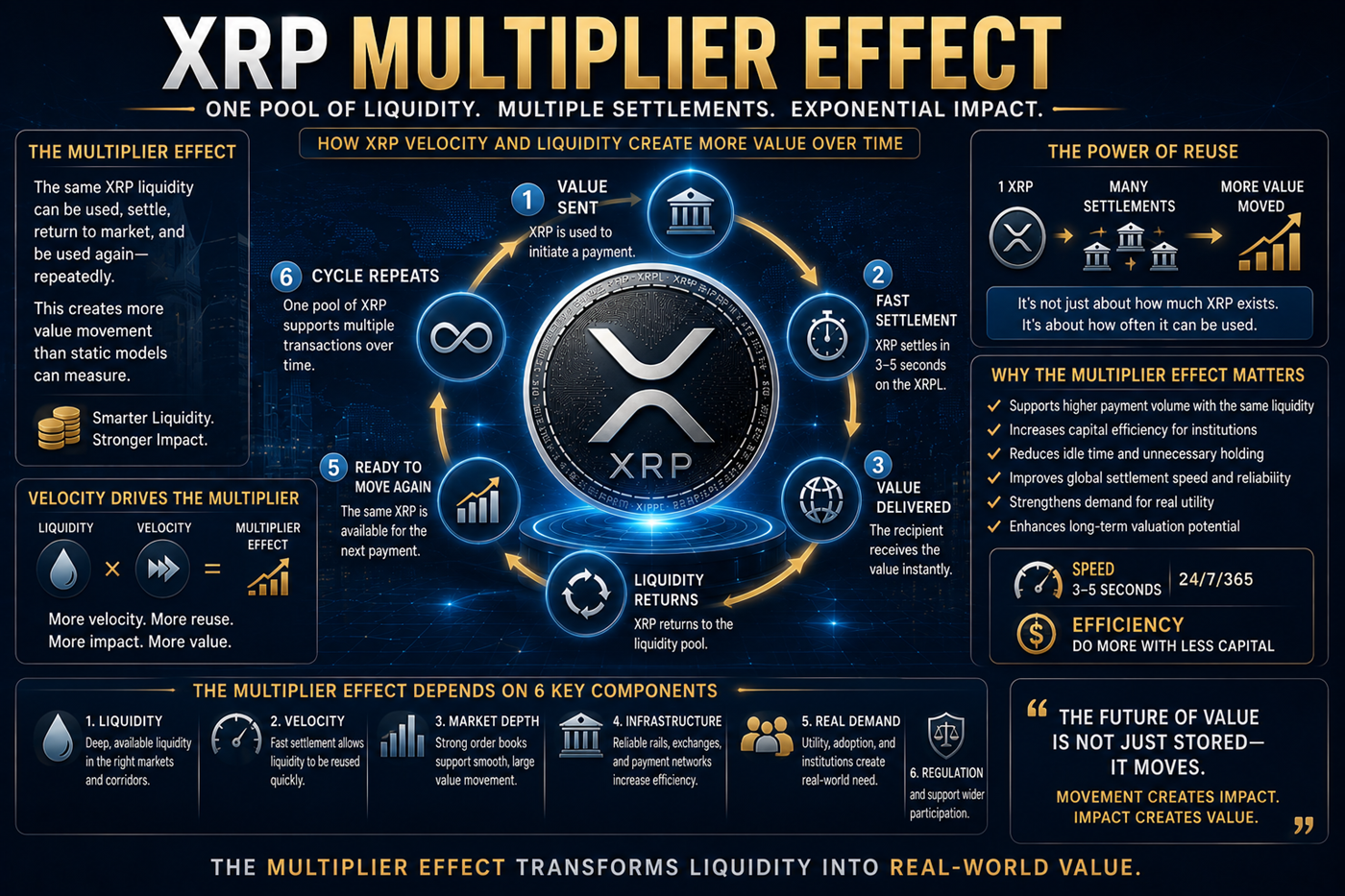
The XRP multiplier effect is the idea that the same XRP liquidity may support more than one transaction over time. If XRP can move, settle, return to market, and be reused efficiently, then one pool of liquidity may help support repeated value movement.
This does not mean price automatically multiplies. It means XRP valuation should consider how liquidity, velocity, infrastructure, and demand may work together.
The multiplier effect describes how one pool of XRP liquidity may support multiple settlement cycles. Instead of thinking only about how much XRP exists, this model asks how often available XRP can be used and reused in real payment or settlement activity.
The more efficiently liquidity can move, settle, and return to use, the more value movement it may support over time.
XRP must be available in the right markets, exchanges, corridors, and institutional pathways.
The faster XRP settles and returns to circulation, the more often the same liquidity can be reused.
Strong order books and active participants help larger value movement happen with less disruption.
The multiplier effect only matters if there is real utility, institutional use, payment activity, or settlement demand.
| Traditional View | Multiplier View |
|---|---|
| Looks mostly at price and market cap. | Looks at how liquidity can be reused across settlement cycles. |
| Asks how much XRP is worth at one moment. | Asks how much value XRP can help move over time. |
| Focuses on static valuation. | Focuses on movement, utility, and capital efficiency. |
| Can miss infrastructure effects. | Connects XRP to payment rails, corridors, and institutional systems. |
The multiplier effect is not a guaranteed price formula. It does not prove any specific XRP price. It does not remove risk. It does not replace liquidity analysis. It is a framework for asking how repeated settlement use could affect the value case for XRP.
No. It means XRP may support repeated value movement if liquidity, demand, infrastructure, regulation, and market access develop together.
Over time, yes. If XRP moves through a transaction, settles, and becomes available again, the same unit may support another transaction later.
Market cap is a snapshot. The multiplier effect looks at flow, reuse, settlement cycles, and the practical movement of value.
Market cap gives scale, but it does not show repeated liquidity reuse.
Liquidity provides the foundation for any meaningful multiplier effect.
Velocity explains how often available liquidity can move and settle.
Infrastructure connects liquidity and velocity to real financial systems.
The XRP multiplier effect helps readers think beyond static price targets. If XRP liquidity can move quickly, settle efficiently, and be reused across real corridors, then valuation must consider flow, infrastructure, and capital efficiency—not just market cap.