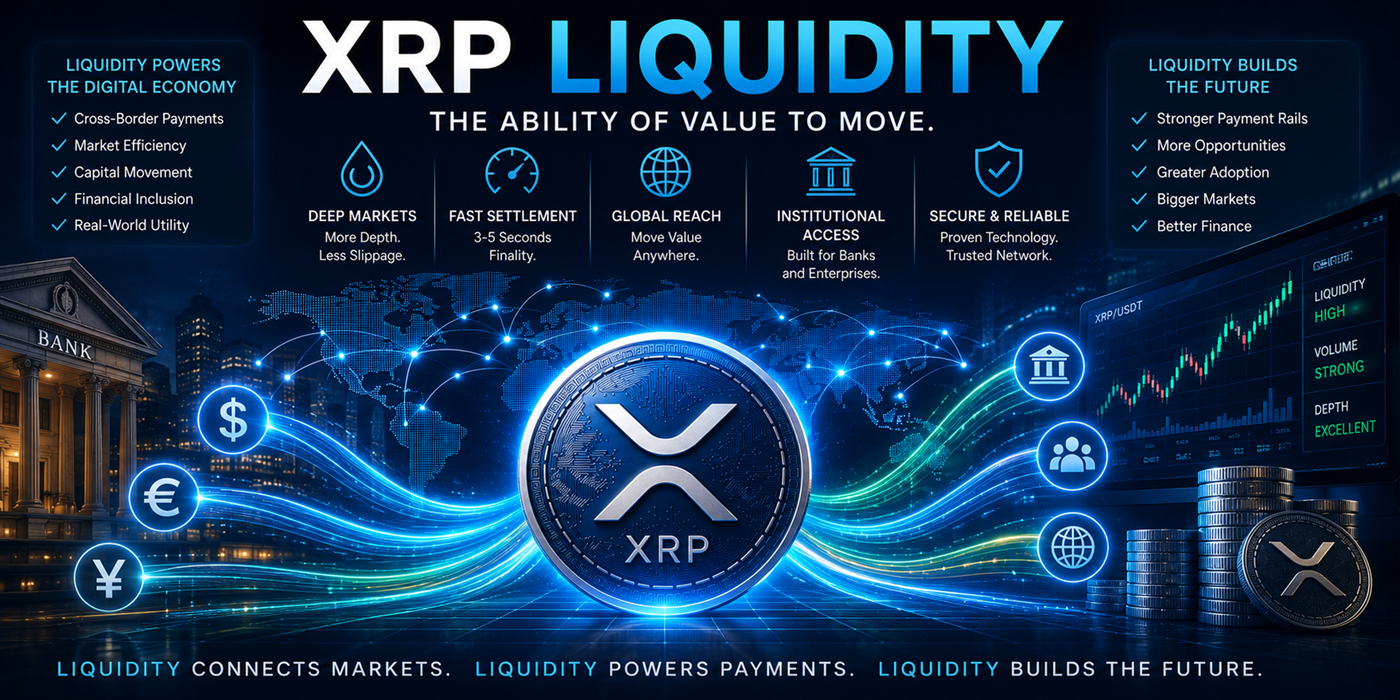
Liquidity is one of the most important pieces of XRP valuation. Market cap tells you the implied size of the asset. Liquidity tells you whether XRP can actually support meaningful buying, selling, settlement, and movement of value without major price disruption.
For XRP, liquidity is not just about trading volume. It includes order book depth, exchange access, payment corridors, market makers, institutional rails, and the ability to move value efficiently across currencies and markets.
Liquidity refers to how easily an asset can be bought, sold, converted, or used without causing large price swings. A liquid market has enough buyers, sellers, and depth to handle larger transactions smoothly.
In XRP valuation, liquidity matters because real-world financial use requires more than price. It requires reliable access to XRP across exchanges, corridors, currencies, institutions, and settlement pathways.
XRP’s settlement use case depends on the ability to move value quickly between different currencies and markets.
Larger transactions need deep order books so value can move without excessive slippage or unstable price movement.
Banks, payment companies, funds, and market makers need regulated, reliable, and scalable access before larger usage can develop.
Liquidity must exist where it is needed. Strong corridors matter more than broad hype or general trading volume.
| Trading Volume | Liquidity |
|---|---|
| Shows how much XRP traded during a period. | Shows how easily XRP can absorb buying, selling, or settlement activity. |
| Can rise from speculation or short-term trading. | Requires real market depth, active participants, and reliable access. |
| May be temporary. | Must be durable for institutional use. |
| Does not always reveal slippage. | Helps determine whether large value can move efficiently. |
Order books show available buy and sell interest at different price levels. Deep order books can support larger transactions with less price movement. Thin order books can cause sharp price changes when larger orders enter the market.
This is why XRP valuation must consider more than market cap. A large implied market value does not automatically mean there is enough real liquidity to support institutional settlement.
A liquidity corridor is a pathway where value can move between two currencies, markets, or regions. For XRP, stronger corridors may increase the usefulness of the asset for settlement.
Liquidity must exist where the transaction happens. XRP may be more useful in one corridor than another depending on exchange access, regulation, demand, and market depth.
No. A global XRP price is only part of the picture. Real utility depends on whether liquidity exists in the places and currencies where value needs to move.
Market cap shows implied value, but liquidity reveals whether the market can support actual movement.
If XRP can move and settle repeatedly, liquidity and velocity must be studied together.
Strong liquidity may allow capital to be reused efficiently across multiple settlement cycles.
Liquidity becomes more powerful when connected to real financial infrastructure and institutional rails.
XRP valuation cannot rely on market cap alone. Liquidity is what determines whether XRP can support real buying, selling, settlement, and cross-market movement. The stronger the liquidity, the stronger the practical valuation case becomes.