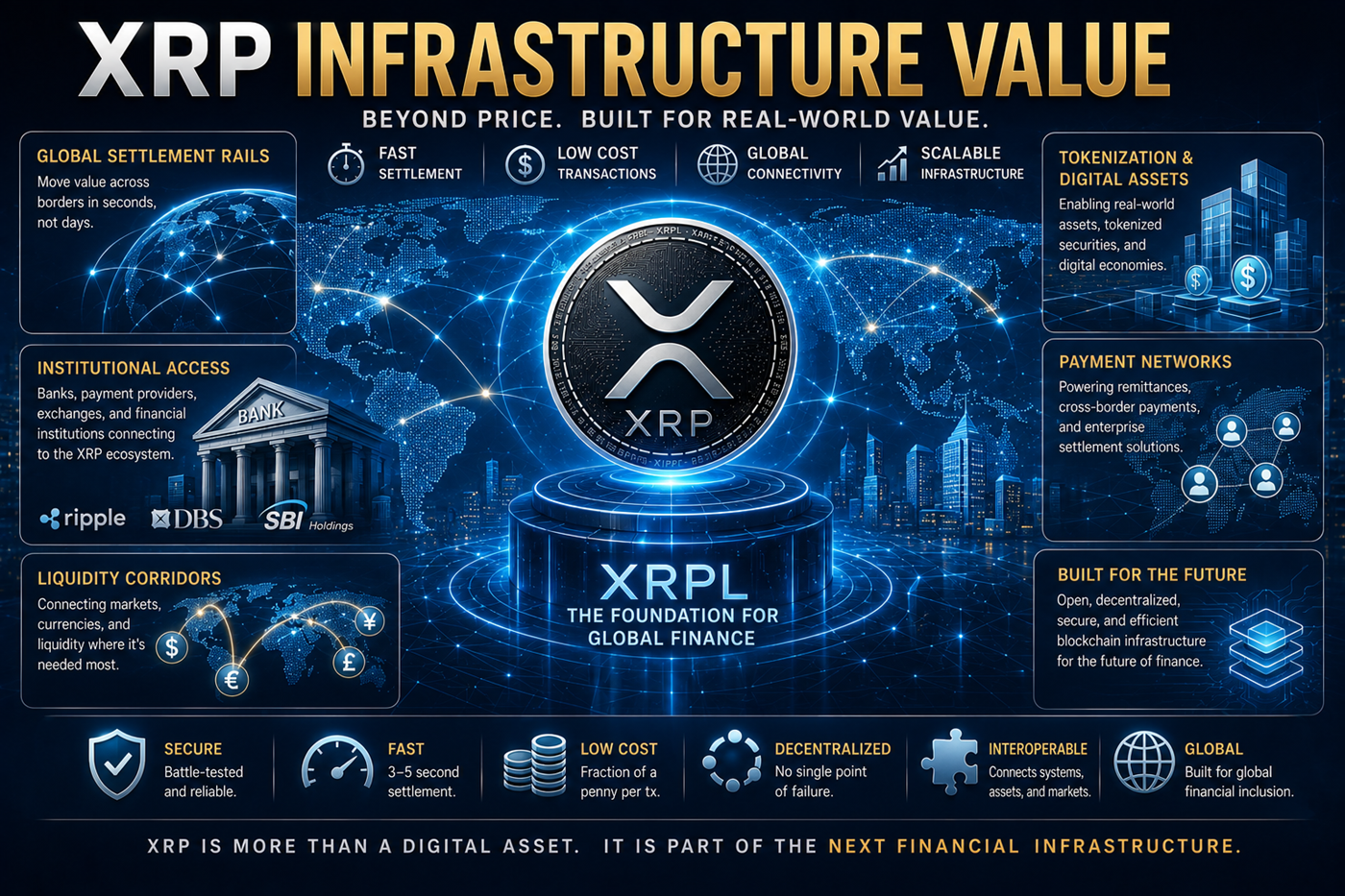
XRP valuation should not only ask what one coin is worth today. A deeper framework asks what value may exist in the infrastructure surrounding XRP: settlement rails, liquidity pathways, institutional access, tokenized assets, payment networks, and the XRP Ledger ecosystem.
Infrastructure value means looking beyond price speculation and asking whether XRP can become part of a larger system for moving, settling, and organizing value.
Infrastructure value comes from the usefulness of the network, rails, tools, participants, liquidity, and systems connected to an asset. In XRP’s case, that includes the XRP Ledger, exchanges, payment corridors, institutional platforms, custody, compliance systems, and real-world use cases.
A token can have speculative value. A working financial network can have infrastructure value. XRP valuation becomes more meaningful when both are studied together.
XRP can be evaluated by whether it helps move and settle value faster, cheaper, and more efficiently across markets.
Infrastructure requires usable corridors where XRP can connect currencies, exchanges, regions, and financial participants.
Banks, funds, exchanges, payment providers, and market makers need trusted access before large-scale usage can grow.
The XRP Ledger adds value through payments, issued assets, tokenization, decentralized exchange features, and developer activity.
| Coin Price View | Infrastructure View |
|---|---|
| Focuses on current XRP price. | Focuses on what the network can do. |
| Often driven by speculation and sentiment. | Driven by utility, adoption, access, liquidity, and real usage. |
| Asks what investors are willing to pay today. | Asks what financial systems may rely on tomorrow. |
| Can change quickly with market emotion. | May develop over time as systems, corridors, and use cases mature. |
A digital asset connected to real infrastructure may be valued differently from an asset driven only by hype. If XRP supports settlement, liquidity movement, tokenized assets, institutional payments, or cross-border financial rails, then the valuation conversation becomes larger than market cap alone.
Infrastructure does not guarantee price appreciation, but it can strengthen the long-term utility case if real adoption continues to develop.
Infrastructure value depends on whether XRP supports useful activity such as settlement, liquidity movement, tokenized assets, payments, or financial interoperability.
Institutional use depends on regulation, custody, compliance, liquidity, market depth, exchange access, and operational confidence.
Strong infrastructure often becomes more valuable as more participants, corridors, assets, and use cases connect to the same system.
Infrastructure needs liquidity in the right places before large-scale financial usage can develop.
Fast settlement makes infrastructure more efficient when real corridors and participants exist.
Tokenized assets may increase the importance of fast, reliable, digital settlement rails.
Stablecoins may interact with XRP infrastructure by creating new forms of digital value movement.
Infrastructure value asks whether XRP is part of a larger financial system capable of moving, settling, and connecting value. That makes valuation deeper than market cap alone and connects XRP to liquidity, velocity, tokenization, stablecoins, institutional adoption, and long-term utility.