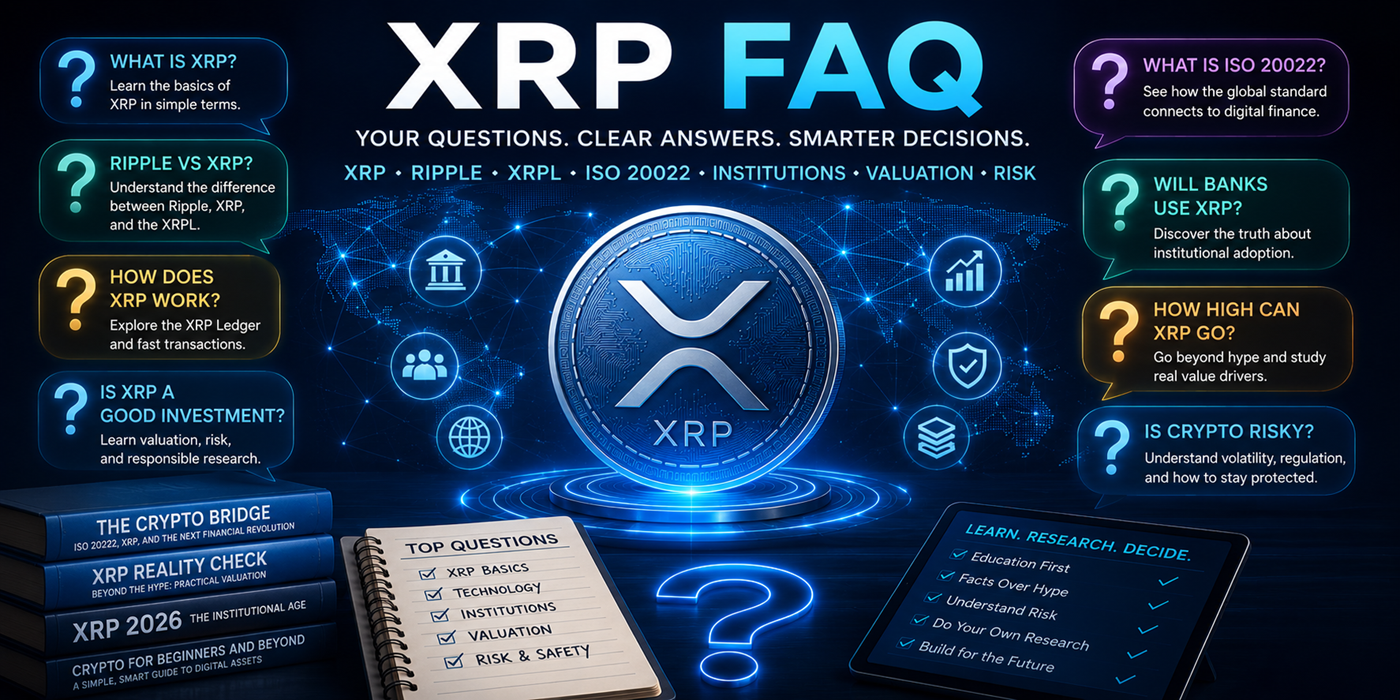
This FAQ page answers common questions about XRP, Ripple, the XRP Ledger, ISO 20022, institutional adoption, valuation, liquidity, digital finance, and crypto risk.
The goal is simple: help readers move from confusion to clarity with plain-language answers and links to deeper pages inside the XRP Knowledge Center.
XRP is a digital asset designed for fast movement of value. It is most often discussed in relation to payments, liquidity, settlement, and the modernization of financial systems.
Yes. XRP is a cryptocurrency and digital asset. It operates on the XRP Ledger and is used in conversations about digital value transfer and settlement.
The XRP Ledger, often called XRPL, is the blockchain network where XRP transactions occur. It is designed for fast settlement, low transaction costs, and efficient value movement.
XRP is commonly discussed in relation to moving value quickly and efficiently, especially across borders, currencies, markets, and financial systems.
No. Ripple is a financial technology company. XRP is a digital asset. XRPL is the blockchain network. They are connected in public discussion, but they are not the same thing.
No. XRP is not stock in Ripple. Owning XRP does not mean owning shares of Ripple or owning part of the company.
Ripple is one of the most visible companies connected to XRP-related conversations. News about Ripple can influence market attention, sentiment, and public discussion around XRP.
Read the dedicated page: Ripple vs XRP.
ISO 20022 is a global financial messaging standard. It helps financial institutions exchange richer, more structured transaction information.
No. ISO 20022 is not a cryptocurrency, not XRP, and not a blockchain. It is a financial messaging standard used by payment and banking systems.
No. ISO 20022 may support financial modernization, but it does not automatically guarantee adoption of XRP or any specific digital asset.
Many XRP supporters see ISO 20022 as part of a larger shift toward modern, data-rich, interoperable financial systems where digital assets may eventually play a greater role.
Institutional adoption refers to banks, funds, exchanges, custodians, payment companies, and other large organizations researching, supporting, integrating, using, or providing access to digital assets.
Institutions can influence liquidity, custody, market access, regulation, credibility, payment infrastructure, and long-term digital asset adoption.
Not always. A partnership, pilot, announcement, or integration may be important, but readers should carefully distinguish between interest, testing, infrastructure support, and actual usage.
Start with Institutional Adoption and XRP, then explore Liquidity and Banking & XRP.
No. No one can know future price with certainty. XRP valuation depends on many factors, including supply, demand, utility, liquidity, regulation, adoption, market cycles, and risk.
No. A prediction gives a target number. Valuation research studies conditions, assumptions, risks, and value drivers that could support or weaken a valuation idea.
Common value drivers include utility, liquidity, adoption, regulation, market access, custody, token demand, supply, payment use, and broader crypto market conditions.
Start with XRP Valuation and XRP Reality Check.
Yes. Cryptocurrency markets are volatile and involve substantial risk. Prices can rise or fall quickly, and regulations, market conditions, and technology can change.
No. The XRP Knowledge Center is for educational and informational purposes only. It should not be interpreted as financial, investment, tax, or legal advice.
No. Bruce Goldwell is not a licensed financial advisor, investment advisor, broker, accountant, or attorney.
Readers should conduct independent research, evaluate their personal financial situation, understand risks, and consult qualified professionals before making investment decisions.
Beginners should start with the XRP Beginner Guide, then read What Is XRP? and Ripple vs XRP.
If you are new to crypto, begin with Crypto for Beginners and Beyond or XRP 2026 for Beginners. Then move into The Crypto Bridge, XRP Reality Check, and the XRP Advantage Series.
Yes. Bruce Goldwell's XRP books form a connected learning path covering beginner education, XRP basics, ISO 20022, institutional adoption, valuation, and future digital finance.
Visit the XRP Books page for the complete XRP book library.
Learn the simple beginner-friendly explanation of XRP.
Understand the XRP Ledger and how XRP transactions occur.
Explore the global financial messaging standard.
Think beyond hype and study value drivers.
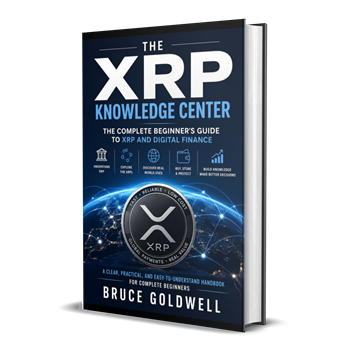
Want everything in one place? The XRP Knowledge Center: The Complete Beginner's Guide to XRP and Digital Finance brings together the essential lessons from this website into a structured, easy-to-follow handbook. Perfect for beginners, it explains cryptocurrency, XRP, the XRP Ledger, wallets, security, market capitalization, utility, valuation concepts, and much more—all in plain English.
Priced as low as possible, this book was created to make quality XRP education accessible to everyone. If you have a friend, family member, or colleague who wants to understand XRP but doesn't know where to begin, consider gifting them a copy. Better-informed investors make better decisions, and our goal is to help readers build knowledge before investing.
XRP education begins by asking better questions. Learn the basics, separate facts from hype, study risk, understand the technology, and keep building knowledge one topic at a time.