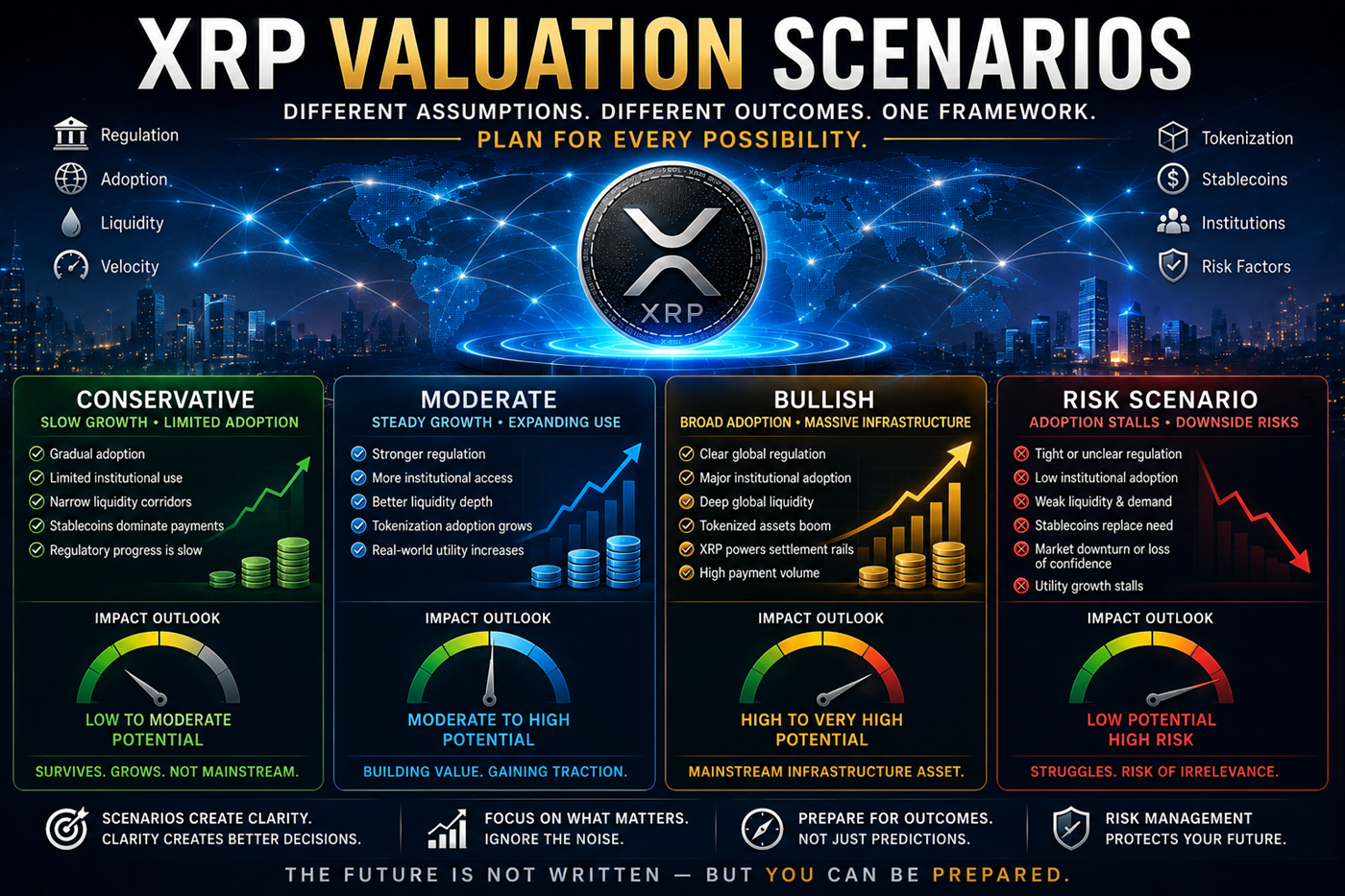
No one can predict XRP’s future price with certainty. A better approach is to study scenarios. Scenarios allow readers to compare different possible futures based on adoption, regulation, liquidity, stablecoins, tokenization, market cycles, institutional use, and risk.
This page does not promise a price target. It gives readers a practical way to think about possible XRP outcomes without depending on hype, fear, or one-size-fits-all predictions.
XRP valuation depends on assumptions. If the assumptions change, the valuation changes. A conservative scenario may assume limited adoption and slow regulation. A bullish scenario may assume deeper liquidity, stronger institutional access, broader tokenization, and larger payment flows.
Scenario thinking helps readers avoid emotional extremes by asking: what must happen for each outcome to become realistic?
XRP remains important within crypto markets but adoption grows slowly. Liquidity improves, but institutional usage stays limited or uneven.
XRP gains stronger utility, better liquidity corridors, clearer regulation, and increased institutional participation over time.
XRP becomes part of larger settlement infrastructure, tokenized markets, institutional flows, and liquidity networks across multiple regions.
Adoption slows, stablecoins dominate key payment flows, regulation restricts usage, or market conditions reduce demand for XRP.
| Scenario | Main Assumption | Key Question |
|---|---|---|
| Conservative | Limited real-world adoption and slow institutional growth. | Can XRP maintain relevance without large-scale utility demand? |
| Moderate | Gradual adoption, improved liquidity, and clearer regulation. | Can XRP become a practical settlement and liquidity tool over time? |
| Bullish | Broad infrastructure use, tokenization growth, and deeper institutional liquidity. | Can XRP become part of global value movement infrastructure? |
| Risk | Competition, regulation, weak adoption, or market decline reduce demand. | What assumptions could fail? |
Stronger order books, institutional market makers, and larger payment corridors could support more practical XRP usage.
Clear rules may allow more exchanges, funds, institutions, and payment companies to participate with confidence.
Real-world assets, digital securities, and tokenized markets may increase demand for fast settlement and liquidity systems.
Larger usage from banks, payment firms, fintechs, and financial platforms could strengthen the infrastructure case.
Stablecoins may handle some payment and settlement use cases without needing XRP as a bridge asset.
If liquidity does not deepen in the right corridors, XRP may struggle to support larger-scale value movement.
Unclear or restrictive regulation could limit institutional participation, exchange access, and market confidence.
If real-world usage does not grow, XRP may remain more dependent on speculation and market cycles.
Market cap helps test whether scenario assumptions are realistic at different price levels.
Liquidity determines whether higher-value scenarios can support real buying, selling, and settlement.
Tokenization may expand the settlement demand behind moderate and bullish scenarios.
Stablecoins may either support ecosystem growth or compete with XRP in certain payment flows.
XRP valuation should not depend on a single price prediction. A stronger approach is to compare conservative, moderate, bullish, and risk scenarios while testing the assumptions behind each one: liquidity, adoption, infrastructure, tokenization, stablecoins, regulation, market depth, and demand.