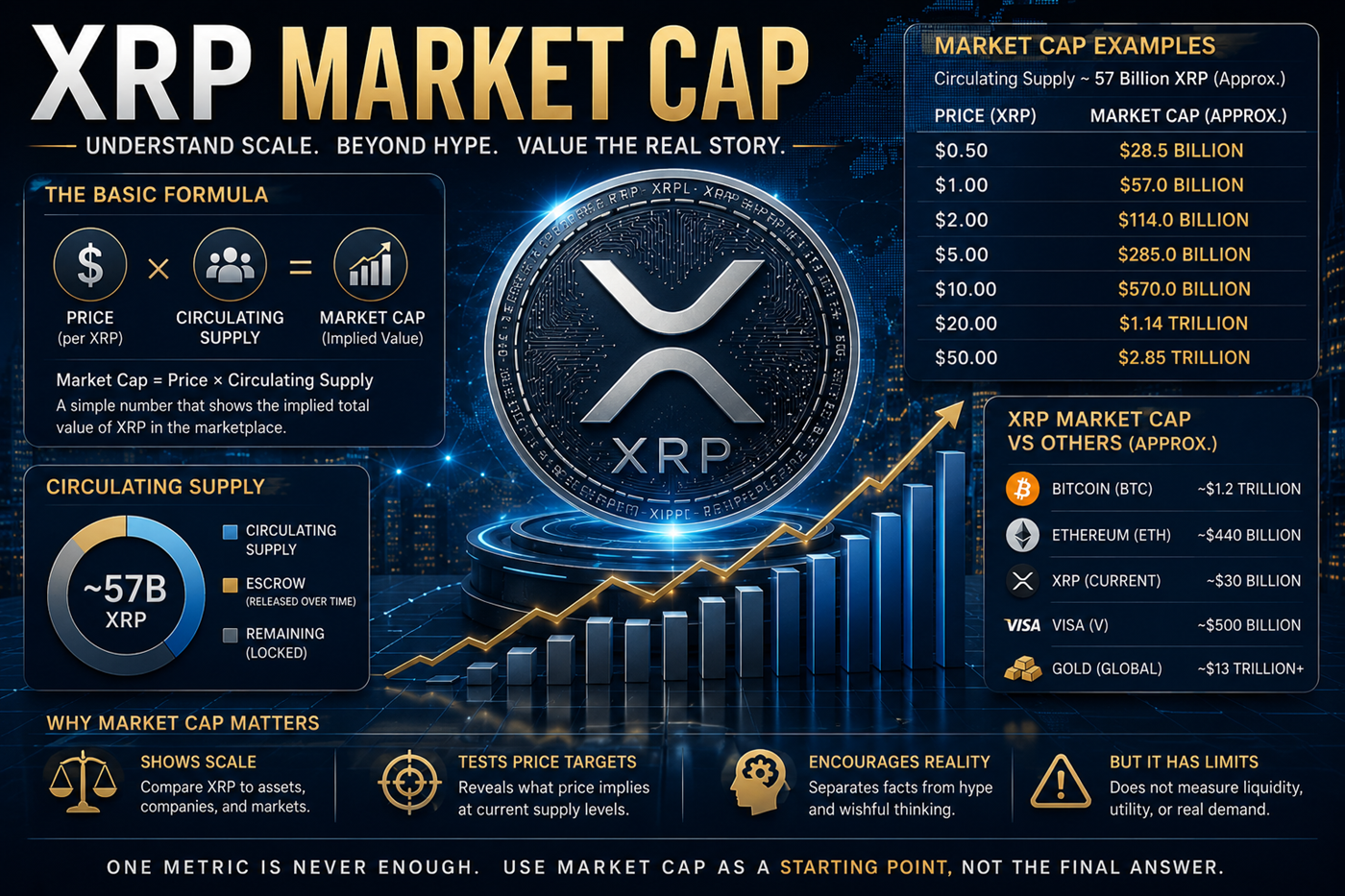
Market cap is one of the most common ways people judge cryptocurrency value. It is simple: price multiplied by circulating supply. But when it comes to XRP, market cap is useful only as a starting point.
XRP valuation requires more than asking, “What would the market cap be at a certain price?” A serious analysis must also consider liquidity, velocity, utility demand, institutional adoption, payment corridors, tokenization, stablecoins, and infrastructure value.
Market cap measures the current implied value of a cryptocurrency based on its price and circulating supply. If the price rises, market cap rises. If circulating supply changes, market cap changes.
This makes market cap a helpful comparison tool, but it does not tell the full story. It does not show how much real money entered the market, how deep liquidity is, how much XRP is actively used, or whether the asset is being driven by speculation or utility.
| Metric | Meaning |
|---|---|
| Price | The current market price of one XRP. |
| Circulating Supply | The amount of XRP currently available in circulation. |
| Market Cap | Price multiplied by circulating supply. |
Market cap helps investors test whether a price target sounds realistic compared to other major assets, cryptocurrencies, and financial markets.
It allows XRP to be compared with Bitcoin, Ethereum, stablecoins, public companies, payment networks, and other financial systems.
It helps separate practical valuation thinking from emotional price predictions and hype-based targets.
Market cap does not mean that the full market cap amount has actually flowed into XRP. A small amount of buying or selling can move price if liquidity is thin. That means market cap can expand or shrink quickly without representing actual dollar-for-dollar capital movement.
This is why liquidity and order book depth matter. A high market cap with weak liquidity is very different from a high market cap supported by deep institutional markets, strong corridors, and real demand.
Not by itself. Market cap can show scale, but it does not fully measure infrastructure value, payment velocity, tokenization demand, institutional liquidity, or future market structure.
No. Market cap can also expose unrealistic assumptions when price targets ignore supply, liquidity, demand, competition, regulation, and adoption timelines.
The next step is liquidity. XRP cannot be valued seriously without asking whether enough real market depth exists to support larger settlement use cases.
| Market Cap | Liquidity |
|---|---|
| Shows implied total value based on price and supply. | Shows how easily XRP can be bought, sold, or used without major price disruption. |
| Useful for scale comparisons. | Useful for real-world payment and settlement analysis. |
| Can rise quickly during speculation. | Requires deeper markets, participants, corridors, and infrastructure. |
XRP market cap matters, but it should not be used alone. Better valuation requires combining market cap with liquidity, velocity, infrastructure, tokenization, stablecoins, regulation, institutional adoption, and risk analysis.