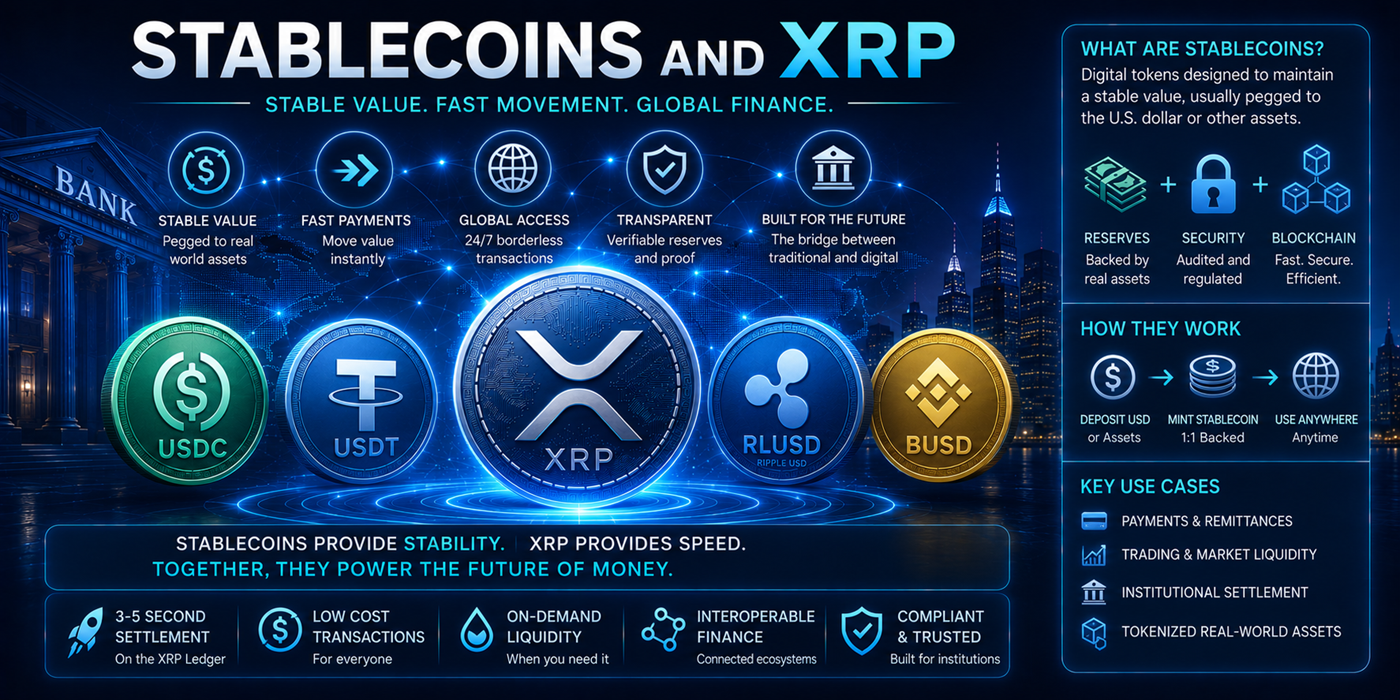
Stablecoins are becoming one of the most important parts of the digital asset economy. They are designed to represent stable value, usually tied to fiat currencies such as the U.S. dollar.
For XRP valuation, stablecoins matter because they may change how payments move, how institutions settle value, how tokenized assets trade, and how liquidity flows across digital financial systems.
Stablecoins are digital tokens designed to maintain a stable value. Many are backed by cash, short-term government securities, or other reserve assets. Their purpose is to make digital payments, trading, settlement, and transfers easier without the same price volatility found in assets like XRP, Bitcoin, or Ethereum.
Stablecoins may act as digital dollars, payment tools, settlement assets, trading pairs, or liquidity bridges inside crypto and tokenized financial systems.
Stablecoins may handle some payment use cases where users prefer a dollar-like asset instead of a volatile asset.
Stablecoins can create trading pairs, settlement routes, and liquidity pathways that interact with XRP markets.
Some institutions may prefer stable-value assets for accounting, compliance, treasury, and payment management.
Stablecoins may become important settlement tools for tokenized assets, digital securities, and real-world asset markets.
| Complement XRP | Compete With XRP |
|---|---|
| Stablecoins can increase digital payment activity and liquidity around blockchain networks. | Stablecoins may handle payment use cases that do not require a bridge asset. |
| RLUSD and other stablecoins may create more activity within the XRP ecosystem. | Some users may prefer holding and transferring stable dollars instead of volatile assets. |
| Stablecoins may help tokenized markets grow, increasing settlement needs. | Stablecoin-to-stablecoin corridors may reduce demand for bridge liquidity in some cases. |
| XRP may still serve as a bridge asset where neutral liquidity and fast settlement are needed. | Regulated stablecoin networks may become direct competitors for certain payment flows. |
RLUSD is important because it connects Ripple’s stablecoin strategy to the broader XRP and XRPL ecosystem conversation. A regulated stablecoin may help institutions experiment with digital payments, tokenized settlement, and blockchain-based liquidity in a way that feels more familiar.
The key valuation question is whether stablecoins reduce XRP demand, increase ecosystem activity, or create new pathways where XRP and stablecoins work together.
Not necessarily. Stablecoins may replace XRP for some payment use cases, but XRP may still be useful for bridge liquidity, settlement speed, exchange movement, and cross-market value transfer.
They can if stablecoins bring more users, assets, liquidity, and payment activity into networks where XRP is also used.
Stablecoins may reshape demand assumptions. A realistic XRP valuation must consider both competition and cooperation between stablecoins, XRP, CBDCs, fiat rails, and tokenized assets.
Stablecoins can deepen digital liquidity and create new trading or settlement pathways.
Stablecoins may become part of broader blockchain payment and settlement infrastructure.
Tokenized assets may rely on stablecoins for pricing, settlement, and digital cash movement.
Stablecoins can change conservative, moderate, bullish, and risk-based XRP valuation scenarios.
Stablecoins may compete with XRP in some areas while strengthening the broader digital asset ecosystem in others. A serious XRP valuation must consider RLUSD, stablecoins, CBDCs, tokenized dollars, liquidity pathways, institutional preferences, and future settlement demand.