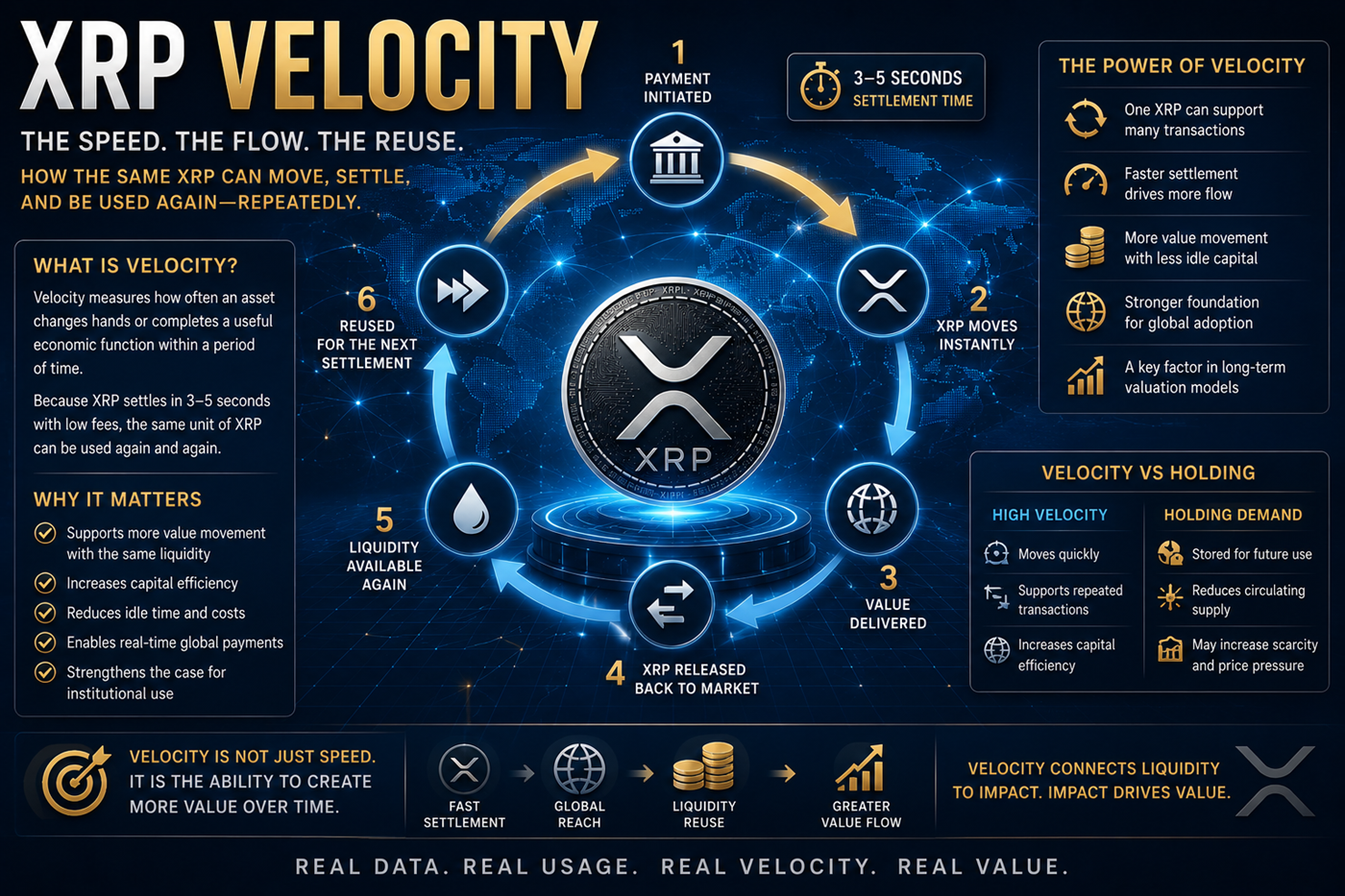
Velocity is one of the most misunderstood ideas in XRP valuation. It refers to how often the same unit of XRP can move, settle, and be reused within a period of time. Because XRP is designed for fast settlement, velocity can change the way investors think about demand, liquidity, and value.
Market cap asks how large XRP appears at a given price. Liquidity asks whether XRP can support meaningful movement. Velocity asks how often that liquidity can be reused.
Velocity measures how frequently an asset changes hands or completes a useful economic function. In XRP’s case, the key question is how often XRP can be used for settlement, liquidity movement, exchange bridging, or payment activity.
If the same XRP can move multiple times in a short period, then the asset may support more transaction value than a slower asset with the same amount of available liquidity.
XRP’s speed allows value to move quickly compared to traditional settlement systems, which may allow the same liquidity to be reused more efficiently.
The same pool of XRP may support multiple transactions over time if it can move, settle, and return to market quickly.
Higher velocity may reduce the amount of idle capital needed to support a given level of payment activity.
Velocity can change valuation models because demand depends not only on how much XRP exists, but how often it is used.
| High Velocity | Holding Demand |
|---|---|
| XRP moves quickly through settlement cycles. | XRP is held by investors, institutions, exchanges, or market participants. |
| Supports repeated transaction use. | Can reduce circulating supply available for active markets. |
| May increase capital efficiency. | May increase scarcity if demand grows and available supply tightens. |
| Can reduce the need for large balances in some models. | Can strengthen price pressure if utility and holding demand grow together. |
Velocity can be positive because it allows XRP to support more value movement. But high velocity can also mean XRP does not need to be held for long periods during each transaction.
This creates an important valuation question: will XRP’s future value be driven more by rapid settlement use, long-term holding demand, institutional liquidity reserves, scarcity, speculation, or a combination of all of them?
Not automatically. Faster velocity can increase usefulness, but price also depends on demand, supply, liquidity depth, holding behavior, institutional access, regulation, and market psychology.
In theory, repeated settlement cycles can allow a smaller pool of liquidity to support larger cumulative value movement over time. That is why velocity connects directly to the multiplier effect.
Velocity only matters if liquidity is available where transactions happen. Fast movement without strong liquidity corridors does not create the same practical value.
Market cap shows implied scale, but it does not reveal how often XRP can be used.
Liquidity provides the market depth needed for velocity to matter in real settlement activity.
Velocity helps explain how the same liquidity may support multiple value movements over time.
Velocity becomes more meaningful when connected to real financial infrastructure and institutional rails.
XRP velocity is important because it helps explain how quickly liquidity can move, settle, and be reused. But velocity is not a magic price formula. It must be studied alongside liquidity, market cap, holding demand, tokenization, stablecoins, infrastructure, regulation, and risk.