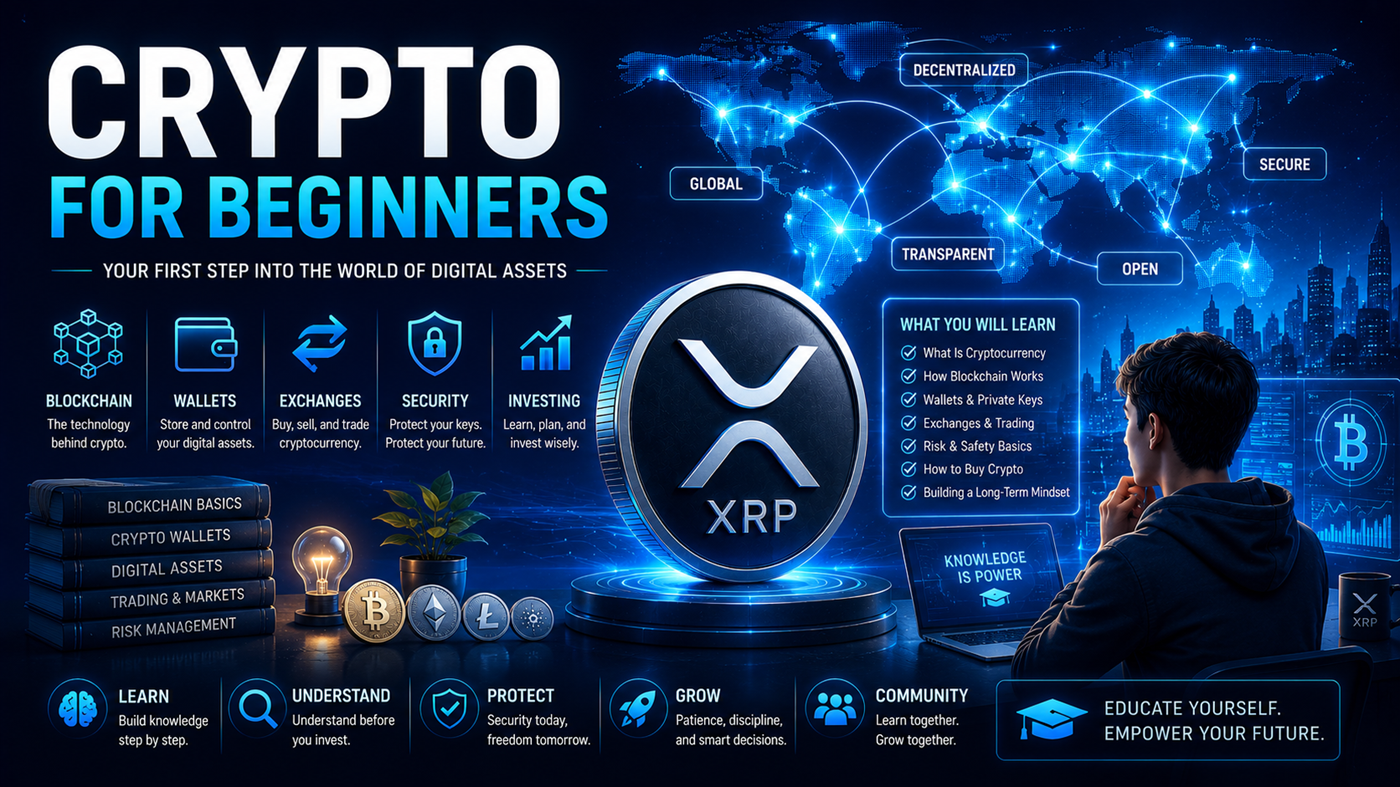
Before learning XRP deeply, it helps to understand the basic language of cryptocurrency. Crypto can feel confusing at first because it combines money, technology, security, markets, and personal responsibility.
This guide gives you the foundation: what cryptocurrency is, what blockchain means, how wallets work, what exchanges do, why private keys matter, and how beginners can avoid common mistakes.
Cryptocurrency is digital value that can be sent, received, stored, and verified using blockchain or distributed ledger technology. Instead of existing as paper money or coins, it exists as records on a digital network.
Some cryptocurrencies are designed as money. Some are designed for smart contracts. Some are designed for payments, settlement, gaming, identity, tokenization, or decentralized finance. XRP belongs mainly in the value transfer, payment, liquidity, and settlement conversation.
A digital record system that stores transactions across a network instead of one central database.
A token or coin that exists on a blockchain or distributed ledger. XRP is a digital asset.
A tool that controls access to your crypto using cryptographic keys.
A platform where users may buy, sell, or trade crypto assets.
A blockchain or ledger allows participants to agree on records without relying on one traditional central bookkeeper. When a transaction happens, the network checks whether it follows the rules. Once confirmed, it becomes part of the shared record.
Different crypto networks use different designs. Bitcoin uses mining. Ethereum uses a smart contract platform. The XRP Ledger uses a consensus process designed for fast and efficient settlement.
One of the most important beginner lessons is that wallets do not physically hold coins like a leather wallet holds cash. Crypto balances are recorded on the network. The wallet controls access to those balances.
A public address is like a receiving location. You can share it with others so they can send crypto to you.
A private key controls the ability to move crypto. It should be protected carefully and never shared.
A seed phrase can restore access to a wallet. Anyone who has it may be able to control the funds.
Self-custody means you control your own wallet keys. This gives control, but also responsibility.
Crypto exchanges are platforms where people may buy and sell digital assets. For many beginners, an exchange is the first place they buy XRP or another cryptocurrency.
However, keeping crypto on an exchange is different from holding it in your own wallet. An exchange account may be convenient, but it also introduces platform risk, account security risk, and custody risk.
Beginner rule: Buying crypto is only the first step. Learning how to protect it is just as important.
Prices move when buying and selling pressure changes across the market.
Headlines, regulation, partnerships, lawsuits, ETFs, and social media can affect market emotion.
Real usage, network activity, liquidity, and institutional interest can influence long-term views.
Crypto markets often move in cycles of excitement, fear, speculation, and correction.
Use strong passwords, two-factor authentication, and trusted devices when accessing exchanges or wallets.
No legitimate support person, exchange, wallet, or community member should ask for your seed phrase.
Crypto scams often promise easy profit, secret insider information, or risk-free returns.
Understand what you are buying before making financial decisions.
Once you understand crypto basics, XRP becomes easier to study. You can better understand why XRP’s speed, low fees, ledger design, wallet structure, and liquidity focus matter.
You can also avoid beginner mistakes like confusing Ripple with XRP, thinking all crypto works like Bitcoin, or assuming every digital asset has the same purpose.
Crypto is digital value powered by blockchain and ledger technology. Before focusing on price predictions, learn the basics: wallets, keys, exchanges, custody, risk, and how different networks solve different problems.
Learn the difference between wallets, keys, custody, and exchange accounts.
Wallet BasicsAvoid common beginner errors involving hype, scams, storage, and risk.
Avoid MistakesA broader beginner guide to crypto, blockchain, wallets, exchanges, and digital assets.
View BookA focused beginner guide to XRP, Ripple, XRPL, and digital finance.
View BookExplore crypto as a bridge to financial education, freedom, and digital transformation.
View Book