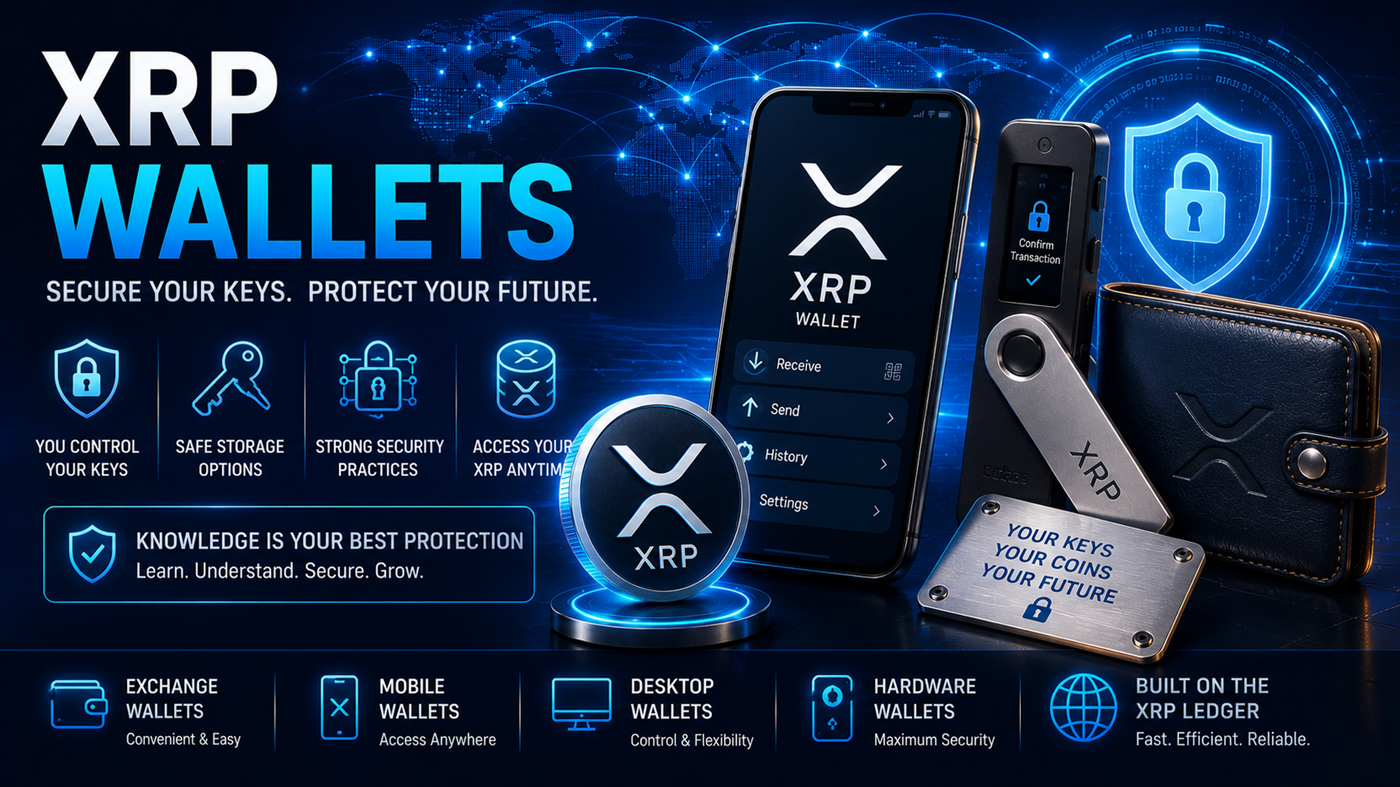
An XRP wallet is the tool that gives you access to XRP recorded on the XRP Ledger. The wallet does not physically hold coins. Instead, it manages the keys that allow you to send, receive, and control XRP.
Understanding wallets is one of the most important parts of crypto education. Buying XRP is easy compared with learning how to protect it properly.
An XRP wallet is a software or hardware tool that controls access to an XRP address on the XRP Ledger. Your XRP balance exists on the ledger. Your wallet controls permission to move it.
This is why private keys and recovery phrases are so important. If someone gains access to your keys, they may be able to move your XRP. If you lose access to your keys, you may lose access to your XRP.
Your XRP is held inside your account on a crypto platform. Convenient, but you rely on the platform.
A wallet app on your phone. Useful for access, but device security is important.
Software installed on your computer. Security depends on your device and backup practices.
A physical device that stores keys offline. Often used for longer-term self-custody.
| Option | What It Means | Main Risk |
|---|---|---|
| Exchange Wallet | The platform holds custody of your XRP for you. | You rely on the exchange, its security, and your account protection. |
| Self-Custody Wallet | You control your own private keys or recovery phrase. | You are fully responsible for protecting access. |
| Hardware Wallet | A self-custody device that keeps keys offline. | You must protect the device, PIN, and recovery phrase. |
The address where XRP can be sent. This can usually be shared with someone sending XRP to you.
The secret key that controls the ability to move XRP. Never share it.
A recovery phrase that can restore wallet access. Store it offline and protect it carefully.
Some exchanges require a destination tag when receiving XRP. Missing it can cause problems with deposits.
XRP has a special beginner trap: some exchanges use a shared XRP address and require a destination tag to identify your account. When sending XRP to an exchange, always check whether a destination tag is required.
Double-check the receiving address, destination tag, network, and amount. Crypto transfers are usually final. A small test transfer can help reduce risk when learning.
No legitimate exchange, wallet provider, support agent, or community member should ask for it.
Do not store seed phrases only in email, screenshots, cloud storage, or notes apps.
Strong account security helps protect against unauthorized access.
When learning transfers, a small test transaction can help confirm the address and destination tag.
The best wallet depends on your experience, amount held, comfort with self-custody, and security habits. Beginners may start with an exchange account while learning, but long-term holders often study self-custody and hardware wallet options.
There is no perfect wallet for everyone. Convenience and control always involve tradeoffs. The key is understanding those tradeoffs before moving XRP.
An XRP wallet controls access to XRP recorded on the XRP Ledger. Learn public addresses, private keys, seed phrases, custody, hardware wallets, and destination tags before sending large amounts.
A beginner-friendly guide to XRP, Ripple, XRPL, wallets, and digital finance.
View BookA broader guide to crypto basics, wallets, exchanges, and digital assets.
View Book