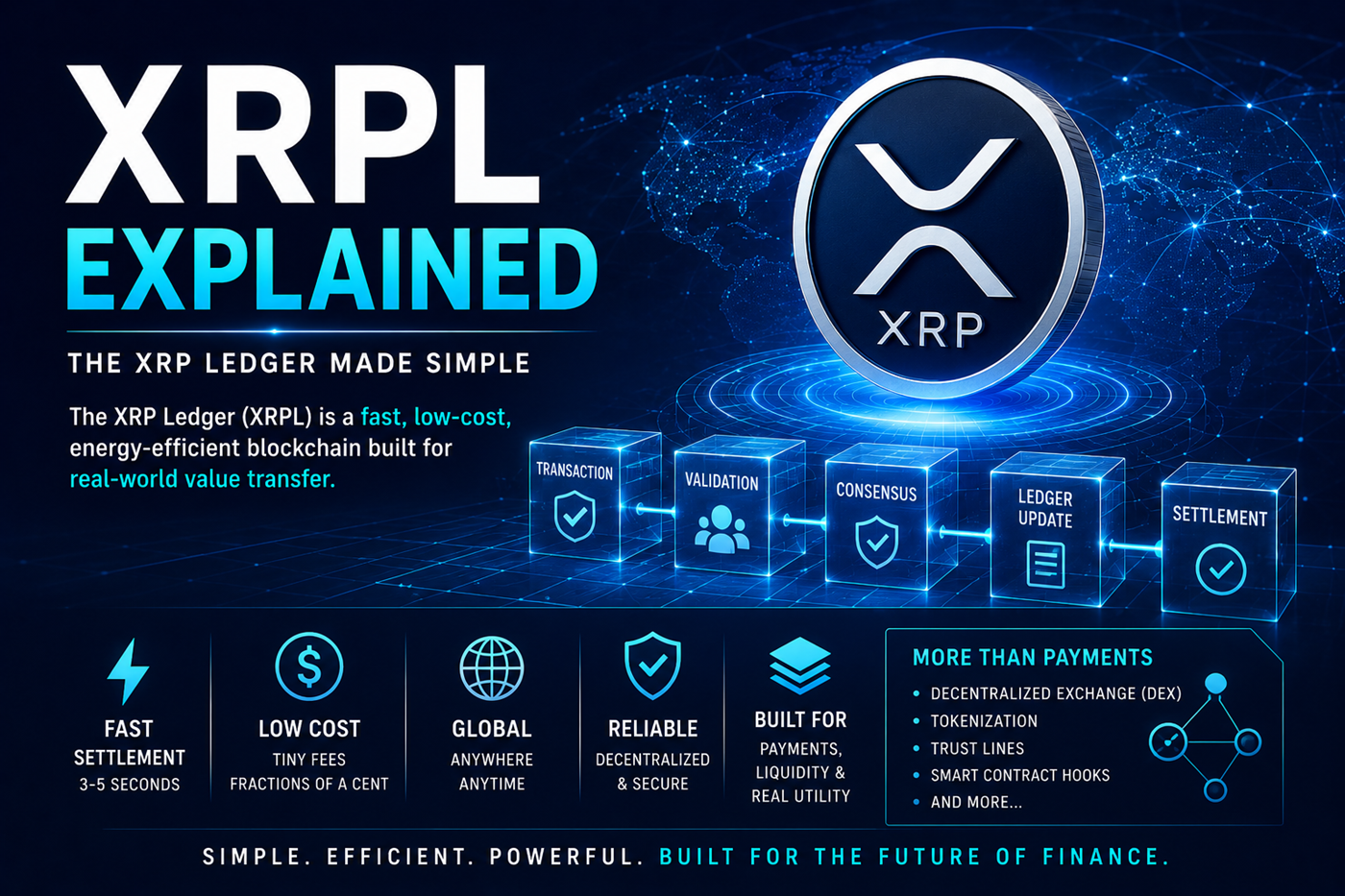
XRPL stands for XRP Ledger. It is the public blockchain network where XRP transactions are recorded, verified, and settled. If XRP is the digital asset, then the XRP Ledger is the system that allows XRP to move.
The XRPL was designed for speed, low cost, efficiency, and reliable value transfer. It is not simply a place where XRP exists. It is a working ledger built to process transactions and support financial activity.
The XRP Ledger is a decentralized public ledger that records transactions and account balances. It allows XRP and other supported assets to move between accounts without depending on traditional banking rails.
A ledger is simply a record of who owns what. In traditional finance, banks maintain ledgers. In blockchain systems, a distributed network maintains the ledger. The XRP Ledger is the shared record that keeps XRP transactions organized and verifiable.
The XRPL is designed for quick transaction settlement, making it useful for payment-focused activity.
The network was built to avoid unnecessary complexity and support efficient value movement.
Transaction fees are typically very small, which supports frequent transfers and practical usage.
The ledger can be accessed globally by users, developers, businesses, and applications.
When someone sends XRP, the transaction is submitted to the network. Validators help confirm the transaction and agree on the updated state of the ledger. Once consensus is reached, the ledger updates and the transaction becomes part of the permanent record.
This process is what allows XRP to move quickly without waiting on traditional banking settlement windows.
While many beginners first learn about XRPL because of XRP, the ledger can support more than basic XRP movement. It has features that can be used for tokenized assets, decentralized exchange activity, trust lines, payments, and other forms of digital value transfer.
XRPL can process value transfer between accounts quickly and efficiently.
Assets can be represented digitally on the ledger depending on the use case and issuer.
XRPL includes built-in exchange functionality that can support asset trading and liquidity.
XRPL features may support movement between assets and payment paths within the ecosystem.
Utility means real use. For XRP, much of the utility discussion comes from the XRP Ledger’s ability to move value quickly and affordably. The ledger gives XRP a working environment. Without the ledger, XRP would simply be a token name. With the ledger, XRP becomes part of a functioning payment and settlement system.
That is why serious XRP research should include more than price charts. It should include the technology, network activity, use cases, adoption, liquidity, and risks.
No. XRPL is the public blockchain network. Ripple is a company that builds financial technology solutions and participates in the XRP ecosystem.
XRP is the native digital asset of the XRP Ledger and is used for transaction fees and movement of value. Some XRPL features may also involve issued assets and other ledger functions.
No. Although XRP is often discussed in connection with financial institutions, XRPL is a public ledger that can be used by many types of participants.
Because understanding XRP without understanding the XRP Ledger is incomplete. The ledger explains how XRP actually moves and why speed, cost, and settlement are central to its value story.
The XRP Ledger is the engine behind XRP movement. It records transactions, supports fast settlement, enables low-cost transfers, and gives XRP its working blockchain environment. To understand XRP seriously, learn the ledger first.
A practical beginner guide to XRP, Ripple, XRPL, and digital finance.
View BookLearn about liquidity, settlement efficiency, and XRP multiplier ideas.
View BookExplore how crypto connects financial education, freedom, and digital transformation.
View Book