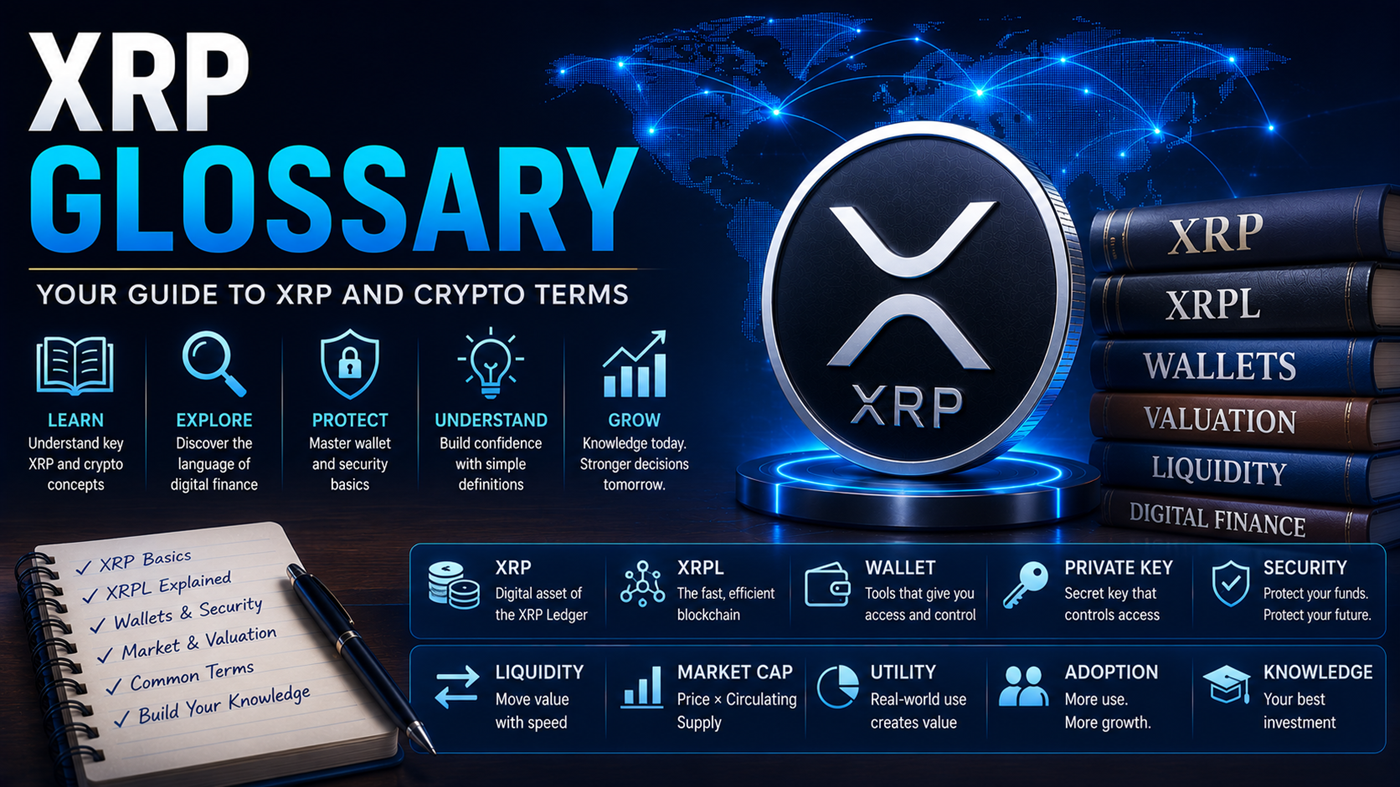
This glossary explains common XRP and cryptocurrency terms in simple language. Use it as a quick reference while reading the XRP Knowledge Center, studying valuation pages, or exploring Bruce Goldwell’s XRP books.
Crypto becomes much easier to understand when the vocabulary becomes familiar. Start with the terms below, then follow the related learning links to go deeper.
XRP is the native digital asset of the XRP Ledger. It is designed for fast, low-cost value transfer and is often discussed in connection with payments, liquidity, and settlement.
The XRP Ledger is the public blockchain network where XRP transactions are recorded and settled. XRPL is the common abbreviation.
Ripple is a financial technology company that builds payment and digital finance solutions. Ripple is not the same thing as XRP.
Ripple is the company. XRP is the digital asset. The XRP Ledger is the network. Understanding this distinction is one of the first lessons in XRP education.
A wallet is a tool that controls access to crypto recorded on a blockchain or ledger. It does not physically hold coins. It controls keys.
A public address is the receiving address where XRP or other digital assets can be sent.
A private key is secret information that allows crypto to be moved. Anyone with the private key may control the funds.
A seed phrase is a recovery phrase used to restore wallet access. It should be stored offline and never shared.
Self-custody means you control your own wallet keys instead of relying on an exchange or platform.
A hardware wallet is a physical device designed to keep wallet keys offline. It is often used for longer-term crypto storage.
A destination tag is sometimes required when sending XRP to an exchange. It helps the exchange identify the correct customer account.
A blockchain is a digital record system that stores transactions across a network. Different blockchains use different designs and rules.
A ledger is a record of balances and transactions. The XRP Ledger records XRP account activity.
A validator helps the network agree on which transactions are valid and what the updated ledger should contain.
Consensus is the process of network participants agreeing on valid transactions and ledger updates.
A transaction fee is a small cost paid to submit a transaction on a network. XRP transaction fees are typically very small.
Settlement means the transaction has been completed and recorded. XRP is often discussed because of fast settlement.
Market cap is calculated by multiplying asset price by circulating supply. It helps compare assets, but it does not explain everything about value.
Circulating supply is the amount of a digital asset currently available in the market.
Total supply is the full amount of an asset created or existing under its supply rules.
Liquidity means how easily an asset can be bought, sold, or used to move value without major friction.
Utility means real use. For XRP, utility discussions often focus on payments, settlement, liquidity, and value transfer.
Speculation means buying or selling based on expectations, emotion, hype, or future price possibilities rather than current use alone.
Volatility means price can move sharply up or down. Crypto markets are often highly volatile.
A crypto exchange is a platform where users may buy, sell, or trade digital assets.
Custody refers to who controls the keys or access to crypto. An exchange may hold custody, or you may use self-custody.
A stablecoin is a digital asset designed to track the value of another asset, often a fiat currency like the U.S. dollar.
Tokenization means representing real-world or digital assets as tokens on a blockchain or ledger.
DeFi means decentralized finance. It refers to financial applications built using blockchain technology.
FOMO means fear of missing out. It can cause emotional buying after a price move or social media hype.
FUD means fear, uncertainty, and doubt. It is often used to describe negative claims or market fear.
The more terms you understand, the easier XRP becomes to study. Use this glossary as a learning companion while exploring XRP basics, wallets, valuation, and long-term digital finance trends.
A beginner-friendly guide to XRP, Ripple, XRPL, wallets, and digital finance.
View BookA broader guide to crypto basics, wallets, exchanges, and digital assets.
View BookA balanced look at XRP valuation, hype, liquidity, risk, and expectations.
View Book