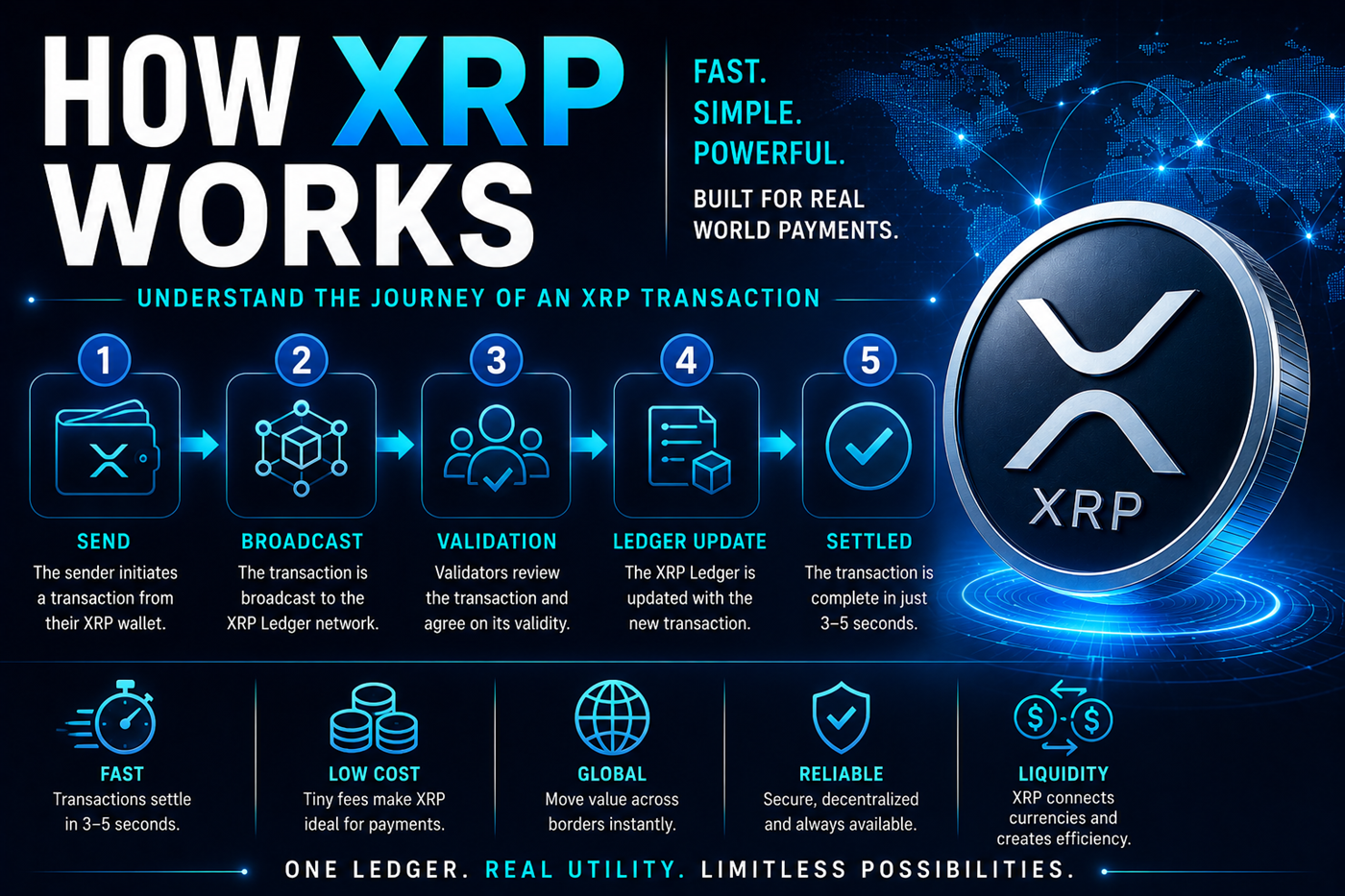
XRP works by moving value across the XRP Ledger, a public blockchain designed for speed, efficiency, and low-cost settlement. When someone sends XRP, the transaction is submitted to the ledger, reviewed by network validators, confirmed, and recorded.
For beginners, the most important idea is this: XRP is not moved through slow banking rails. It moves across a digital ledger built for fast value transfer.
When a user sends XRP, their wallet creates and signs the transaction. The transaction is sent to the XRP Ledger network. Validators help confirm that the transaction follows the rules of the ledger. Once the ledger updates, the XRP has settled.
A wallet holds the keys that allow someone to send XRP. The XRP itself is recorded on the ledger.
Private keys control access. Whoever controls the private key controls the ability to move the XRP.
The XRP Ledger records account balances, transaction history, fees, and settlement activity.
Validators help the network agree on which transactions are valid and what the updated ledger should contain.
XRP was designed for fast settlement. Instead of waiting for long confirmation times or traditional banking delays, the XRP Ledger reaches agreement quickly and updates the ledger in short intervals.
This speed is one reason XRP is often discussed in connection with payments, remittances, institutional settlement, liquidity movement, and cross-border value transfer.
Beginner takeaway: XRP’s speed comes from the design of the XRP Ledger. The network is built to confirm and settle transactions efficiently.
Every XRP transaction includes a very small network fee. This fee helps prevent spam and keeps the network usable. Unlike some blockchains where fees can rise sharply during congestion, XRP is known for very low transaction costs.
Low fees are important because they make small transfers, frequent transfers, and payment-focused use cases more practical.
Liquidity means the ability to move in and out of value efficiently. XRP is often discussed as a bridge asset because it may help value move between different currencies, payment corridors, or digital asset systems.
For example, instead of one currency needing a direct relationship with every other currency, a bridge asset can potentially help connect value between them. This is one reason XRP is often linked to global payments and settlement conversations.
| Traditional Payment Systems | XRP / XRP Ledger |
|---|---|
| May involve multiple intermediaries. | Uses a public ledger to move value directly between accounts. |
| Settlement can take longer depending on banks, borders, and systems. | Designed for fast settlement on the ledger. |
| Fees may vary depending on provider, country, and transfer type. | Network fees are typically very small. |
| Banking hours and regional systems may affect movement. | The ledger is designed for global digital access. |
XRP is the digital asset that moves across the ledger. It can be sent, received, held, and used as part of transaction activity.
The XRP Ledger is the blockchain system that records transactions and updates balances.
Wallets do not physically store coins. They control access to ledger balances through cryptographic keys.
Validators help maintain agreement on valid transactions and ledger updates.
XRP transactions are designed to settle very quickly compared with many traditional systems and some other blockchains.
No. XRP moves on the XRP Ledger. Ripple is a company in the ecosystem, but users do not need Ripple directly to send XRP between compatible wallets.
XRP balances are recorded on the XRP Ledger. Wallets control access to those balances through keys.
Yes. XRP can be used for value transfer, settlement, liquidity-related use cases, and broader digital finance activity depending on the application.
XRP works by moving value across the XRP Ledger. Wallets sign transactions, validators help confirm activity, fees help protect the network, and the ledger records settlement. This combination is why XRP is often described as fast, efficient, and built for value transfer.
A beginner-friendly guide to XRP, Ripple, XRPL, and digital finance.
View BookLearn about liquidity, settlement efficiency, adoption, and XRP multiplier ideas.
View Book