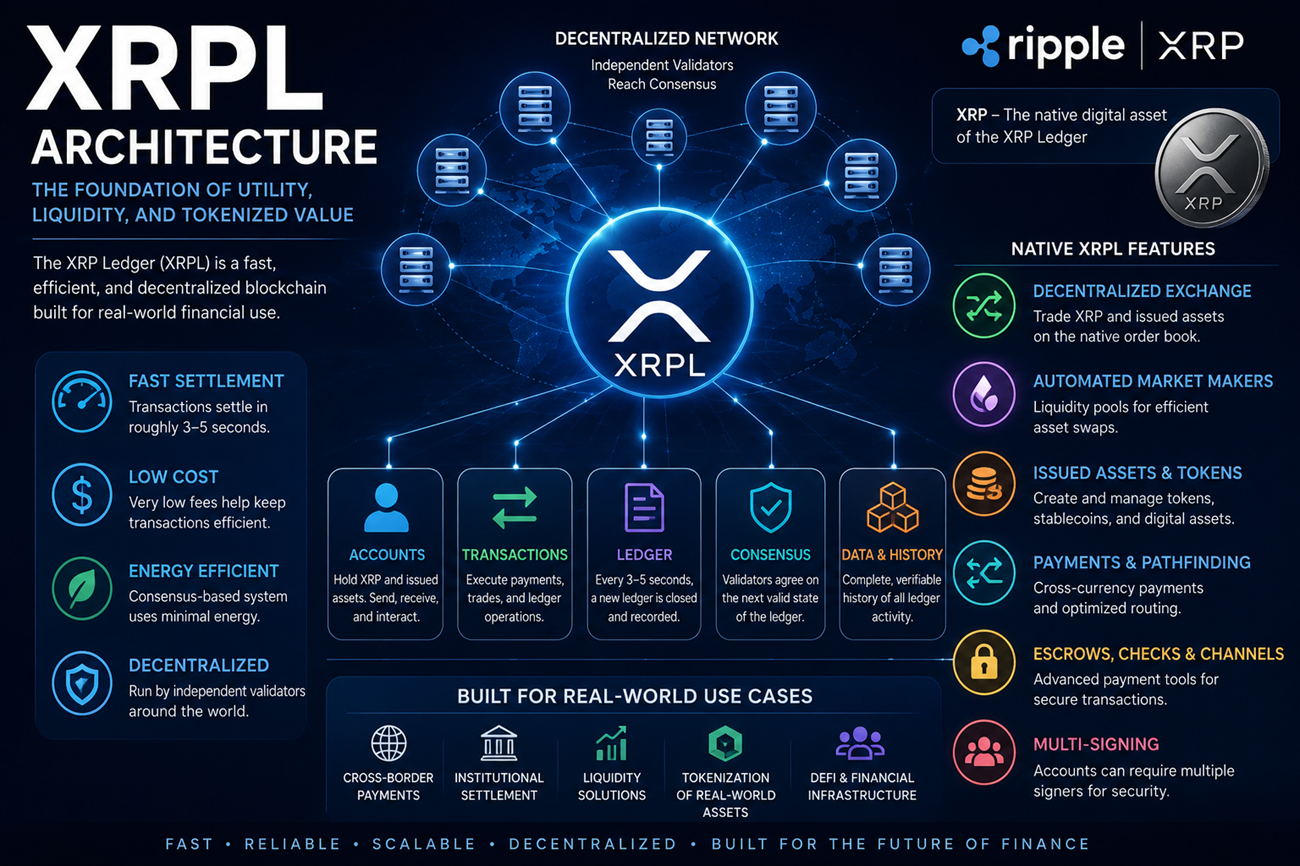
The XRP Ledger, often called the XRPL, is a decentralized public blockchain designed to move value quickly, efficiently, and at low cost. Its architecture is different from proof-of-work mining systems because it uses a consensus process rather than mining to validate transactions.
This page gives a beginner-friendly overview of how the XRPL is structured and how its main components work together to support payments, liquidity, issued assets, tokenization, decentralized exchange activity, and future institutional finance.
Important: Ripple is the company, XRP is the native digital asset, and the XRP Ledger is the decentralized public ledger. They are connected, but they are not the same thing.
The XRP Ledger is made up of accounts, transactions, validators, ledger history, native features, and network participants. Together, these components allow the network to record ownership, process payments, issue tokens, trade assets, and settle value without relying on traditional mining.
Accounts hold XRP and other issued assets. They can send payments, create offers, hold tokens, set trust lines, sign transactions, and interact with XRPL features.
Transactions are instructions submitted to the network. They may send XRP, trade issued assets, create escrows, manage trust lines, use payment channels, or interact with other ledger functions.
Validators participate in the consensus process by evaluating proposed transactions and helping the network agree on the next valid ledger.
Each validated ledger is a record of the network state at a specific point in time, including account balances, offers, settings, tokens, and transaction results.
The XRPL does not use proof-of-work mining. Instead, independent validators participate in a consensus process to agree on which transactions are valid and should be included in the next ledger. This design allows the network to settle transactions in roughly 3 to 5 seconds under normal conditions while keeping transaction costs very low.
Because there is no mining competition, the XRPL is designed to be more energy efficient than proof-of-work blockchains. The goal is fast final settlement, predictable fees, and reliable movement of value.
XRP is the native digital asset of the XRP Ledger. It is used for transaction fees, account reserves, and value transfer across the network. Every transaction on the XRPL requires a small amount of XRP to prevent spam and help keep the network efficient.
Because XRP is native to the ledger, it does not need an issuer. This makes XRP different from issued currencies or tokens that represent other assets on the XRPL.
Small XRP fees help protect the network from spam and excessive transaction activity.
Accounts must maintain a minimum XRP reserve to exist on the ledger and use certain features.
XRP can be used as a bridge asset for moving value between currencies, tokens, and markets.
XRP settles directly on the XRPL without relying on a separate token issuer.
One of the most important parts of XRPL architecture is that many financial functions are built directly into the ledger. This means the XRPL can support payments, trading, token issuance, and liquidity features at the protocol level.
The XRPL includes a native decentralized exchange where users can trade XRP and issued assets through order books.
AMMs add another liquidity layer by allowing assets to be traded through liquidity pools.
The XRPL allows entities to issue tokens representing currencies, stablecoins, assets, credits, or other forms of value.
The ledger can route payments across different assets when liquidity is available, helping value move between markets.
Escrow functionality allows XRP to be locked until specific time or condition requirements are met.
Payment channels can support high-volume payment activity by allowing many small payments to be settled efficiently.
Checks allow one account to authorize another account to claim a payment later.
Multi-signing allows accounts to require multiple approved signatures before transactions are authorized.
The XRPL architecture was designed to support efficient movement of value. Liquidity is central to that purpose. Through XRP, issued assets, the native DEX, AMMs, and cross-currency payment paths, the ledger can support different ways of moving value between assets and markets.
This does not mean liquidity is automatic. Real-world liquidity depends on market participants, trading depth, demand, institutional usage, regulatory conditions, and available on-chain or off-chain infrastructure.
The XRPL can support issued assets and tokenized value. This makes it relevant to discussions around stablecoins, real-world assets, treasury movement, remittances, regulated settlement, and institutional digital finance.
As institutions explore blockchain-based financial infrastructure, features such as compliance controls, permissioned environments, liquidity tools, custody, stablecoins, and transparent settlement may become increasingly important.
Stablecoins such as RLUSD may support payments, treasury movement, liquidity, and institutional settlement use cases.
Tokenized assets may represent financial instruments, funds, securities, commodities, or other forms of value.
Permissioned tools may help institutions meet compliance requirements while participating in blockchain-based finance.
Regulated DeFi may combine on-chain liquidity with identity, compliance, custody, and institutional risk controls.
Ripple often frames XRP around utility, but the deeper story includes the architecture of the XRP Ledger itself. Fast settlement, low fees, built-in exchange functions, issued assets, and liquidity tools all contribute to the broader utility conversation.
The value of this architecture is not based on hype alone. It depends on real adoption, transaction demand, liquidity depth, institutional participation, regulatory clarity, and the continued development of useful financial applications.
Return to the main utility overview.
Learn the basics of the XRP Ledger.
Explore speed, fees, throughput, and settlement.
Continue with official and educational resources.
Bruce Goldwell's XRP books expand on XRP utility, valuation, liquidity, institutional adoption, and the difference between speculation and real-world use.
A practical look at XRP valuation beyond hype and unrealistic price predictions.
An educational look at liquidity, utility, and how value may move through XRP markets.
A look at XRP in the institutional age of crypto, payments, and digital finance.
Explore the full XRP book collection.
This page is for educational purposes only and is not financial advice. XRPL technology, digital asset regulation, liquidity conditions, institutional adoption, and market behavior can change over time. Readers should verify current information through official Ripple, XRPL, exchange, regulatory, and independent research sources before making financial decisions.