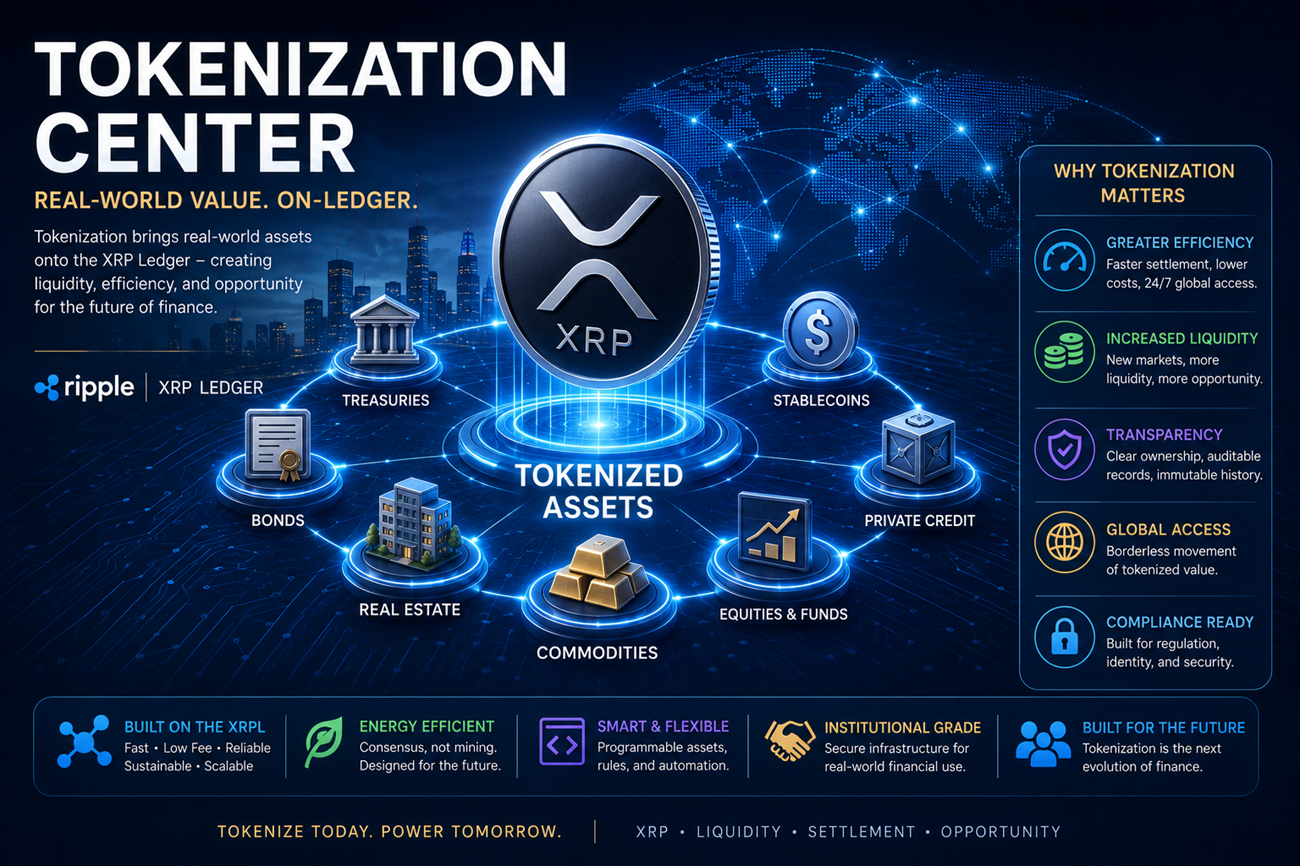
Tokenization is the process of representing value on a blockchain. That value may represent currencies, stablecoins, financial instruments, real-world assets, credits, funds, or other forms of digital ownership.
The XRP Ledger supports issued assets and token movement, making it part of the broader conversation around tokenized finance, institutional settlement, liquidity, and real-world asset infrastructure.
Important: Tokenization does not automatically make an asset safe, liquid, legal, or valuable. Every token depends on its issuer, legal structure, market demand, redemption rules, custody, compliance, and transparency.
At its simplest, tokenization turns something into a digital representation that can move on a blockchain. The token may represent a dollar, a bond, a fund share, a commodity, a credit, a loyalty point, or another form of value.
The key question is always what the token actually represents and who stands behind it. A token is only as strong as the asset, issuer, agreement, custody, and rules supporting it.
A token can represent ownership, access, credit, value, or a claim connected to something else.
Tokenized value can move across a ledger faster than many traditional recordkeeping systems.
Issued assets depend on the entity that creates, backs, redeems, or manages them.
A token only becomes useful at scale if there is real demand, trust, regulation, and liquidity.
The XRPL allows entities to issue assets on the ledger. These issued assets can represent currencies, stablecoins, tokenized value, credits, or other financial instruments depending on how they are created and governed.
Unlike XRP, issued assets have issuers. That means users should understand the issuer, trust lines, redemption rules, legal terms, and risks before relying on any issued asset.
Stablecoins are one of the most common examples of tokenized value. They are designed to track the value of another asset, often a national currency such as the U.S. dollar.
Ripple’s RLUSD is part of the growing institutional discussion around stablecoins, payments, liquidity, treasury movement, and settlement. Stablecoins may complement XRP by supporting fiat-denominated movement while XRP may still serve other roles in liquidity, bridging, and settlement.
Stablecoins and XRP are not the same thing. A stablecoin is usually issued and backed by reserves or claims. XRP is the native digital asset of the XRP Ledger and does not require an issuer.
Real-world asset tokenization, often called RWA tokenization, refers to representing traditional assets on blockchain rails. Examples may include treasury products, bonds, funds, commodities, real estate interests, invoices, credits, or other financial instruments.
The purpose is not simply to create a token. The larger goal is to improve settlement, transparency, programmability, transfer efficiency, access, and lifecycle management for assets that currently depend on slower financial infrastructure.
Government securities and treasury-related products are often discussed as major candidates for tokenization.
Tokenized fund shares may create new ways to manage ownership, transfer, settlement, and investor access.
Some tokens may represent claims on commodities or commodity-backed products, depending on issuer structure.
Tokenization may eventually support private credit, invoices, real estate interests, and other less liquid assets.
Tokenization can increase the number of assets moving across blockchain networks. If more value exists on-ledger, liquidity, settlement, trading, custody, compliance, and cross-asset movement become more important.
This is where XRP utility enters the discussion. XRP may serve as a native settlement asset, a bridge asset, or a liquidity tool depending on the use case, available markets, and institutional adoption.
Tokenization can bring more forms of value into digital financial infrastructure.
As more assets become digital, markets need ways to move between them efficiently.
Tokenized finance depends on reliable settlement and accurate ledger records.
XRP may help connect assets and markets when sufficient liquidity and demand exist.
Tokenized assets need liquidity. On the XRPL, liquidity may come from the native decentralized exchange, Automated Market Makers, exchanges, institutional market makers, and payment paths.
AMMs can help create pool-based liquidity between XRP, issued assets, stablecoins, and other tokens. However, pool usefulness depends on depth, demand, volatility, issuer trust, and market participation.
Institutions usually need more than a token standard. They need compliance controls, custody, reporting, identity rules, redemption processes, governance, auditability, and legal clarity.
This is why institutional tokenization often connects to permissioned features, regulated DeFi, stablecoins, liquidity providers, custodians, and enterprise infrastructure.
Regulated entities may need controls for identity, access, transfer restrictions, and reporting.
Institutions need secure custody solutions for digital assets, tokenized assets, and settlement assets.
Tokenized assets need clear rules explaining how holders can redeem or settle claims.
Audits, reserves, disclosures, issuer credibility, and public data all affect trust.
Tokenization can be powerful, but it can also be misunderstood. A token does not remove legal, custody, market, issuer, liquidity, or regulatory risk. In some cases, the token may be easy to transfer while the underlying rights are complicated.
If the issuer fails, mismanages reserves, or changes terms, token holders may be affected.
A token may exist on-chain but still have little trading demand or poor market depth.
Ownership rights, redemption claims, transfer rules, and securities laws may vary by asset and jurisdiction.
Wallet security, smart systems, integrations, bridges, custody, and operational processes can create risk.
Return to the main XRP utility hub.
Learn how the XRP Ledger is structured.
See how liquidity pools may support tokenized value movement.
Explore regulated finance, compliance, and on-chain liquidity.
Learn how permissioned exchange activity may support regulated participants.
Verify current tokenization and XRPL information through deeper resources.
A practical XRP valuation guide focused on utility, liquidity, and realistic assumptions.
An educational look at value movement, tokenization, liquidity, and XRP utility.
Explore XRP in the institutional age of payments, regulation, stablecoins, and tokenization.
Browse Bruce Goldwell’s XRP book collection.
This page is for educational purposes only and is not financial advice. Tokenized assets, stablecoins, XRP, XRPL features, liquidity, custody, issuers, legal rights, and regulations can change over time. Readers should verify current information through official Ripple, XRPL, issuer, exchange, regulatory, and independent research sources before making financial decisions.