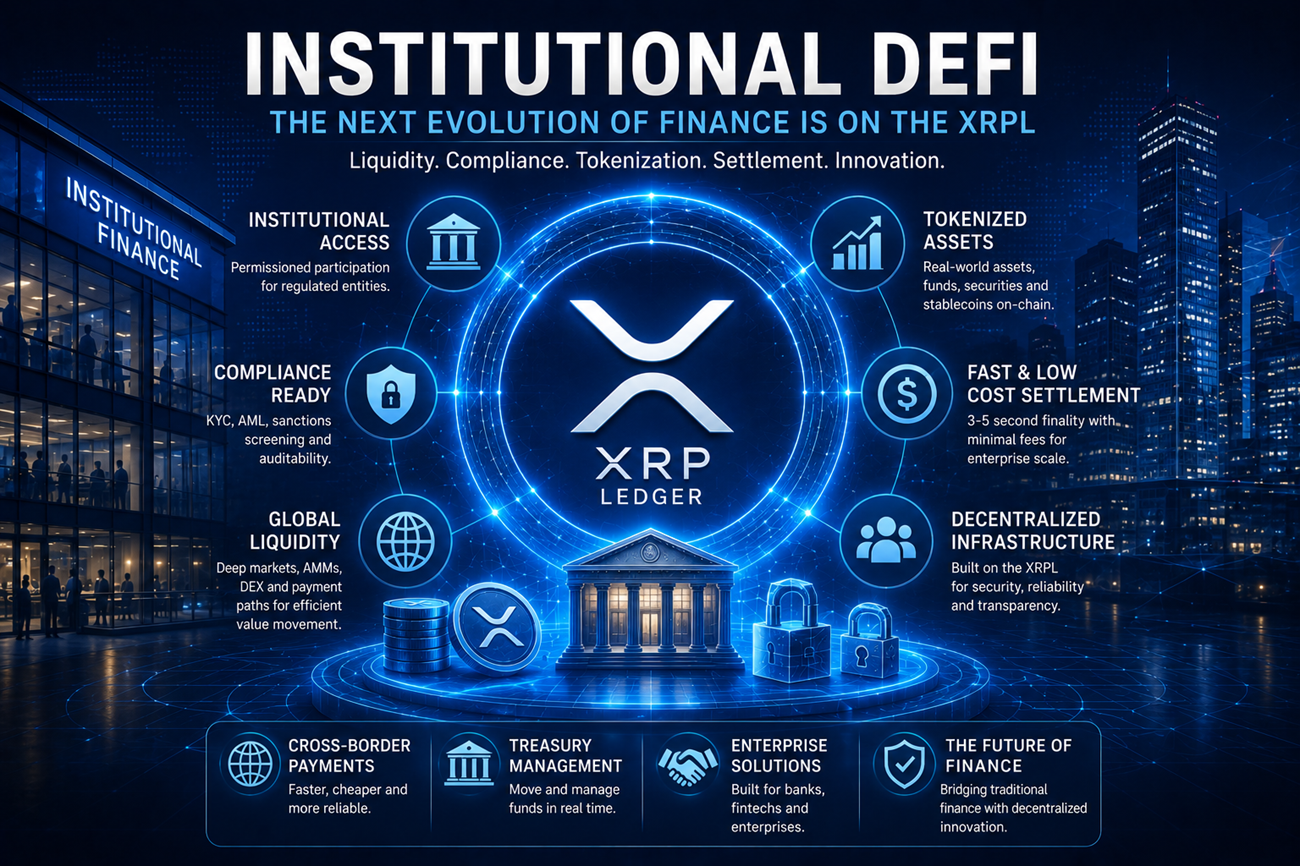
Institutional DeFi refers to decentralized finance infrastructure designed for banks, funds, payment companies, custodians, enterprises, and regulated financial institutions. Unlike early DeFi, which was mostly open and retail-driven, institutional DeFi focuses on compliance, identity, liquidity, custody, reporting, and risk controls.
The XRP Ledger is increasingly being discussed as infrastructure that may support this next stage of digital finance through fast settlement, low fees, native exchange features, tokenized assets, stablecoins, permissioned environments, and liquidity tools.
Educational note: Institutional DeFi is an evolving area. Features, adoption, regulations, and technical implementations may change over time. Always verify current details through official Ripple, XRPL, regulatory, and independent research sources.
Decentralized finance allows financial activity to occur through blockchain-based systems. Institutional DeFi adds the controls and standards required by regulated organizations.
For institutions, the question is not simply whether a transaction can happen on-chain. The question is whether the transaction can happen safely, legally, transparently, and at the scale required by serious financial markets.
Institutions may require KYC, AML, sanctions screening, jurisdiction controls, audit trails, and regulatory reporting.
Digital assets, tokenized assets, and stablecoins must be stored and managed securely.
Institutional markets require deep liquidity, reliable counterparties, and efficient execution.
Financial firms need controls for market risk, operational risk, counterparty risk, and technology risk.
The XRP Ledger was designed for efficient value movement. Its core strengths include fast settlement, low transaction costs, consensus-based validation, native token functionality, issued assets, and built-in exchange capabilities.
These characteristics make the XRPL relevant to discussions around institutional payments, liquidity, tokenization, stablecoins, treasury movement, and regulated DeFi.
Institutional DeFi is not one single feature. It is a combination of infrastructure pieces working together to support regulated financial activity.
Real-world assets, stablecoins, funds, treasuries, and issued currencies may move on blockchain rails.
Approved participants may interact within defined environments that support compliance and identity rules.
Native DEX functionality, AMMs, and payment paths may help value move between assets.
Institutions may use blockchain infrastructure to settle value faster and with clearer records.
Tokenization is one of the largest themes driving institutional blockchain interest. When real-world assets are represented on-chain, institutions need infrastructure for issuance, transfer, trading, custody, reporting, and settlement.
The XRP Ledger may support tokenized finance through issued assets, stablecoins, liquidity tools, permissioned environments, and fast settlement. This creates a foundation where tokenized assets can potentially move more efficiently than they do in traditional systems.
Institutional DeFi often requires more structure than open DeFi. Banks, funds, custodians, and regulated companies may need approved participant lists, identity checks, transfer restrictions, and market access rules.
Permissioned Domains and Permissioned DEX concepts may help create controlled environments where institutions can participate in on-chain finance while meeting compliance obligations.
Institutions may need to confirm who is allowed to access certain assets, pools, markets, or services.
Permissioned DEX environments may support compliant trading between approved entities.
Some tokenized assets may require rules governing who can hold, send, receive, or redeem them.
On-ledger records may support transparency, reporting, and oversight when combined with proper controls.
Stablecoins can play an important role in institutional DeFi because they provide a digital representation of fiat value. They may be used for settlement, treasury management, trading pairs, liquidity routing, remittances, and cross-border movement.
Ripple’s RLUSD fits into this broader stablecoin discussion. Rather than viewing stablecoins and XRP as enemies, institutions may use different digital assets for different purposes. Stablecoins may represent fiat-denominated value, while XRP may support bridge liquidity, transaction efficiency, and native XRPL settlement use cases.
A healthy digital finance ecosystem may include stablecoins, XRP, tokenized assets, AMMs, native DEX liquidity, permissioned environments, and institutional custody working together.
Institutional finance depends on liquidity. Fast settlement is useful, but markets also need depth, active participants, pricing efficiency, market makers, and reliable execution.
On the XRPL, liquidity may come from several sources: XRP markets, issued assets, stablecoins, the native decentralized exchange, Automated Market Makers, payment paths, centralized exchanges, and institutional liquidity providers.
XRP may support bridge value movement when sufficient market depth and demand exist.
Automated Market Makers may help create pool-based liquidity between XRP, stablecoins, and issued assets.
Professional liquidity providers may support deeper markets for tokenized assets and settlement flows.
XRPL pathfinding may help payments move through available liquidity routes when conditions allow.
Institutional DeFi is not limited to speculative trading. Its larger purpose is to improve how financial assets move, settle, trade, and interact across digital infrastructure.
Digital assets and stablecoins may help move value across borders faster than traditional systems.
Companies may use blockchain rails to manage liquidity, settlement, and funds movement more efficiently.
Investment funds may use tokenization for ownership records, settlement, transfer management, and investor access.
Treasuries, bonds, private credit, commodities, and other assets may become part of regulated on-chain markets.
Institutional DeFi may offer significant advantages, but it also raises important questions. Technology alone does not solve regulation, liquidity, custody, governance, legal rights, or market risk.
Rules for tokenized assets, stablecoins, DeFi, and digital asset markets may continue changing.
Institutions need secure custody and operational controls for digital assets and tokenized instruments.
A market may exist on-chain but still lack enough depth for large institutional movement.
Institutional systems require careful integration, governance, compliance, security, and oversight.
Tokenization is one of the largest themes driving institutional blockchain interest. When real-world assets are represented on-chain, institutions need infrastructure for issuance, transfer, trading, custody, reporting, and settlement.
The XRP Ledger may support tokenized finance through issued assets, stablecoins, liquidity tools, permissioned environments, and fast settlement. This creates a foundation where tokenized assets can potentially move more efficiently than they do in traditional systems.
Institutional DeFi often requires more structure than open DeFi. Banks, funds, custodians, and regulated companies may need approved participant lists, identity checks, transfer restrictions, and market access rules.
Permissioned Domains and Permissioned DEX concepts may help create controlled environments where institutions can participate in on-chain finance while meeting compliance obligations.
Institutions may need to confirm who is allowed to access certain assets, pools, markets, or services.
Permissioned DEX environments may support compliant trading between approved entities.
Some tokenized assets may require rules governing who can hold, send, receive, or redeem them.
On-ledger records may support transparency, reporting, and oversight when combined with proper controls.
Stablecoins can play an important role in institutional DeFi because they provide a digital representation of fiat value. They may be used for settlement, treasury management, trading pairs, liquidity routing, remittances, and cross-border movement.
Ripple’s RLUSD fits into this broader stablecoin discussion. Rather than viewing stablecoins and XRP as enemies, institutions may use different digital assets for different purposes. Stablecoins may represent fiat-denominated value, while XRP may support bridge liquidity, transaction efficiency, and native XRPL settlement use cases.
A healthy digital finance ecosystem may include stablecoins, XRP, tokenized assets, AMMs, native DEX liquidity, permissioned environments, and institutional custody working together.
Institutional finance depends on liquidity. Fast settlement is useful, but markets also need depth, active participants, pricing efficiency, market makers, and reliable execution.
On the XRPL, liquidity may come from several sources: XRP markets, issued assets, stablecoins, the native decentralized exchange, Automated Market Makers, payment paths, centralized exchanges, and institutional liquidity providers.
XRP may support bridge value movement when sufficient market depth and demand exist.
Automated Market Makers may help create pool-based liquidity between XRP, stablecoins, and issued assets.
Professional liquidity providers may support deeper markets for tokenized assets and settlement flows.
XRPL pathfinding may help payments move through available liquidity routes when conditions allow.
Institutional DeFi is not limited to speculative trading. Its larger purpose is to improve how financial assets move, settle, trade, and interact across digital infrastructure.
Digital assets and stablecoins may help move value across borders faster than traditional systems.
Companies may use blockchain rails to manage liquidity, settlement, and funds movement more efficiently.
Investment funds may use tokenization for ownership records, settlement, transfer management, and investor access.
Treasuries, bonds, private credit, commodities, and other assets may become part of regulated on-chain markets.
Institutional DeFi may offer significant advantages, but it also raises important questions. Technology alone does not solve regulation, liquidity, custody, governance, legal rights, or market risk.
Rules for tokenized assets, stablecoins, DeFi, and digital asset markets may continue changing.
Institutions need secure custody and operational controls for digital assets and tokenized instruments.
A market may exist on-chain but still lack enough depth for large institutional movement.
Institutional systems require careful integration, governance, compliance, security, and oversight.
Institutional DeFi sits at the intersection of payments, tokenization, liquidity, compliance, and blockchain infrastructure. Continue exploring the XRP Knowledge Center using the pages below.
Learn how controlled participation may support regulated blockchain finance.
Explore compliant decentralized trading environments for institutions.
Discover how tokenized real-world assets may reshape financial markets.
See how AMMs provide additional liquidity across the XRP Ledger ecosystem.
Understand the technical foundation supporting institutional blockchain applications.
Learn why settlement speed, low fees, and scalability matter to enterprise finance.
Explore why liquidity is one of the most important drivers of blockchain utility.
Continue your research using official XRPL documentation and educational resources.
Bruce Goldwell's XRP books examine blockchain from the perspectives of education, liquidity, valuation, institutional finance, and real-world adoption.
A balanced look at XRP valuation beyond speculation, focusing on utility, liquidity, and adoption.
Explore how liquidity, tokenization, settlement, and institutional participation may work together.
An overview of XRP's expanding role during the institutional era of blockchain finance.
Browse the full XRP educational library.
The first generation of blockchain technology demonstrated that digital assets could move without traditional intermediaries. The next generation is focused on integrating blockchain with existing financial systems. Institutional DeFi represents this evolution by combining decentralized technology with the safeguards expected by governments, banks, regulators, custodians, investment firms, and payment providers.
Rather than replacing traditional finance overnight, institutional blockchain infrastructure is more likely to expand gradually as regulations mature, technology improves, and market confidence grows. The XRP Ledger is one of several blockchain networks positioning itself to participate in that transformation.
Institutional DeFi is less about replacing today's financial system and more about modernizing how value moves, settles, and is managed across global markets.
Institutional DeFi combines several important trends:
The XRP Ledger continues evolving in these areas, but adoption depends on technology, regulation, market demand, liquidity, and institutional participation. Readers should view this page as an educational overview rather than a prediction of future outcomes.
This page is provided solely for educational purposes and should not be interpreted as financial, legal, investment, or regulatory advice. Institutional DeFi, tokenization, stablecoins, XRP, XRP Ledger capabilities, liquidity, and blockchain regulations continue to evolve. Readers should verify current information through official Ripple resources, XRPL documentation, regulatory agencies, and independent research before making financial or business decisions.