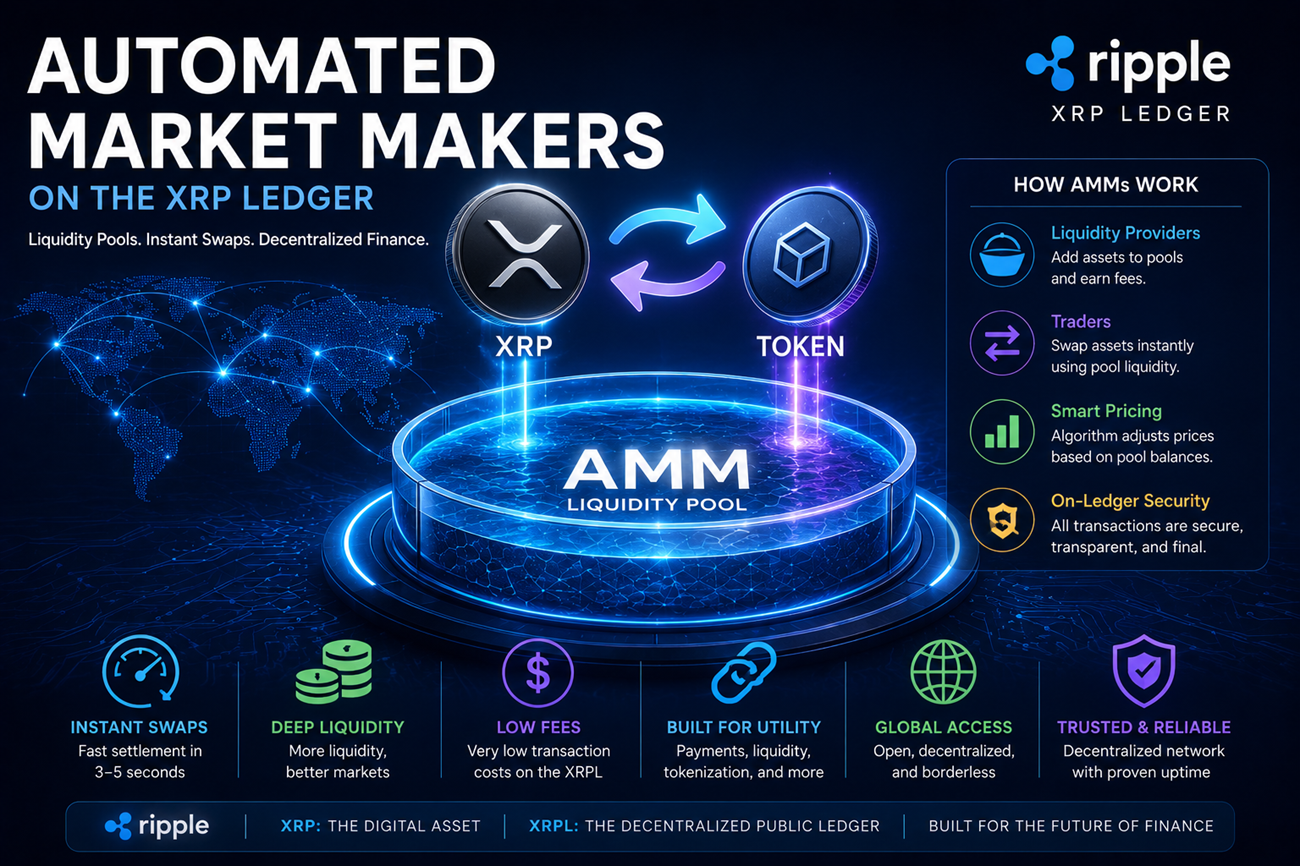
Automated Market Makers, often called AMMs, are a major part of decentralized finance. On the XRP Ledger, AMMs add liquidity pool functionality to an ecosystem that already includes a native decentralized exchange.
AMMs can help users swap assets, support liquidity, and create new pathways for XRP, issued currencies, stablecoins, and tokenized assets to move through the ledger.
Educational note: AMMs can support liquidity, but they also involve risk. Liquidity providers should understand price movement, pool behavior, fees, volatility, and possible loss before participating.
An Automated Market Maker is a system that allows assets to be traded through a liquidity pool instead of only through a traditional order book. Rather than matching one buyer directly with one seller, an AMM uses pooled assets and a pricing formula to allow swaps.
This can make trading possible even when there is not a perfect buyer-seller match available at that moment. For the XRPL, AMMs expand the ways liquidity can exist and move across the ledger.
A pool holds two assets that users can swap between, depending on available liquidity and pool pricing.
Users can trade from one asset to another through the pool without waiting for a direct matching order.
Users who add assets to a pool may receive a share of fees, but they also take on market and pool-related risks.
AMMs are one building block in DeFi because they help create on-chain liquidity and automated trading paths.
The XRP Ledger already includes a native decentralized exchange using order books. AMMs add another liquidity layer by allowing assets to trade through pools. This can increase the number of available paths for payments, swaps, tokenized assets, and cross-currency movement.
For XRP utility, liquidity matters because fast settlement only becomes powerful when value can also move efficiently between assets and markets. AMMs may help support that movement when pools are active and sufficiently funded.
The XRPL has long included a native decentralized exchange. This built-in DEX allows offers to be placed and matched on the ledger. AMMs do not replace the native DEX; they expand the liquidity tools available within the XRPL ecosystem.
Together, order books and AMM pools can create more possible routes for asset conversion. This matters for cross-currency payments, issued assets, stablecoins, tokenized value, and liquidity routing.
Buyers and sellers place offers that can be matched through the XRPL’s native decentralized exchange.
AMMs allow swaps through pooled liquidity using automated pricing.
The XRPL can search for available payment paths when moving value between assets.
Multiple liquidity sources may improve flexibility for payments, swaps, and asset movement.
Ripple often frames XRP around utility, including payments, liquidity, settlement, and tokenization. AMMs connect directly to that story because they may help create additional liquidity channels on the ledger.
When XRP is paired with other assets in liquidity pools, it may help bridge value between tokens, stablecoins, and issued assets. However, actual utility depends on real liquidity, real usage, market depth, adoption, and risk management.
XRP may be used in pools that help connect one asset to another through on-chain liquidity.
AMMs may support swaps involving stablecoins and issued currencies on the XRPL.
As tokenization grows, AMMs may help provide trading paths for tokenized forms of value.
More liquidity tools may help reduce friction when users need to move between different assets.
Tokenization is one of the major themes in modern blockchain finance. If assets such as stablecoins, funds, treasury products, credits, or real-world assets are issued on the XRPL, liquidity becomes essential.
AMMs may become part of that liquidity layer. For institutions, the question is not only whether a pool exists, but whether it meets requirements for compliance, custody, depth, transparency, risk controls, and regulated participation.
AMMs are useful educationally, but they are not risk-free. Liquidity providers may face losses when asset prices move. Traders may experience slippage if liquidity is thin. Pools may behave differently during volatile market conditions.
Liquidity providers can lose value compared with simply holding the assets if prices change significantly.
Large trades against shallow pools may receive worse prices than expected.
Rapid price movement can affect pool balances, trading costs, and liquidity provider outcomes.
Users should understand the assets, issuers, pool mechanics, and current XRPL rules before participating.
AMMs are only one part of the XRP Ledger. They work alongside accounts, transactions, issued currencies, trust lines, the native DEX, escrows, checks, payment channels, multi-signing, and consensus.
Understanding AMMs is easier when they are viewed as part of a larger financial architecture designed for payments, liquidity, and tokenized value movement.
See how the main parts of the XRP Ledger fit together.
Learn how validators help the ledger agree on valid transactions.
Review speed, fees, reliability, and scalability.
Return to the main utility-focused hub page.
Start with the beginner foundation.
Learn the basics of the XRP Ledger.
Understand why real use matters more than hype.
Verify current AMM and XRPL information through deeper resources.
A practical XRP valuation guide focused on utility, liquidity, and realistic assumptions.
An educational look at liquidity, value movement, and XRP utility.
Explore XRP in the institutional age of payments, regulation, and digital finance.
Browse Bruce Goldwell’s XRP book collection.
This page is for educational purposes only and is not financial advice. Automated Market Makers, liquidity pools, XRP, issued assets, tokenized assets, fees, market conditions, and regulations can change over time. Readers should verify current information through official Ripple, XRPL, exchange, regulatory, and independent research sources before making financial decisions or participating in any liquidity pool.