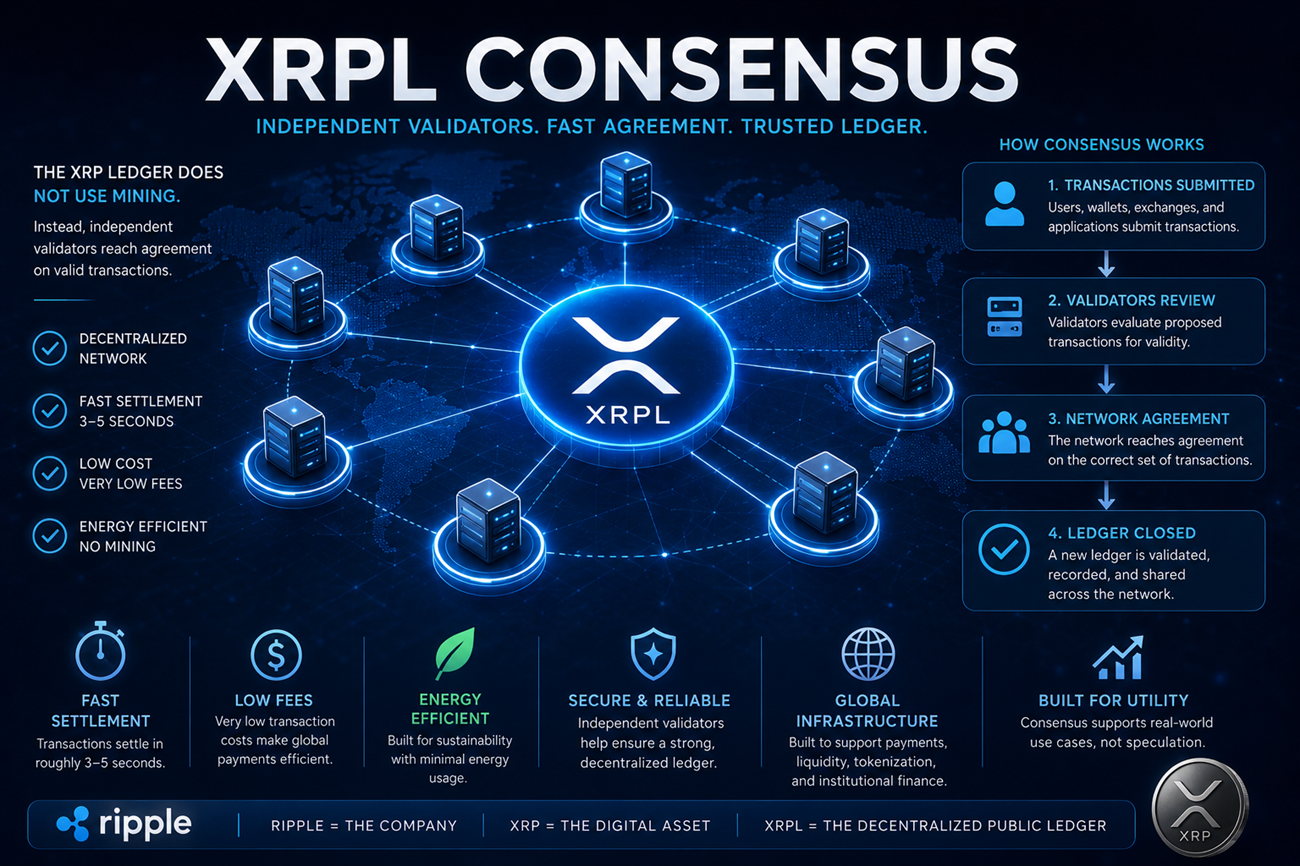
The XRP Ledger does not use mining. Instead, it uses a consensus process where independent validators help the network agree on which transactions are valid and should be included in the next ledger.
This consensus-based design is one reason the XRPL is known for fast settlement, low fees, and energy efficiency. Transactions commonly settle in roughly 3 to 5 seconds under normal network conditions.
Key idea: XRPL consensus is not proof-of-work mining. Validators do not compete to solve energy-intensive puzzles. They help the network agree on the next valid version of the ledger.
Consensus means agreement. On the XRP Ledger, validators evaluate proposed transactions and help determine whether the network should accept them into the next validated ledger.
The goal is to create a shared, reliable record of account balances, asset ownership, offers, settings, and transaction results without relying on a single central operator.
Users, wallets, exchanges, institutions, and applications submit transactions to the XRPL network.
Validators examine proposed transactions and participate in the agreement process.
When enough trusted agreement is reached, valid transactions are included in the next ledger.
The ledger updates, transaction results become final, and the network moves on to the next round.
Validators are servers that participate in the XRPL consensus process. They help confirm the correct order and validity of transactions so the network can maintain a shared ledger state.
Validators may be operated by universities, exchanges, businesses, developers, community members, and other independent participants. This diversity is important because the XRPL is designed to operate as a decentralized public ledger, not as a private company database.
Ripple may operate some infrastructure and build products that use XRP and XRPL technology, but the XRP Ledger itself is a decentralized public blockchain and is not controlled by Ripple.
Mining-based blockchains use proof-of-work, where miners compete to solve difficult computational puzzles. This can provide strong security, but it also requires significant energy use and may result in slower settlement.
The XRPL uses a different model. Validators do not mine new XRP, and they do not receive block rewards for solving puzzles. Instead, the network uses validator agreement to finalize transactions quickly and efficiently.
Miners compete using computing power. The process can be energy intensive and may take longer to reach final settlement.
Validators coordinate agreement on valid transactions without mining, helping support fast settlement and low fees.
XRP was created at ledger launch. New XRP is not mined into existence through validator rewards.
Because the XRPL does not rely on mining competition, its consensus process is designed to use far less energy.
Utility depends on more than a digital asset existing. For payments, liquidity, tokenization, and institutional finance, a network must process transactions reliably, settle quickly, and keep costs manageable.
XRPL consensus supports these goals by helping the ledger close quickly while maintaining a shared record of valid transactions. This makes the XRPL useful for payment flows, exchange activity, token movement, and liquidity routing.
Consensus helps the ledger reach finality in seconds rather than waiting for long confirmation periods.
Small XRP fees help prevent spam while keeping ordinary transactions inexpensive.
Validated ledgers create a clear history of balances, transactions, assets, and account settings.
Fast agreement can support payments, remittances, settlement, treasury movement, and tokenized asset activity.
A Unique Node List, often called a UNL, is a list of validators that a server uses when participating in consensus. Different servers can choose which validators they trust for consensus participation.
This design is part of how the XRPL coordinates agreement across independent participants. For most readers, the important point is simple: validators help the network agree on valid transactions, and servers use trusted validator lists to participate in that process.
Consensus mechanics can get technical quickly. The purpose of this page is to give readers a clear foundation before moving into deeper XRPL documentation and official technical resources.
A common misunderstanding is that XRP, Ripple, and the XRPL are the same thing. They are not. Ripple is a company, XRP is a digital asset, and the XRPL is the public decentralized ledger where XRP operates.
The XRPL’s consensus system depends on independent validators and network participants. Readers should evaluate decentralization by looking at validator diversity, network infrastructure, governance discussions, code development, and official XRPL resources.
The same ledger agreement process supports the XRPL’s native features. Payments, token transfers, decentralized exchange offers, AMM activity, escrows, checks, trust lines, and multi-signing all rely on the network agreeing on valid transaction results.
Learn how AMMs add liquidity pools to the XRP Ledger ecosystem.
Explore how issued assets and tokenized value can exist on the XRPL.
Review speed, fees, settlement, and transaction capacity.
Understand how compliance and liquidity may connect to institutional blockchain use.
Continue exploring how XRPL architecture, consensus, liquidity, and utility fit together.
Return to the main utility-focused hub page.
See how accounts, ledgers, validators, transactions, and native features work together.
Learn why liquidity matters for utility, payments, and valuation discussions.
Use official and educational resources to verify current XRPL information.
A practical XRP valuation guide that separates utility from unrealistic hype.
An educational look at XRP liquidity, value movement, and utility-based thinking.
A broader look at XRP, regulation, institutions, and digital finance.
Explore Bruce Goldwell’s XRP book collection.
This page is for educational purposes only and is not financial advice. Technology, validator participation, regulations, institutional adoption, liquidity, and market conditions can change over time. Readers should verify current details through official Ripple, XRPL, exchange, regulatory, and independent research sources before making financial decisions.