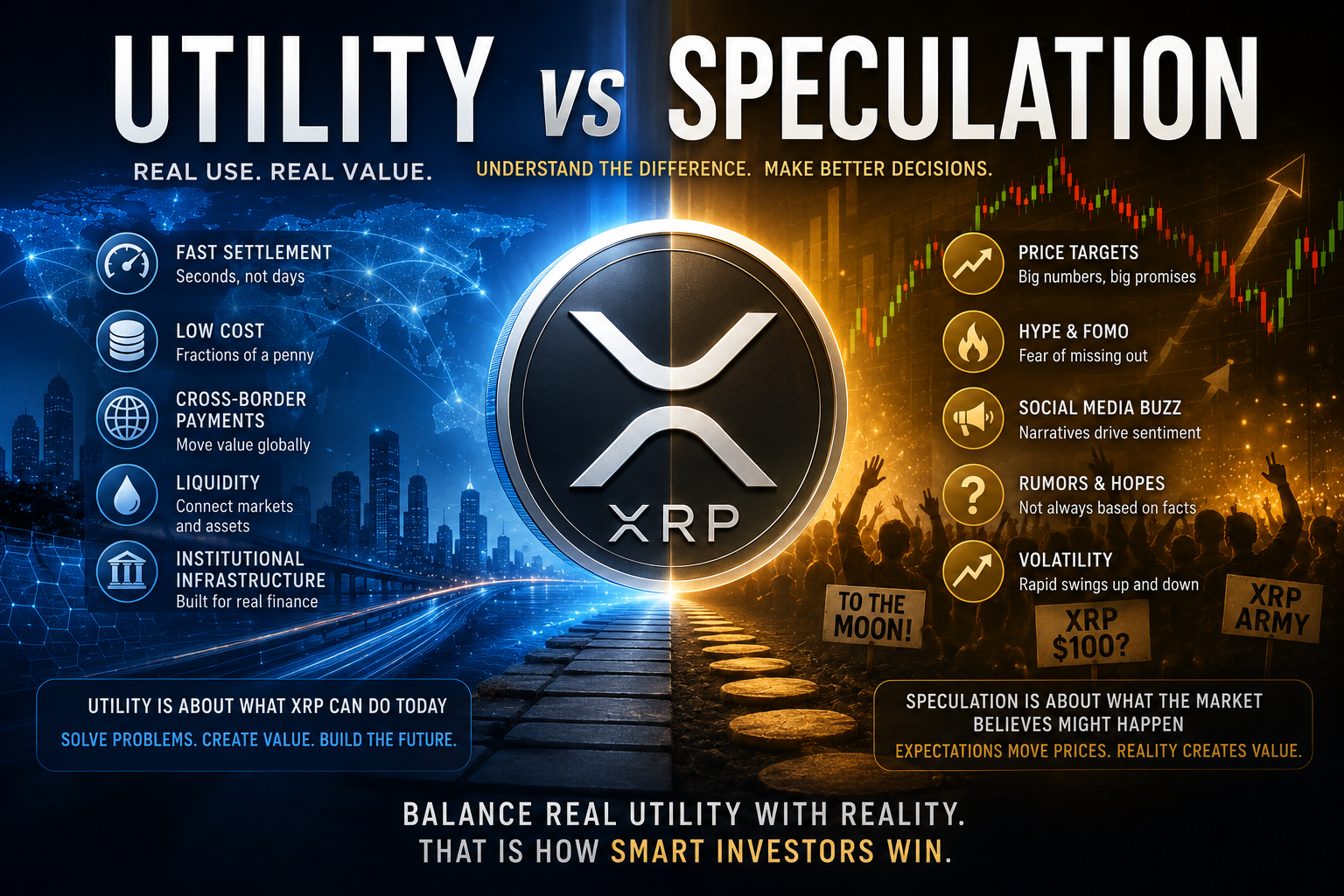
One of the most important questions in XRP valuation is the difference between utility and speculation. Utility asks what XRP is actually useful for. Speculation asks what investors believe XRP might be worth in the future.
Both can influence price, but they are not the same thing. Understanding the difference helps readers avoid hype, think more clearly, and evaluate XRP with a stronger foundation.
Utility means usefulness. For XRP, utility is often discussed in connection with fast settlement, low-cost transactions, cross-border payments, liquidity, tokenization, and efficient movement of value.
A digital asset has stronger utility when it solves a real problem. In XRP's case, the value proposition is tied to speed, settlement efficiency, liquidity movement, and the ability to help value move between systems.
Speculation means buying or selling based on expectations about the future. Speculation may be driven by news, social media, market cycles, regulatory hopes, institutional rumors, price charts, or investor emotion.
Speculation is not automatically bad. All markets contain speculation. The problem begins when speculation replaces understanding. A serious XRP investor should know the difference between a real use case and a hopeful price prediction.
| Category | Utility | Speculation |
|---|---|---|
| Focus | What XRP can actually do. | What investors believe XRP may be worth. |
| Driven By | Use cases, settlement, liquidity, adoption, infrastructure. | Emotion, narratives, news, price expectations, market cycles. |
| Timeframe | Usually develops over time. | Can move quickly. |
| Risk | Utility may grow slowly or face adoption barriers. | Speculation can create bubbles, panic, and overreaction. |
| Best Question | What problem does XRP solve? | What is the market expecting? |
A common mistake is assuming XRP must be either utility-driven or speculation-driven. In reality, both forces can exist at the same time.
Utility explains why XRP exists and what role it may play in payments, settlement, or liquidity.
Speculation can move price before, during, or after real adoption develops.
Investors often buy based on what they believe may happen in the future.
Over time, actual usage, adoption, and results test whether the market story was justified.
XRP transactions are designed to settle quickly on the XRP Ledger.
Very small transaction fees can make XRP practical for efficient movement of value.
XRP may help connect different currencies, payment corridors, or asset systems.
Liquidity is central to XRP's value discussion because it affects how efficiently value can move.
Predictions about XRP reaching a specific price are speculative unless supported by clear assumptions and realistic analysis.
Viral posts and influencer claims can create emotional buying, but excitement alone does not prove value.
News can move sentiment quickly, even when the real-world impact takes time to understand.
Bull markets can make every asset look promising, while bear markets can make useful technology seem forgotten.
Utility can influence valuation if it creates real demand. For XRP, that demand may come from payments, liquidity, settlement use, tokenized assets, institutional activity, or broader financial infrastructure.
However, utility alone does not automatically guarantee a specific price. The market must also consider supply, liquidity, competition, regulation, token reuse, investor demand, and overall market conditions.
Utility helps explain why XRP may matter. Speculation helps explain why the price may move. Valuation requires studying both.
Speculation can move XRP price quickly because markets respond to expectations. A rumor, lawsuit development, ETF discussion, partnership announcement, exchange listing, or broader crypto rally can shift sentiment.
But speculative moves can reverse quickly. That is why serious investors avoid making decisions based only on emotion or short-term excitement.
Which claims are supported by actual technology, usage, partnerships, or data?
Which parts of the valuation argument depend on future adoption or market behavior?
Has the market already reacted to the news, or is future demand still uncertain?
What risks could affect adoption, liquidity, regulation, or investor demand?
Useful technology can still be undervalued, overvalued, delayed, or misunderstood by the market.
Market psychology matters. Even strong utility can experience volatile speculative cycles.
Price predictions should be treated as assumptions, not facts.
Investor excitement is not the same as real-world usage.
Utility explains what XRP can do. Speculation explains what investors believe XRP may become. Both affect the market, but they should never be confused.
The strongest XRP analysis studies real use, liquidity, adoption, market psychology, regulation, supply, and risk together. That balanced approach is far more useful than relying on hype alone.