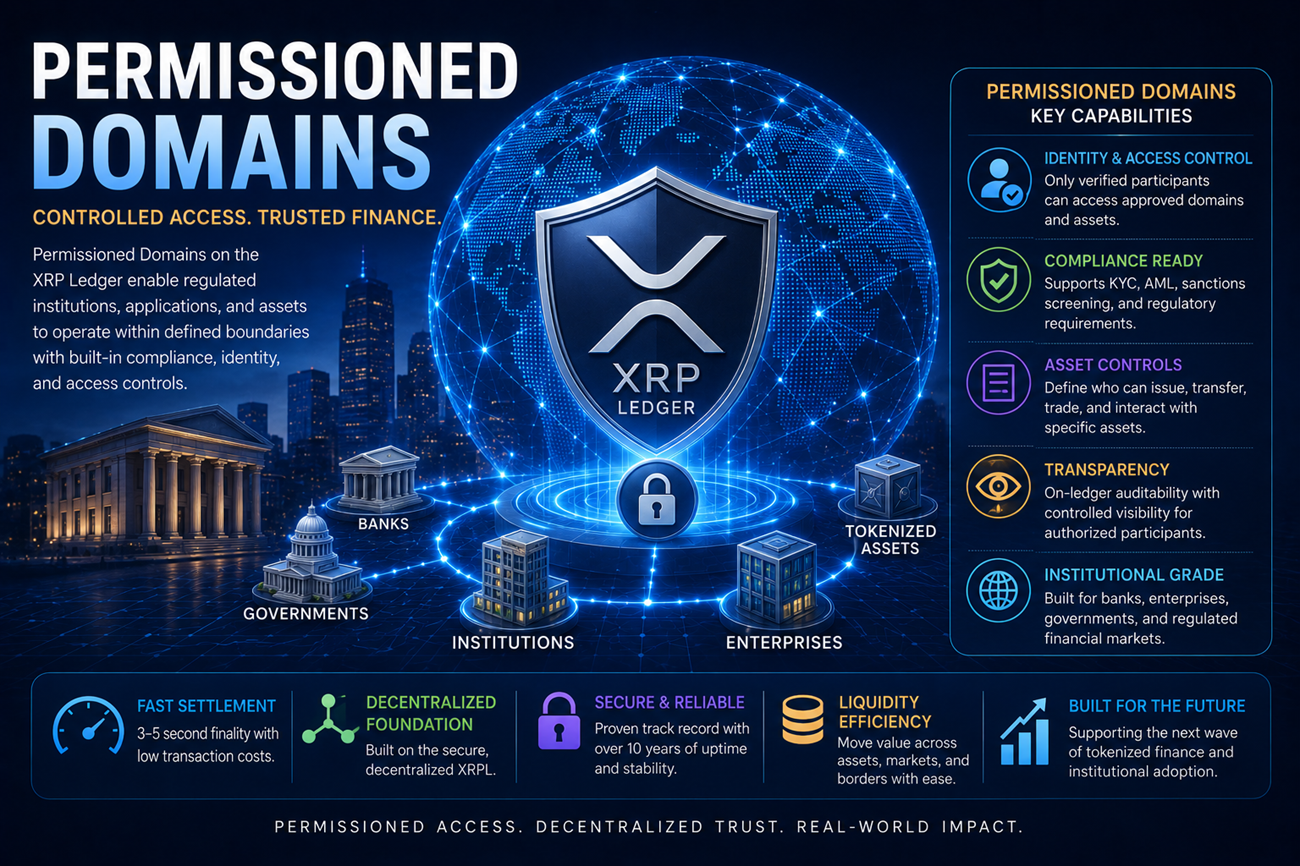
Permissioned Domains are designed to support controlled participation on the XRP Ledger. They may allow approved users, institutions, applications, or assets to interact within defined boundaries while still using blockchain-based settlement and ledger infrastructure.
This concept matters because regulated finance often requires identity controls, compliance rules, access management, reporting, and asset restrictions. Permissioned Domains may help bridge open blockchain technology with institutional requirements.
Educational note: Permissioned Domains are part of the evolving XRPL institutional finance discussion. Features, rules, adoption, and regulatory treatment may change over time. Always verify current details through official XRPL and Ripple resources.
A Permissioned Domain is a controlled environment where participation may be limited to approved accounts or entities. Instead of every user having access to every activity, the domain can define who may participate and under what conditions.
This can be useful when dealing with regulated assets, institutional markets, stablecoins, tokenized securities, or financial products that require compliance checks.
Only approved participants may interact with specific assets, services, or markets.
Domains may help institutions meet KYC, AML, sanctions, reporting, and jurisdictional requirements.
Certain tokens or issued assets may require transfer restrictions or approved participants.
Banks, funds, enterprises, and regulated firms may need controlled environments before entering on-chain finance.
Many financial institutions cannot operate in fully open environments without safeguards. They need to know who they are transacting with, what assets are involved, and whether transactions follow applicable rules.
Permissioned Domains may help create a framework where regulated activity can occur on blockchain rails while still respecting compliance obligations.
The bigger idea is choice: open blockchain activity can continue, while permissioned environments may support assets and participants that require additional controls.
Tokenization is expected to transform many areas of global finance. As traditional financial assets move onto blockchain networks, institutions need ways to control who may own, transfer, trade, or redeem those assets. Permissioned Domains provide one possible framework for supporting these requirements.
Rather than allowing unrestricted transfers, a Permissioned Domain can establish rules that govern participation while still benefiting from blockchain transparency and efficient settlement.
Stocks, bonds, or other regulated investment products may require approved ownership and transfer restrictions.
Certain stablecoin applications may operate within permissioned environments that support compliance and institutional settlement.
Institutional lending products may require verified participants and controlled access.
Permissioned Domains may support digital fund shares where investor eligibility rules apply.
Financial institutions often operate under regulations that require participant verification, transaction monitoring, recordkeeping, and audit capabilities. Permissioned Domains can help provide a blockchain environment where these requirements may be easier to implement.
Permissioned Domains do not change XRP itself. XRP remains the native digital asset of the XRP Ledger. Instead, Permissioned Domains define how certain applications, assets, or participants interact within regulated environments.
Depending upon the implementation, XRP may continue supporting liquidity, settlement, bridge transactions, and payment routing while permissioned rules govern who participates in particular markets.
Transactions may still settle using the XRP Ledger's fast consensus mechanism.
XRP may continue serving as a bridge between currencies and tokenized assets where appropriate.
Permissioned markets may benefit from XRP liquidity when approved participants require efficient asset conversion.
Participation rules apply to the environment—not to XRP itself.
Permissioned Domains are not intended to replace the public XRP Ledger. Instead, they provide additional options for organizations that cannot legally participate in unrestricted blockchain environments.
Anyone can create an account, hold XRP, submit transactions, and interact with supported public features.
Participation is limited to approved users or organizations according to defined rules.
Both environments use the XRP Ledger's blockchain technology for recording and settling transactions.
Public participation supports open innovation, while permissioned participation supports regulated financial activity.
Permissioned Domains may help expand blockchain adoption among institutions that previously could not participate due to compliance concerns.
Financial firms may feel more comfortable participating when access controls and compliance measures are available.
Permissioned environments may encourage banks, custodians, investment firms, and payment companies to explore blockchain-based finance.
Transactions may continue benefiting from the XRP Ledger's fast settlement capabilities.
Permissioned participation may support broader adoption of tokenized real-world assets.
Permissioned Domains represent an evolving area of blockchain development. Readers should continue researching how governance, compliance, identity management, privacy, custody, and interoperability develop over time.
The XRP Ledger ecosystem continues evolving. Permissioned features are one part of a much larger institutional roadmap that also includes tokenization, stablecoins, decentralized finance, and cross-border payments.
Permissioned Domains are one part of the XRP Ledger's expanding institutional ecosystem. Continue your learning by exploring the pages below.
Learn how regulated trading environments may support compliant digital asset markets.
Explore how decentralized finance is evolving for banks, financial institutions, and regulated enterprises.
Discover how real-world assets, stablecoins, and digital securities may operate on blockchain networks.
Understand how liquidity pools complement the XRPL's native decentralized exchange.
Learn how validators, consensus, accounts, and ledger objects work together.
Explore settlement speed, low fees, throughput, reliability, and scalability.
Understand why liquidity is central to payments, settlement, and institutional adoption.
Continue your education using official XRPL resources and independent research.
Bruce Goldwell's XRP book collection explores XRP from educational, technical, valuation, and institutional perspectives.
A practical look at XRP valuation beyond unrealistic price predictions, focusing on utility, liquidity, and adoption.
Explore how liquidity, tokenization, settlement, and institutional participation may influence XRP's role in digital finance.
An overview of XRP's expanding ecosystem during the institutional era of blockchain adoption.
Browse the growing library of educational books covering XRP, blockchain, tokenization, liquidity, and institutional finance.
Permissioned Domains illustrate how blockchain technology is evolving beyond early cryptocurrency use cases. Instead of forcing every application into a single model, future blockchain ecosystems may support both open participation and regulated financial environments.
The XRP Ledger is increasingly being discussed as infrastructure capable of supporting payments, liquidity, tokenized assets, stablecoins, institutional settlement, and compliant financial applications. Permissioned Domains represent one building block within that broader vision.
As blockchain technology matures, the focus is gradually shifting from simply creating digital assets to building complete financial infrastructure capable of supporting governments, enterprises, banks, investment firms, payment providers, and global markets.
Permissioned Domains are intended to explain how blockchain technology may evolve to support regulated participation while preserving many of the benefits of decentralized ledger technology. They are one component of the XRP Ledger's broader institutional roadmap, alongside tokenization, stablecoins, decentralized finance, liquidity management, and enterprise payments.
Readers should view this page as an educational overview rather than a prediction of future adoption. Technology, regulations, implementation details, and institutional participation continue to evolve. Always consult official XRPL documentation and trusted financial resources for the latest information.
This page is provided for educational purposes only and should not be considered financial, investment, legal, or regulatory advice. Permissioned Domains, institutional blockchain infrastructure, tokenized assets, compliance frameworks, XRP, and XRP Ledger features continue to evolve. Readers should verify all current information through official Ripple, XRPL Foundation, regulatory agencies, financial institutions, and independent research before making investment or business decisions.