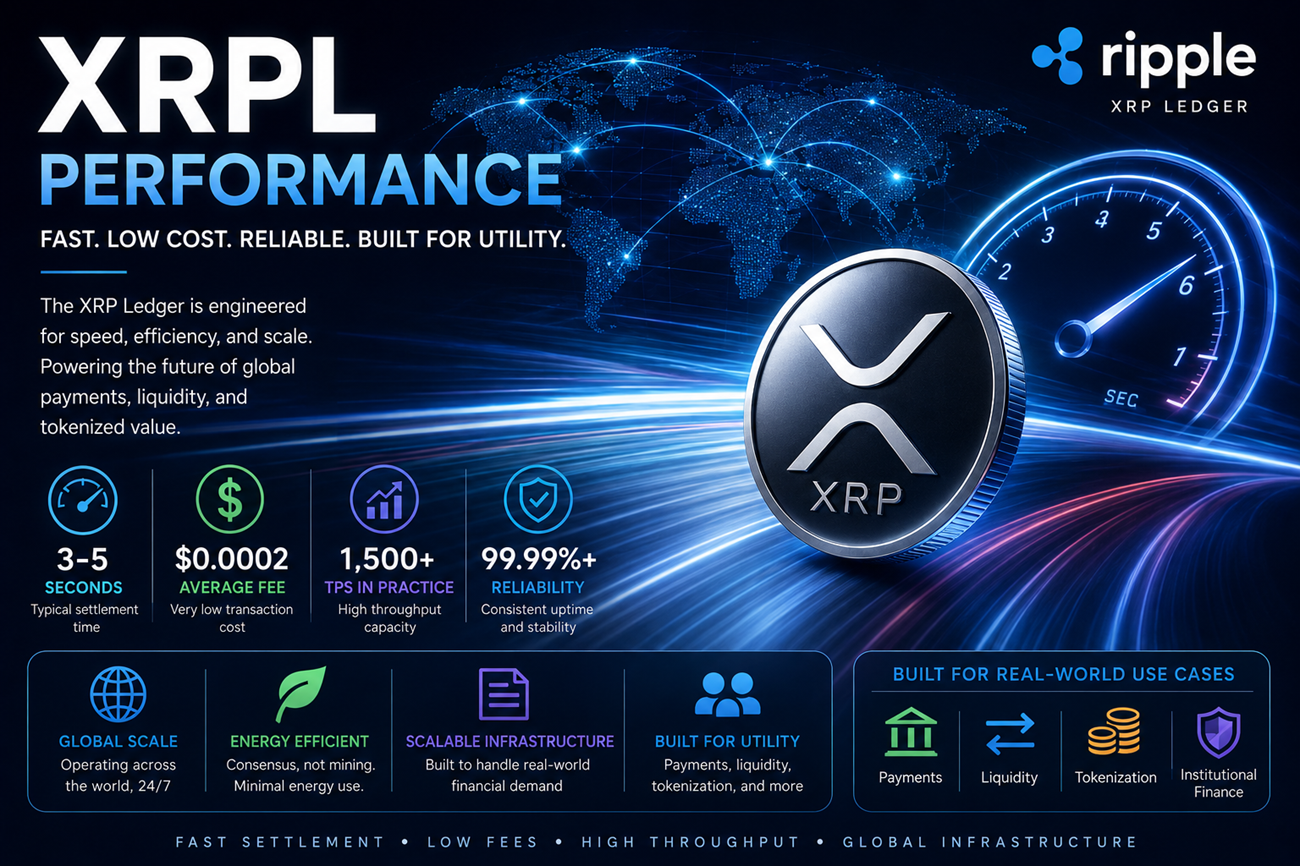
The XRP Ledger is known for fast settlement, low transaction costs, and efficient value movement. Its performance is one of the reasons XRP is often discussed in connection with payments, liquidity, settlement, tokenization, and institutional financial infrastructure.
This page explains XRPL performance in plain language and shows why speed, cost, reliability, and scalability matter when evaluating real-world blockchain utility.
Important: Performance figures can change over time. Transaction speed, fees, network activity, throughput, and adoption metrics should always be verified through current Ripple, XRPL, explorer, and official ecosystem resources.
Performance is not just about how fast a blockchain can process a single transaction. For real-world financial use, performance includes settlement finality, transaction cost, network reliability, energy efficiency, liquidity access, and the ability to support many different types of value movement.
XRPL transactions commonly settle in roughly 3 to 5 seconds under normal network conditions.
Transaction fees are typically very small, helping keep payments and transfers efficient.
The XRPL is designed to handle high transaction activity compared with many older blockchain networks.
A performance-focused ledger must operate consistently over time, not only during ideal conditions.
Settlement speed matters because financial systems need certainty. When a transaction settles quickly, users and institutions can know that value has moved without waiting for long confirmation periods.
The XRPL’s consensus-based design allows ledgers to close quickly. This fast settlement can be useful for payments, remittances, exchange movement, treasury operations, liquidity routing, and tokenized asset transfers.
Low transaction costs are important for utility. A blockchain that is too expensive to use may be difficult to apply to everyday payments, frequent transfers, microtransactions, or high-volume institutional activity.
On the XRP Ledger, transaction fees are designed to be very small. Fees also help protect the network from spam by requiring each transaction to burn a tiny amount of XRP.
Low fees do not guarantee adoption by themselves. Real adoption also depends on liquidity, regulation, integrations, user demand, institutional confidence, and the usefulness of applications built around the ledger.
Throughput refers to how many transactions a network can process in a given period of time. Scalability refers to whether a network can continue operating effectively as usage grows.
XRPL is often described as capable of handling high transaction activity, but readers should treat specific transaction-per-second figures as time-sensitive and verify current information through official XRPL resources. The more important educational point is that performance must support real demand, not just theoretical numbers.
High throughput can help support frequent payment activity across users, businesses, exchanges, and institutions.
Fast processing helps value move between markets, exchanges, currencies, and digital assets.
As tokenization grows, networks may need to support frequent asset transfers, redemptions, settlements, and trading activity.
Institutions often need predictable performance, reliable settlement, and infrastructure that can operate under real market conditions.
The XRPL does not use proof-of-work mining. Instead, it uses consensus among validators, which allows it to operate without energy-intensive mining competition.
Energy efficiency matters for financial institutions, enterprises, regulators, and sustainability-focused users. A network that can settle value quickly without mining may be more attractive for certain payment and infrastructure use cases.
Speed and low fees are important, but liquidity is what allows value to move at scale. A fast ledger still needs active markets, available buyers and sellers, deep order books, AMM pools, exchange access, and institutional participation.
This is why XRP utility discussions often connect performance with liquidity. If XRP is used as a bridge asset, settlement speed and market depth both matter.
Performance allows value to move quickly once a transaction is submitted and validated.
Liquidity determines whether large value transfers can happen efficiently without excessive price movement.
Native exchange features and automated market makers can support additional liquidity paths on the XRPL.
Enterprise payment and treasury use cases require both reliable settlement and sufficient liquidity.
Reliability is one of the most important performance factors for financial infrastructure. A payment network must work consistently, maintain accurate records, and provide a dependable history of validated transactions.
The XRPL records validated ledgers over time, creating a public history of transaction activity, account balances, issued assets, offers, and other ledger objects. This history helps users, developers, exchanges, researchers, and institutions examine network activity.
Reported network statistics, transaction counts, wallet counts, value moved, and market data should be treated as current only at the time they are published. Always check live data sources for the latest figures.
Utility depends on whether a network can solve real problems. For XRP and the XRPL, performance is tied to the ability to move value quickly, cheaply, and reliably.
Payments, remittances, tokenized assets, exchange settlement, treasury movement, and institutional DeFi all require infrastructure that can perform under real conditions. Performance does not guarantee success, but weak performance can limit adoption.
Fast settlement and low fees can help reduce friction in international value movement.
Low-cost settlement can support payment corridors where speed and cost matter to users.
Institutions may use digital infrastructure to move funds more efficiently across accounts and markets.
Tokenized assets need networks that can handle issuance, transfers, trading, redemption, and settlement activity.
Use these pages to continue learning how XRPL performance connects to architecture, consensus, liquidity, tokenization, and XRP utility.
Return to the main XRP utility hub.
Learn how the XRP Ledger is structured.
Understand how validators help the ledger reach agreement.
Explore tokenized assets and issued value on the XRPL.
Separate real network use from market hype.
Verify current information and continue deeper research.
A practical XRP valuation guide focused on utility, liquidity, and realistic assumptions.
An educational look at value movement, liquidity, and XRP utility.
Explore XRP in the institutional age of payments, regulation, and digital finance.
Browse Bruce Goldwell’s XRP book collection.
This page is for educational purposes only and is not financial advice. XRPL performance, network statistics, transaction fees, throughput, adoption, liquidity, and market conditions can change over time. Readers should verify current information through official Ripple, XRPL, exchange, regulatory, and independent research sources before making financial decisions.