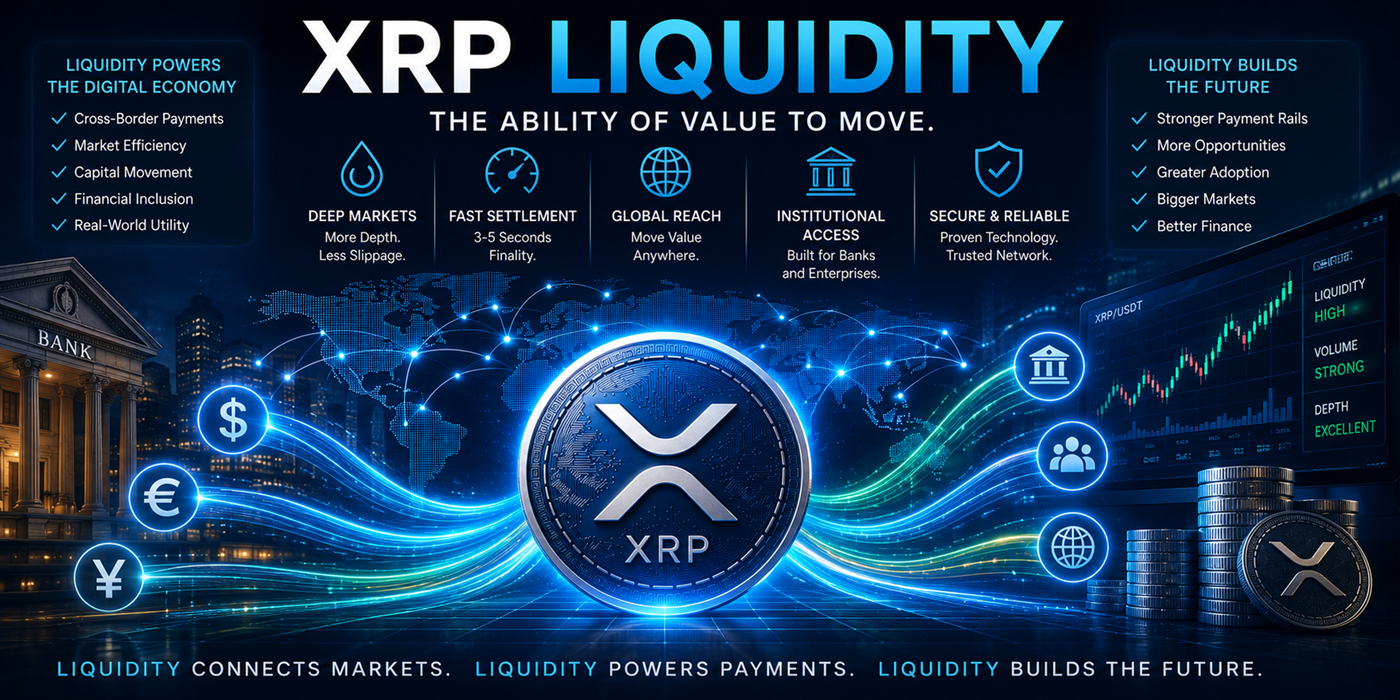
Liquidity is one of the most important ideas in the XRP conversation. In simple terms, liquidity means how easily value can move, trade, convert, or settle without major friction.
When people discuss XRP, cross-border payments, institutional adoption, exchanges, settlement, and financial rails, liquidity is often at the center of the conversation.
Liquidity is the ability to move in and out of an asset, currency, or market efficiently. A highly liquid market has enough buyers, sellers, volume, access, and confidence to support transactions without large disruption.
In the XRP ecosystem, liquidity matters because XRP is often discussed as a digital bridge for value movement. If value is going to move quickly between currencies, markets, or institutions, there must be enough liquidity to support that movement.
Market depth means there are enough buyers and sellers at different price levels to support larger transactions.
Volume shows how much trading activity is happening. Higher volume can help markets become easier to enter and exit.
Liquidity improves when more exchanges, institutions, payment providers, and users can access an asset.
Markets become more liquid when participants trust the infrastructure, regulation, custody, settlement process, and long-term usefulness.
Payments require value to move efficiently. Liquidity helps determine whether an asset can support that movement at scale.
Settlement is about completing a transaction. Liquidity helps value reach the right place at the right time.
Institutions need reliable liquidity before they can seriously evaluate large-scale market participation or payment use cases.
Liquidity can influence valuation because deeper markets may support larger use cases, stronger confidence, and broader participation.
Cross-border payments often involve different currencies, banks, payment networks, time zones, fees, compliance steps, and settlement systems. Liquidity is important because value must be available where it is needed.
XRP is often discussed as a bridge asset because it may help explain how digital value could move between currencies or payment corridors more efficiently. However, that idea depends on real liquidity, real demand, strong infrastructure, and practical adoption.
| Type | What It Means | Why It Matters |
|---|---|---|
| Exchange Liquidity | Buyers, sellers, volume, and trading depth on exchanges. | Supports access, trading, and price discovery. |
| Payment Liquidity | Ability to move value between currencies or payment corridors. | Important for cross-border payment use cases. |
| Institutional Liquidity | Infrastructure large organizations need for custody, compliance, and execution. | Helps institutions participate with greater confidence. |
| Network Liquidity | Value available across wallets, users, apps, markets, and ledger activity. | Supports broader digital asset utility and adoption. |
Social media excitement may bring new buyers and short-term activity, but hype alone does not create reliable long-term liquidity.
Real liquidity depends on exchanges, market makers, custody, compliance, settlement systems, institutional access, and trusted rails.
Markets can become more liquid during strong cycles and less liquid during downturns, uncertainty, or regulatory stress.
Better liquidity may support healthier markets, but it does not guarantee a specific XRP price or investment outcome.
Liquidity is one reason XRP valuation discussions can become complicated. If XRP is studied as a bridge asset or settlement tool, researchers must ask how much liquidity would be needed to support meaningful use.
A serious valuation discussion should examine payment volume, available liquidity, market depth, demand, supply, institutional access, regulation, and whether real-world use is actually growing.
No. Liquidity can improve market function, but price depends on supply, demand, market cycles, sentiment, adoption, regulation, and many other factors.
Institutions need to move larger amounts of value with reliability, compliance, low friction, and manageable market impact.
Some use cases may exist at smaller scales, but large-scale payment or institutional use generally requires deeper liquidity and stronger infrastructure.
Cross-border payments require value to move between currencies and markets. Liquidity helps make that movement possible.
Explore how liquidity connects to moving value across countries and currencies.
Learn why institutions need reliable liquidity before large-scale adoption.
Study how liquidity fits into practical valuation and market research.
Understand the network layer where XRP transactions and digital value movement occur.
Explores institutional adoption, liquidity, and the multiplier effect often discussed around XRP.
A grounded guide to practical valuation, liquidity, risk, and realistic expectations.
A deeper look at institutions, liquidity, and the changing financial system.
Connects ISO 20022, XRP, and the next financial revolution.
XRP liquidity matters because the future of digital finance depends on movement: movement between currencies, institutions, payment systems, markets, and people. The stronger the liquidity infrastructure, the stronger the foundation for real-world use.