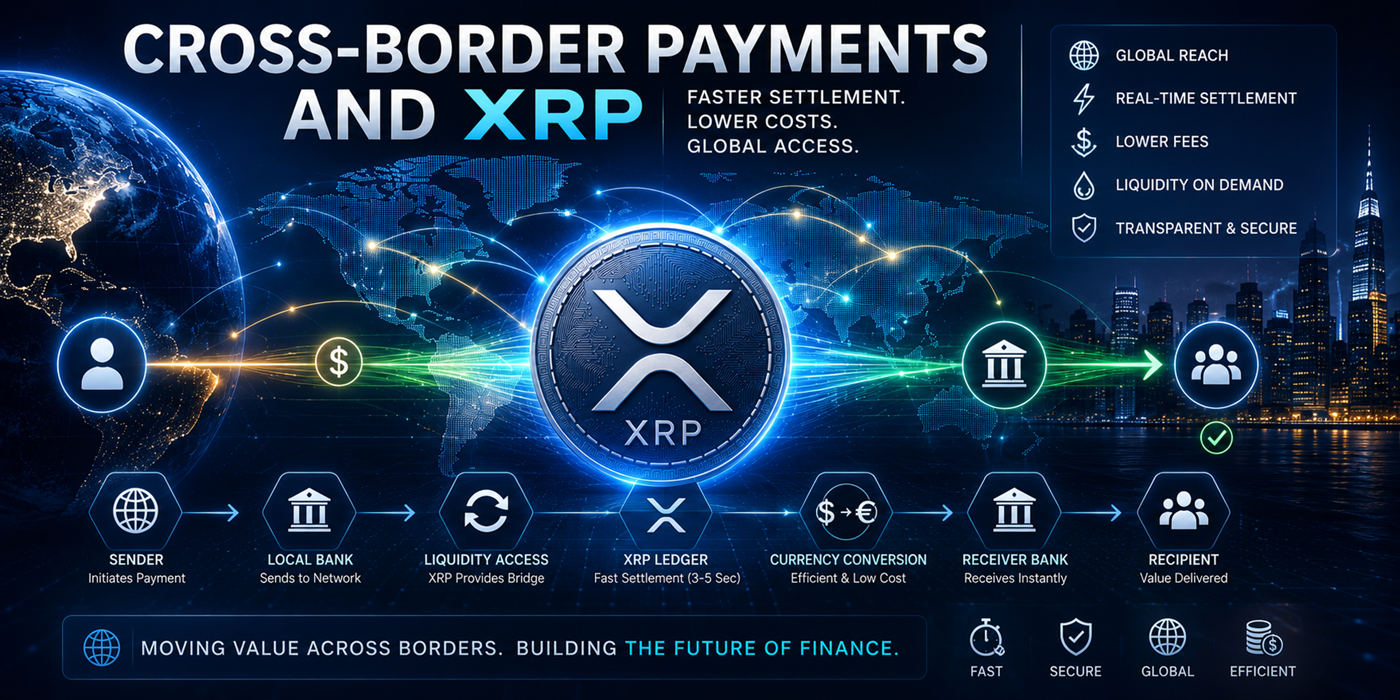
Cross-border payments are payments that move value from one country to another. They may involve different currencies, banks, payment networks, compliance checks, exchange rates, intermediaries, and settlement systems.
XRP is often discussed in this area because of its connection to fast settlement, liquidity, digital value movement, and the possibility of more efficient global financial rails.
Sending money across borders is often more complicated than sending money inside one country. A payment may pass through multiple banks, payment processors, currency exchanges, and compliance systems before it reaches the final recipient.
XRP enters the conversation because digital assets and blockchain networks offer a different way to think about moving value. Instead of relying only on slow legacy rails, value may be able to move across digital networks with faster settlement and lower friction.
International payments often require one currency to be exchanged for another, which can add cost, delay, and complexity.
Payments may pass through several banks or processors before reaching the final recipient.
Traditional systems may take time to finalize payments, especially across borders and time zones.
Banks and payment providers must follow rules, verify information, manage risk, and meet regulatory requirements.
XRP is often discussed because transactions on the XRP Ledger can settle quickly compared with many traditional payment processes.
XRP is sometimes described as a possible bridge asset because it can be studied as a way value might move between currencies, markets, or payment corridors.
Liquidity matters because cross-border value movement requires enough market depth and access to support conversion and settlement.
XRP and XRPL are part of the larger digital finance conversation about how value may move across future financial infrastructure.
| Topic | Traditional Cross-Border Payments | Digital Value Movement |
|---|---|---|
| Process | May involve banks, intermediaries, clearing, and settlement networks. | May use digital ledgers, assets, APIs, and faster settlement networks. |
| Timing | Can take time depending on countries, systems, and compliance steps. | Designed around faster digital settlement and value movement. |
| Liquidity | Often depends on banking relationships and pre-funded accounts. | May depend on digital asset liquidity, exchanges, corridors, and market depth. |
| Data | Payment information can vary between systems and formats. | May connect with richer messaging, digital records, and modern infrastructure. |
Liquidity is the heart of international value movement. If a payment needs to move from one currency into another, the system must have access to enough value, market depth, and exchange capacity to complete that movement efficiently.
This is why XRP liquidity is so important to study. A bridge asset idea only becomes meaningful if there is enough liquidity, access, compliance, and infrastructure to support real payment flows.
The core problem is moving value across countries, currencies, and systems with less friction, lower cost, faster settlement, and reliable compliance.
Banks, remittance companies, payment providers, businesses, marketplaces, exporters, freelancers, and families may all depend on cross-border payment systems.
Liquidity determines whether value can move efficiently at meaningful scale.
Serious research should distinguish between theory, interest, pilots, partnerships, limited use, and real production usage.
Speed is important, but institutions also need compliance, reliability, liquidity, risk controls, custody, and integration.
Payment systems require more than technology. They require trust, legal clarity, networks, users, standards, and operational support.
A bridge asset concept depends on deep, accessible, reliable liquidity across the payment corridors being served.
Cross-border payment utility should be studied separately from short-term market price predictions and social media excitement.
Understand why liquidity is essential for cross-border payment movement.
Learn about the financial messaging standard connected to modern payment systems.
Explore how institutions affect payment rails, custody, compliance, and adoption.
Study how banks and financial systems connect to XRP discussions.
Connects ISO 20022, XRP, banking modernization, and the next financial revolution.
Explores institutional adoption, liquidity, and XRP's role in financial movement.
A cryptocurrency investing guide focused on institutional shifts and digital finance.
Studies liquidity, institutions, and how global finance may be changing.
XRP matters in this conversation because the future of finance depends on faster, more efficient, more connected value movement. The key questions are liquidity, adoption, infrastructure, regulation, and real-world use.