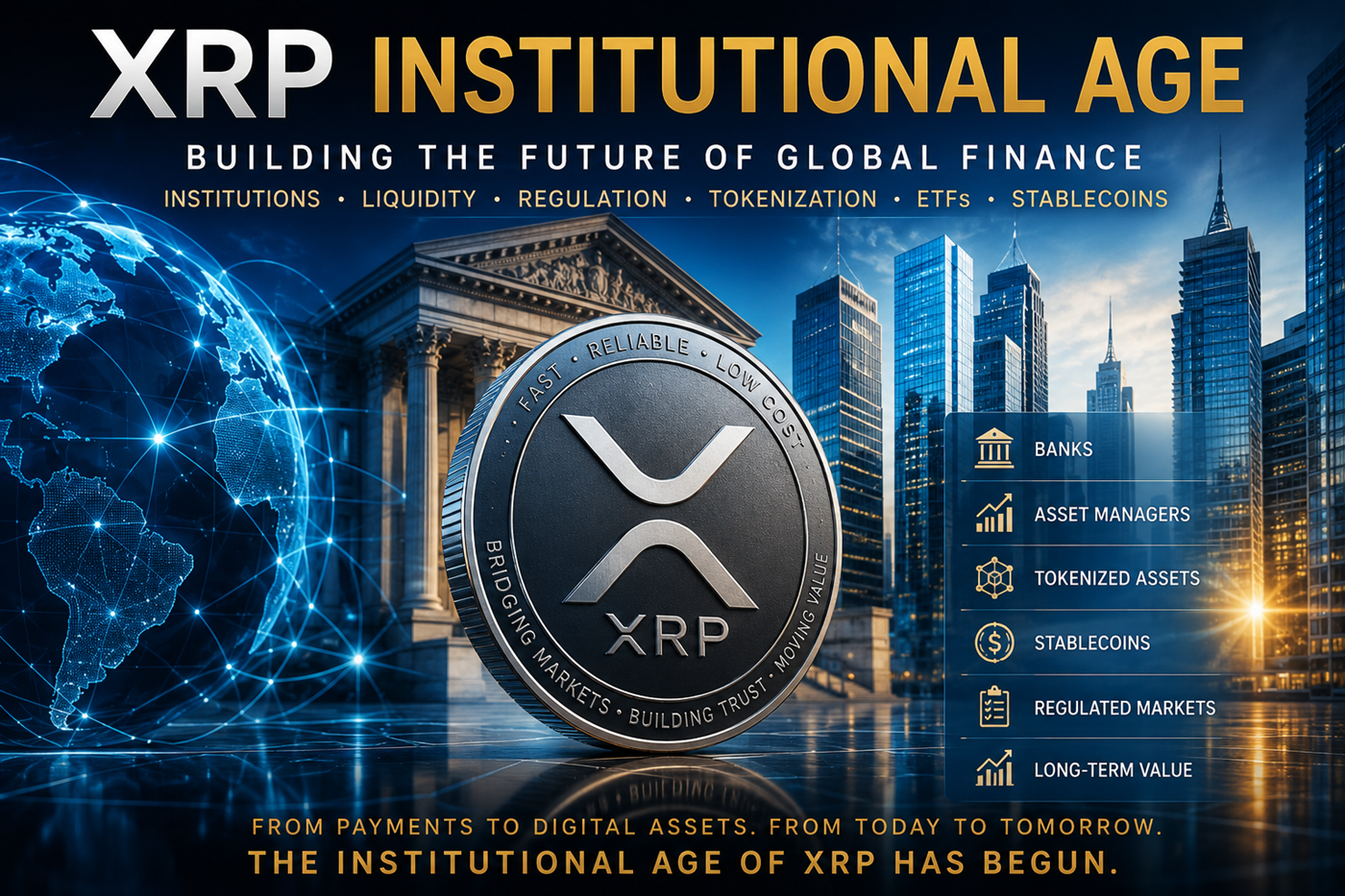
The next phase of digital finance may be shaped less by retail excitement and more by institutional adoption. Banks, asset managers, payment providers, fintech companies, ETF issuers, and regulated financial platforms are all studying how blockchain technology may improve settlement, liquidity, and asset movement.
For XRP, the institutional age is about more than price. It is about infrastructure, access, regulation, liquidity, tokenization, and the possibility that digital assets may become part of mainstream finance.
The institutional age refers to the period when digital assets move beyond early adopters and retail traders into regulated financial products, enterprise infrastructure, payment systems, asset tokenization, and professional investment portfolios.
This does not mean every institution will use XRP. It means the conversation around XRP increasingly includes professional finance topics such as custody, compliance, liquidity, market structure, tokenized assets, ETFs, and regulatory clarity.
Institutions can bring larger pools of capital, broader investor access, and professional market participation.
Institutional involvement often requires stronger custody, compliance, reporting, and infrastructure.
Deeper participation may improve market depth, trading efficiency, and the ability to move value.
Institutional attention can increase awareness, but it should still be evaluated with realistic expectations.
Exchange-traded funds may allow traditional investors to gain XRP exposure through brokerage accounts.
ETF CenterReal-world assets such as bonds, funds, real estate, and financial instruments may increasingly move on-chain.
Future RoadmapStablecoins may become important settlement tools and liquidity layers within digital finance ecosystems.
Research LibraryXRP is often studied for fast settlement and efficient movement of value across markets.
How XRP Works| Retail Hype | Institutional Thinking |
|---|---|
| Focuses heavily on price predictions. | Focuses on utility, custody, compliance, liquidity, and market structure. |
| Often driven by social media excitement. | Often driven by due diligence and risk review. |
| May react quickly to headlines. | Moves more slowly due to regulation and internal approval processes. |
| Asks, “How high can it go?” | Asks, “What problem does this solve, and can it scale?” |
Institutional adoption can influence XRP valuation, but not automatically. Serious valuation asks how adoption might create demand, improve liquidity, strengthen market confidence, or expand real use.
A stronger institutional environment may help XRP if it supports deeper liquidity, broader access, regulatory clarity, and practical financial use. But each claim should be evaluated carefully.
Institutional headlines should be examined carefully. Awareness is not the same as active use.
Liquidity is one of the most important institutional questions for XRP.
ETFs, regulated custody, and brokerage products may make XRP easier for traditional investors to access.
Regulation, competition, market cycles, and adoption delays can still affect outcomes.
The institutional age is not about instant certainty. It is about watching how digital assets move into regulated finance, professional investment products, tokenized markets, liquidity systems, and global payment infrastructure. For XRP, that makes education more important than ever.