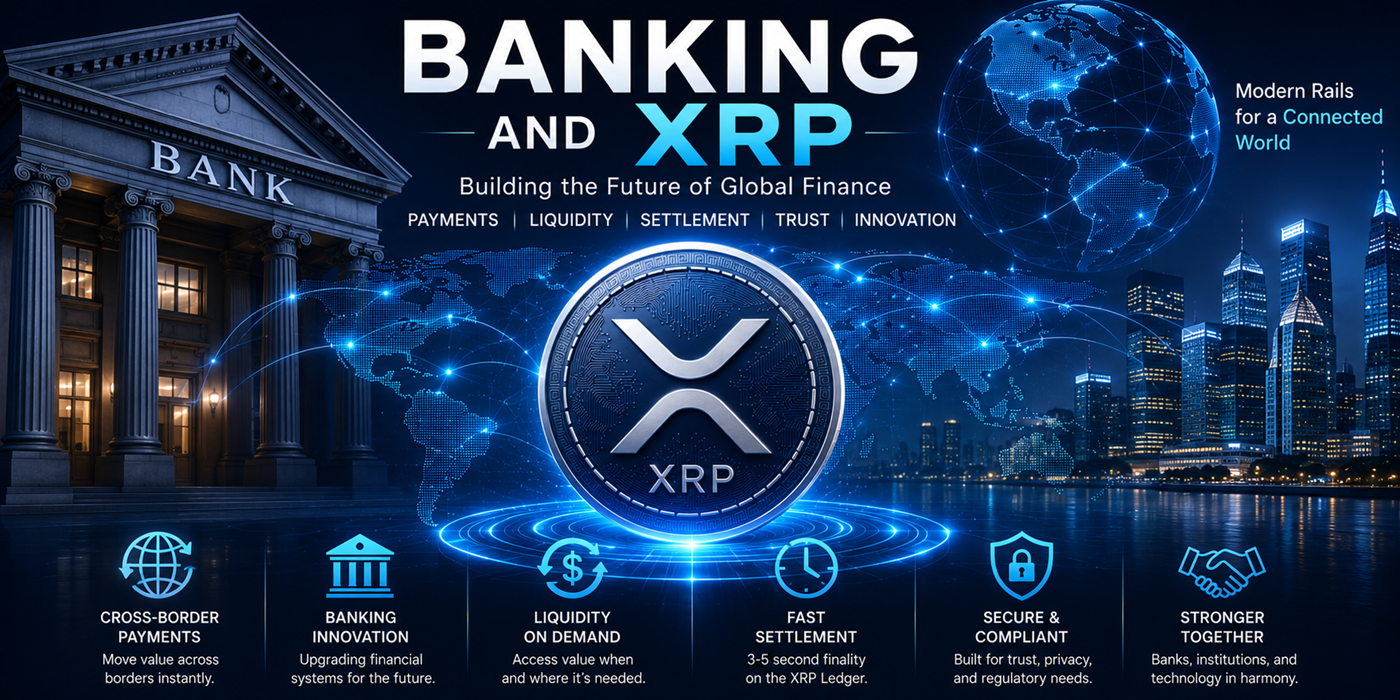
Banking and XRP is one of the central themes in the XRP conversation. Readers often want to understand how a digital asset could relate to banks, payment systems, settlement, liquidity, and the modernization of global financial rails.
This page explains the banking connection in plain language, without treating speculation, rumors, or headlines as guarantees.
Banks move money, manage accounts, provide payment services, settle transactions, handle compliance, and connect people and businesses to the financial system. XRP is often discussed because it represents a different way to think about moving value across digital networks.
The key question is not simply whether banks “like XRP.” The better question is whether XRP, XRPL, liquidity, and digital asset infrastructure can solve real problems in payments, settlement, and financial modernization.
Banks help move money between individuals, businesses, institutions, and countries.
Settlement is the final completion of a transaction. Faster settlement is a major topic in modern finance.
Banks must follow rules, monitor risk, verify customers, and meet regulatory obligations.
Banks remain important because financial systems depend on trust, security, access, and reliability.
XRP is often discussed in relation to international payments because traditional cross-border transfers can involve delays, costs, intermediaries, and currency conversion.
Banks and payment providers need liquidity to move value efficiently. XRP is often studied as a possible bridge asset in liquidity discussions.
Financial institutions care about settlement speed, reliability, cost, and finality. XRP and XRPL are often discussed through this lens.
Banking systems are evolving. Digital assets, tokenization, stablecoins, ISO 20022, and blockchain networks are part of the larger modernization conversation.
| Topic | Traditional Banking Rails | Digital Finance Rails |
|---|---|---|
| Speed | Can involve delays depending on systems, banks, and countries. | Designed around faster digital settlement and value movement. |
| Data | Payment information may vary between older systems. | Can connect with richer data standards and digital records. |
| Liquidity | Often depends on pre-funded accounts and banking relationships. | May involve digital assets, exchanges, market depth, and on-demand liquidity models. |
| Access | Usually controlled through banks and traditional financial institutions. | May expand through digital wallets, custodians, exchanges, and blockchain networks. |
That depends on the use case. Banks may explore many tools for payments, liquidity, settlement, messaging, compliance, and tokenization. XRP is one possible part of the digital finance conversation, not an automatic answer for every bank.
Yes. Banks can study or use different blockchain systems, stablecoins, tokenized assets, private ledgers, messaging standards, and payment technologies. XRP must be evaluated by its specific utility and adoption pathway.
XRP has long been discussed around payments and liquidity, and Ripple has focused heavily on financial technology and institutional payment solutions.
No. Price depends on many forces including demand, supply, liquidity, regulation, market cycles, sentiment, access, and actual usage.
Learn why international payment systems are central to the XRP banking conversation.
Explore why liquidity matters for banks, payments, settlement, and institutional adoption.
Understand the financial messaging standard connected to banking modernization.
Study how real-world assets and financial instruments may move onto digital rails.
Connects ISO 20022, XRP, banking modernization, and the next financial revolution.
Explores liquidity, institutions, and the future of global finance.
Looks at how institutions may be building the next generation of financial rails.
A grounded book focused on practical valuation and realistic assumptions.
XRP matters in the banking conversation because financial systems are being upgraded. The real questions are utility, liquidity, regulation, adoption, compliance, and whether digital rails can move value more efficiently than older systems.