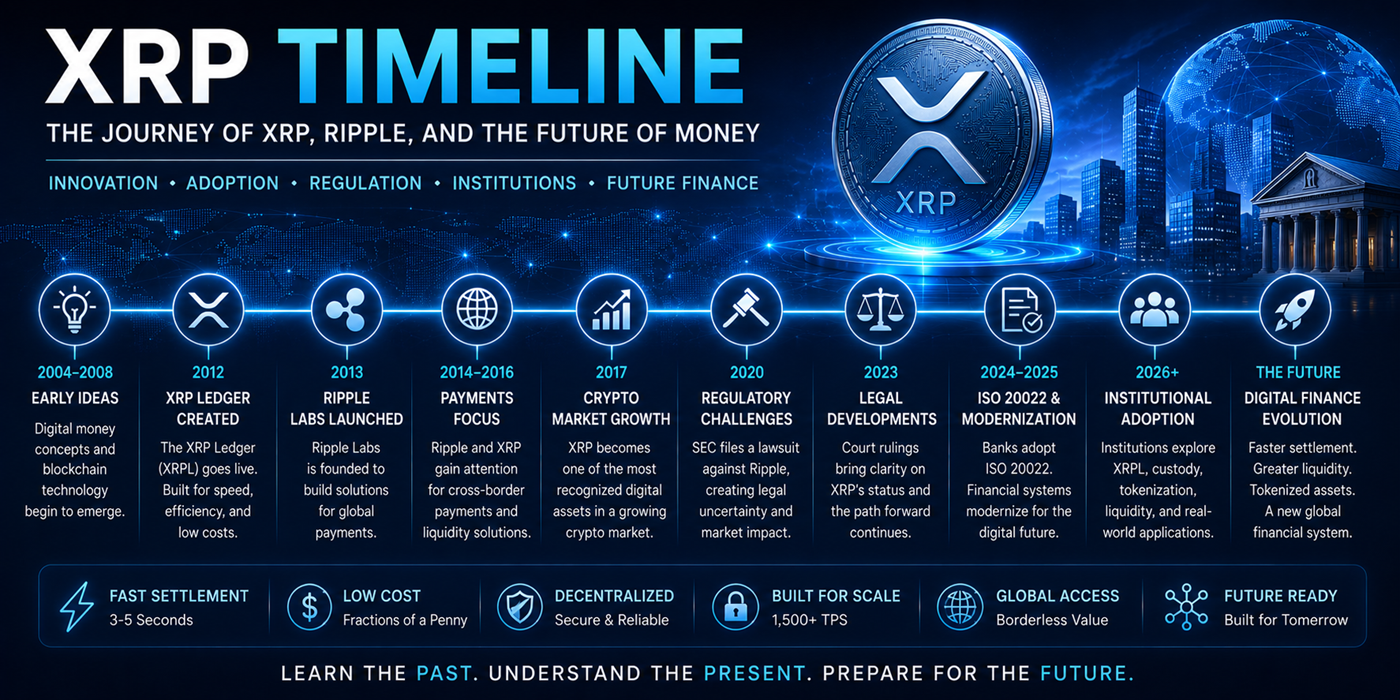
The XRP Timeline helps readers understand how XRP, Ripple, the XRP Ledger, regulation, ISO 20022, institutional adoption, and digital finance developed over time.
This page is not a price-prediction timeline. It is an educational roadmap designed to show how major ideas, events, technologies, and narratives connect inside the broader XRP ecosystem.
XRP can be confusing when readers encounter isolated headlines without context. A timeline helps organize the story into stages: early blockchain development, XRP Ledger creation, Ripple's growth, regulatory conflict, market cycles, banking modernization, and future digital finance possibilities.
Understanding the sequence helps readers separate long-term development from short-term hype.
Before XRP became widely known, the larger world of digital money was already developing. Bitcoin introduced millions of people to the idea of decentralized digital value, and other projects began exploring different ways blockchain technology could be used.
The XRP Ledger emerged as a blockchain network focused on speed, low transaction costs, and efficient settlement. XRP became the native digital asset associated with that ledger.
Ripple became one of the most visible companies connected to XRP-related discussions. Its focus on payments, financial technology, liquidity, and cross-border value movement helped shape the public XRP narrative.
As the cryptocurrency market expanded, XRP became one of the most discussed digital assets. Readers began comparing XRP with Bitcoin, Ethereum, banking systems, payment networks, and future finance.
XRP became closely associated with regulatory discussion, especially in the United States. Legal questions, court decisions, and policy debates became major parts of the XRP story.
ISO 20022 entered many XRP conversations because it represents a global shift toward richer, more structured financial messaging. While ISO 20022 is not XRP, both topics appear in discussions about modern financial rails.
Institutional adoption became one of the central XRP themes. Banks, payment providers, exchanges, custodians, asset managers, and financial technology firms became part of the broader conversation about digital asset infrastructure.
As blockchain use cases expanded, tokenization became a larger theme. XRP and XRPL are often discussed alongside the future of real-world assets, digital settlement, and tokenized finance.
Stablecoins became an important part of the digital finance landscape. Readers studying XRP often explore stablecoins to better understand liquidity, settlement, payments, and future banking systems.
Bruce Goldwell's XRP book collection and this XRP Knowledge Center organize the topic into a learning system for readers who want clear explanations, research paths, and grounded educational content.
XRP and XRPL belong to the larger technology timeline of blockchain, distributed ledgers, settlement networks, and digital asset infrastructure.
XRP is often discussed in relation to payments, liquidity, cross-border settlement, banking modernization, and the future of money.
Regulatory events shaped XRP's public narrative and remain important for institutional confidence and market access.
The next stage is reader education: helping people understand XRP through books, research, timelines, FAQs, and plain-language explanations.
A focused page on the regulatory and legal history that influenced XRP's market narrative.
A deeper look at institutional adoption, custody, payment rails, and financial infrastructure.
A broader timeline showing how digital money, stablecoins, CBDCs, and tokenization evolved.
Possible future developments in XRP, digital finance, tokenization, and institutional rails.
Not every headline changes the long-term story. A true milestone usually affects technology, regulation, infrastructure, adoption, liquidity, or public understanding.
The most important changes are often not loud. Custody, compliance, payment integrations, liquidity growth, and regulatory clarity can matter more than hype.
Research, announcements, partnerships, pilots, integrations, and live production use are different stages. They should not be treated as identical.
Timelines can help readers recognize progress, but they should not be used as guarantees of investment returns or price outcomes.
A broad view of XRP's history, current position, and future possibilities.
Connects ISO 20022, XRP, and the next financial revolution.
Explores digital money, future financial rails, and the changing role of utility.
Helps readers think about valuation, risk, and realistic assumptions.
Return to the foundational explanation of XRP.
Learn about the network layer behind XRP transactions.
Understand the financial messaging standard connected to modern banking systems.
Continue exploring the XRP Research Center.
A timeline helps readers see XRP as part of a larger evolution in digital finance. The story includes technology, regulation, institutions, liquidity, education, and the future of money.