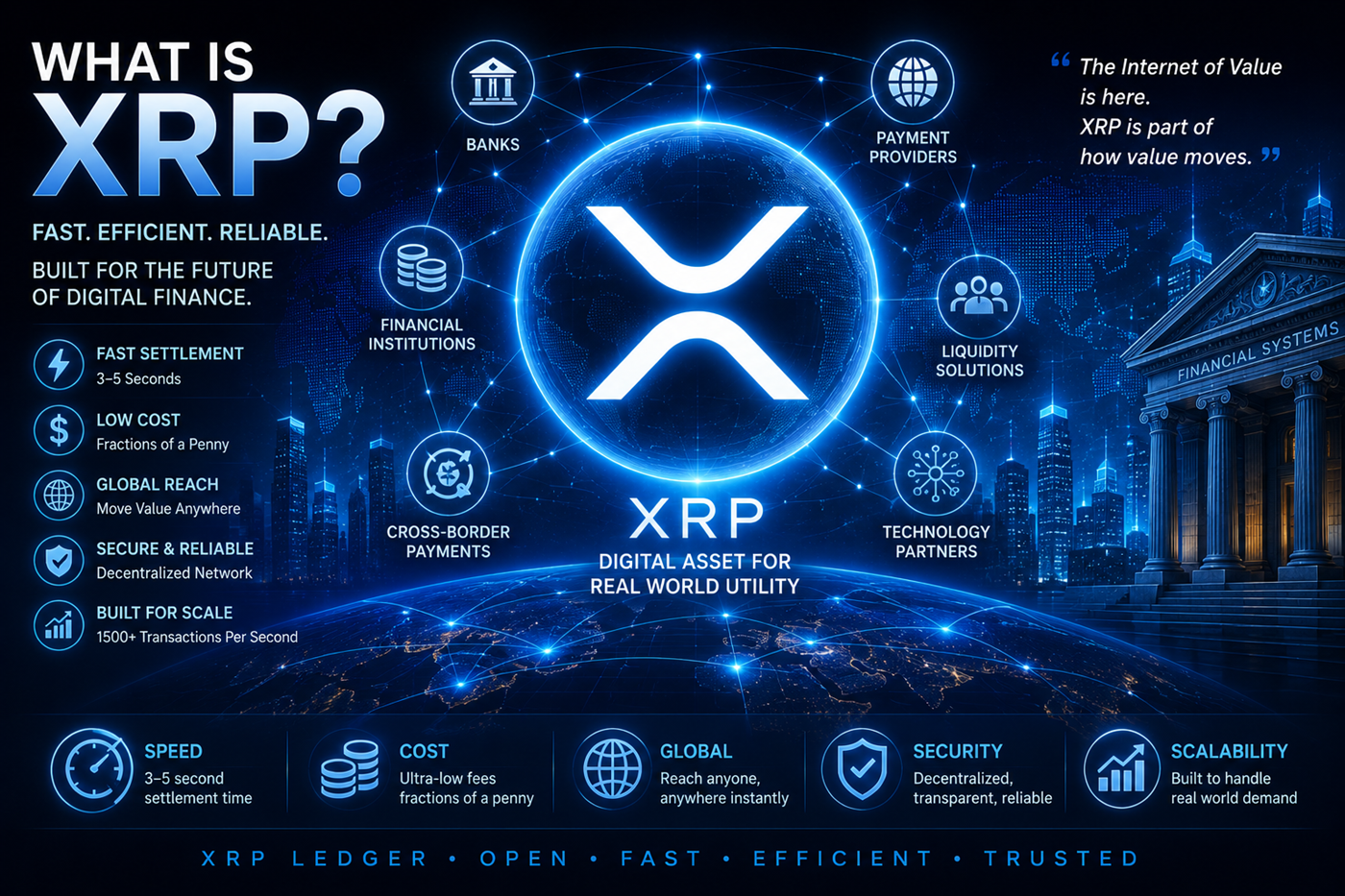
XRP is a digital asset designed for fast movement of value across the internet. It is most often discussed in connection with payments, liquidity, settlement, and the modernization of financial systems.
For beginners, the simplest way to understand XRP is this: XRP is not just another crypto coin created for speculation. It was designed to move value quickly, efficiently, and at low cost across a digital network called the XRP Ledger.
XRP is a cryptocurrency, but its purpose is different from many other digital assets. Bitcoin is often described as digital gold. Ethereum is often associated with smart contracts and decentralized applications. XRP is most often discussed as a digital asset built for fast settlement and efficient value transfer.
That is why XRP appears in conversations about banks, payment providers, cross-border transfers, liquidity, financial rails, ISO 20022, and institutional adoption.
XRP is the digital asset. It can be transferred across the XRP Ledger and is often discussed in relation to liquidity, settlement, and value movement.
The XRP Ledger is the blockchain network where XRP transactions occur. It is designed for fast settlement, low transaction costs, and efficient digital asset activity.
Ripple is a financial technology company. Ripple is connected to the XRP ecosystem, but Ripple and XRP are not the same thing.
XRP is part of a larger shift toward digital money, faster payments, blockchain-based assets, and modernized financial infrastructure.
XRP is commonly discussed because it can help demonstrate how value can move quickly across a blockchain-based network rather than waiting through slower legacy systems.
The XRP Ledger was designed with very small transaction costs, making it useful to study when comparing traditional transfers with digital value movement.
XRP is frequently connected to the idea of liquidity because it may be used in discussions about bridging value between currencies, assets, institutions, or payment corridors.
XRP is often studied in the context of cross-border payments because the traditional global payment system can be slow, expensive, and fragmented.
Traditional money usually moves through banks, card networks, payment processors, clearinghouses, and settlement systems. Those systems work, but they can involve delays, multiple intermediaries, fees, and limited operating hours.
XRP operates on a blockchain-based network. This means value can move across the XRP Ledger without needing the same structure as traditional banking rails. That does not mean XRP replaces every part of the financial system. It means XRP gives readers a way to understand how digital assets may fit into future payment and settlement systems.
XRP is often discussed as part of the effort to move value across countries more efficiently.
Liquidity is central to XRP conversations because financial systems depend on value being available where and when it is needed.
Banks, payment providers, exchanges, and financial infrastructure companies are part of the broader institutional discussion.
XRP and XRPL are often included in conversations about tokenized assets and future digital finance systems.
Owning XRP does not mean owning shares of Ripple. Ripple is a company. XRP is a digital asset.
Like all cryptocurrencies, XRP involves market risk, volatility, uncertainty, and changing regulatory and economic conditions.
Bitcoin and XRP have different designs, histories, communities, use-case discussions, and market narratives.
Price attracts attention, but serious XRP education also studies technology, liquidity, regulation, settlement, institutional finance, and utility.
Yes. XRP is a cryptocurrency and digital asset. It operates on the XRP Ledger and is used in discussions about fast value transfer and settlement.
No. You can begin with the basics. As you learn more, banking and payment topics will become easier to understand.
Both are major digital assets, but they are built around different ideas. Bitcoin is usually discussed as digital scarcity. XRP is usually discussed around payments, liquidity, and settlement.
Beginners should read the XRP Beginner Guide, then explore Ripple vs XRP, XRPL Explained, and the XRP Books page.
A simple guide for readers who want to understand XRP in a changing financial world.
Explore ISO 20022, XRP, and the next financial revolution.
A practical book focused on grounded valuation thinking beyond hype.
A broader look at XRP's history, present role, and future possibilities.
Return to the beginner guide and follow the learning path from the beginning.
Learn about the network that powers XRP transactions and digital asset movement.
Compare two major digital assets with different purposes and market narratives.
Explore related XRP, digital finance, liquidity, and institutional adoption topics.
The best way to begin understanding XRP is to focus on movement: movement of value, movement across borders, movement between systems, and movement toward a more digital financial future.