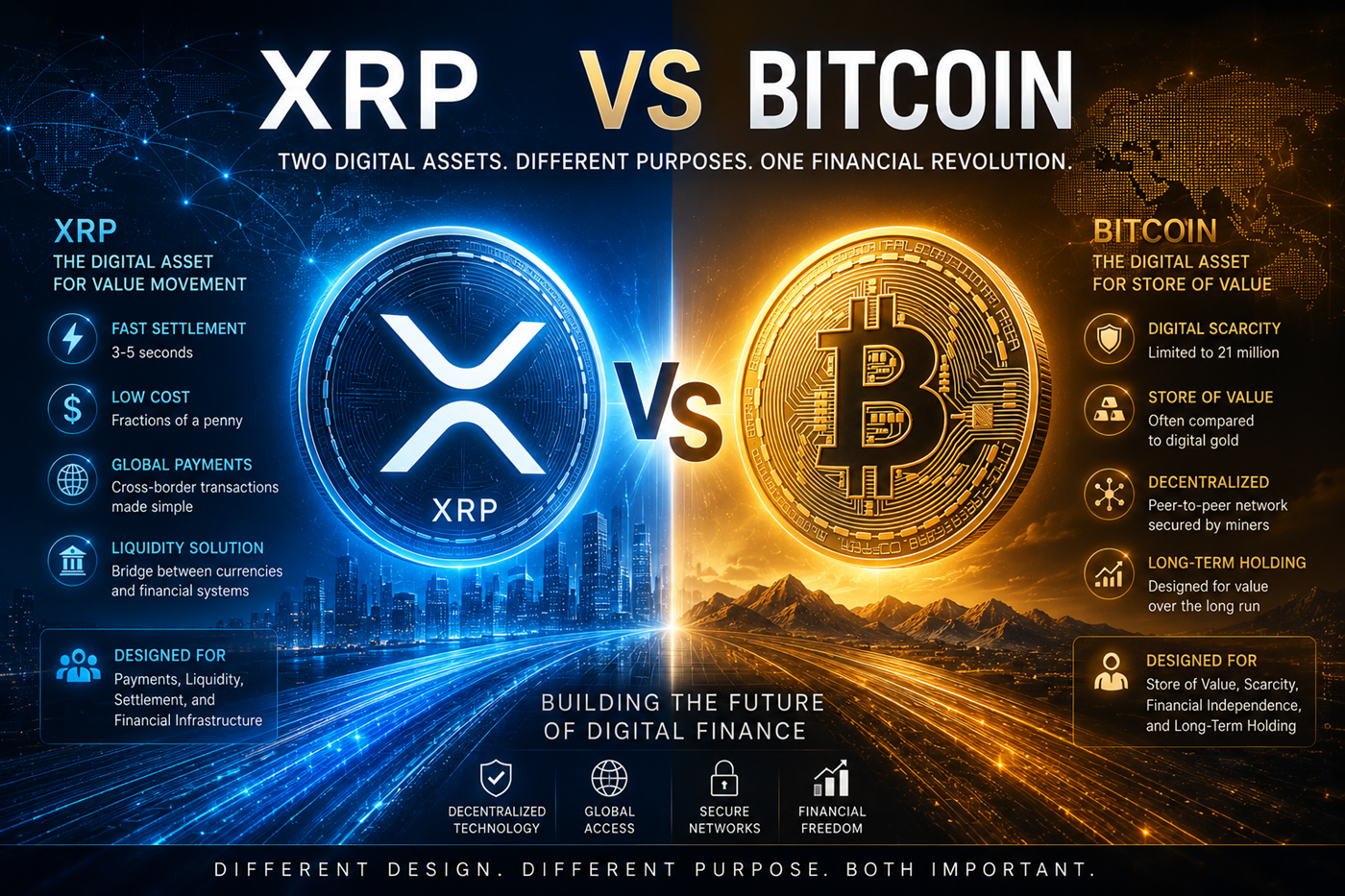
XRP and Bitcoin are two of the most discussed digital assets in the cryptocurrency world, but they were created around very different ideas. Bitcoin is often described as digital gold. XRP is often discussed in relation to payments, liquidity, settlement, and digital financial rails.
This page compares XRP and Bitcoin in simple language so beginners can understand why people talk about them differently, why both matter, and how each one fits into the larger digital finance conversation.
Bitcoin is usually understood as a scarce digital asset designed around decentralization, fixed supply, and long-term store-of-value discussion. XRP is usually understood as a digital asset designed around speed, settlement, liquidity, and value movement.
In simple terms: Bitcoin is often compared to digital gold, while XRP is often compared to a fast-moving bridge for digital value.
| Topic | Bitcoin | XRP |
|---|---|---|
| Main Narrative | Digital gold, scarcity, store of value | Fast value transfer, settlement, liquidity, payments |
| Common Use-Case Discussion | Long-term holding, monetary independence, digital scarcity | Cross-border payments, financial rails, institutional liquidity |
| Design Focus | Security, decentralization, limited supply | Speed, low cost, settlement efficiency |
| Beginner Analogy | A digital form of gold | A digital bridge for moving value |
| Market Narrative | Scarcity and adoption as a reserve-like digital asset | Utility, liquidity, payments, and financial infrastructure |
Bitcoin is widely known for its fixed supply narrative. That scarcity is one of the main reasons many people compare it to gold.
Many Bitcoin supporters view it as a long-term store of value that exists outside traditional banking systems.
Bitcoin is often discussed as a form of decentralized money that does not depend on a central bank or government issuer.
Bitcoin has become the best-known cryptocurrency and often serves as the benchmark for the entire digital asset market.
XRP is commonly discussed because of its connection to fast settlement on the XRP Ledger.
XRP is often studied because transactions on the XRP Ledger are designed to be efficient and low cost.
XRP is frequently connected to liquidity conversations because it can be discussed as a bridge asset for moving value between currencies, markets, and systems.
XRP is often associated with the modernization of payment systems, especially cross-border payments and institutional settlement.
XRP and Bitcoin are often compared because both are major digital assets, both have large communities, and both are part of the cryptocurrency conversation. But comparison does not mean they are trying to do the same thing.
A better way to compare them is by asking what each asset represents. Bitcoin represents the idea of digital scarcity. XRP represents the idea of fast digital value movement.
Can a scarce digital asset become a long-term store of value in a changing financial world?
Can a fast digital asset play a role in settlement, liquidity, and value movement?
How much risk, volatility, uncertainty, and time horizon can an individual realistically handle?
Which real-world problems are these assets trying to address, and what evidence supports those use cases?
XRP and Bitcoin can both matter for different reasons. Bitcoin's strength is usually discussed around scarcity. XRP's strength is usually discussed around movement, settlement, and liquidity.
Digital assets can serve different roles. A store-of-value asset and a payment-focused asset may be evaluated using different ideas.
Speed is one factor, but investment outcomes depend on adoption, regulation, liquidity, demand, supply, market cycles, risk, and many other variables.
Serious comparison should include purpose, design, market structure, adoption pathways, risks, and realistic expectations.
Bitcoin may continue to be studied as a scarce digital asset, a store-of-value experiment, and a symbol of financial independence.
XRP may continue to be studied through the lens of settlement, liquidity, digital finance, cross-border payments, and institutional infrastructure.
The broader market may include many types of assets, each with different use cases, narratives, technologies, and risks.
Understanding the differences helps readers avoid simplistic thinking and develop stronger independent research habits.
A simple guide for readers who want to understand XRP in a changing financial world.
Explores the comparison between Bitcoin-style growth narratives and XRP's institutional rail discussion.
A grounded book focused on practical valuation and moving beyond hype.
A beginner-friendly foundation for understanding digital assets before comparing them.
Return to the simple explanation of XRP and how it fits into digital finance.
Learn about the network behind XRP transactions and settlement.
Explore why institutions matter in the larger XRP conversation.
Study value drivers, market narratives, risk, liquidity, and realistic expectations.
Bitcoin and XRP do not need to compete for the same role. They represent different visions of digital finance. Understanding those differences helps readers think more clearly, research more carefully, and avoid treating every cryptocurrency as if it were built for the same purpose.