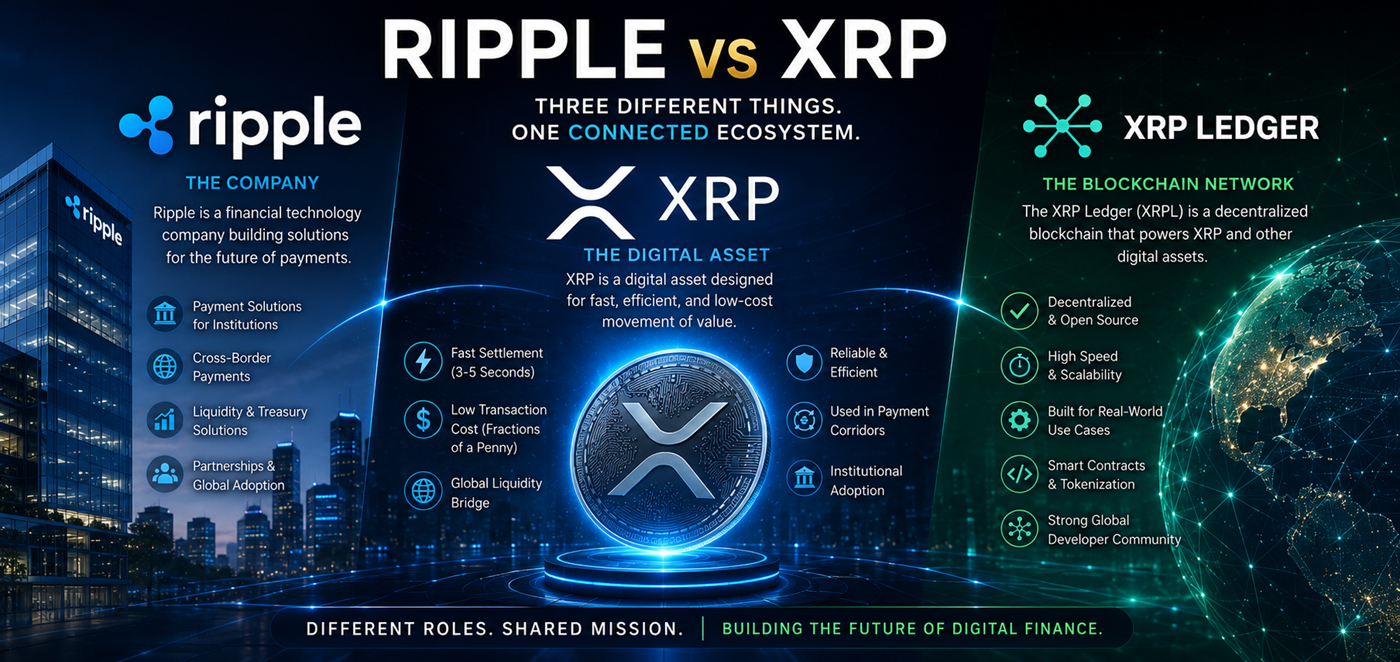
Ripple and XRP are not the same thing. This is one of the most important beginner lessons in the XRP ecosystem. Ripple is a financial technology company. XRP is a digital asset. The XRP Ledger, often called XRPL, is the blockchain network where XRP moves.
Understanding this difference helps readers avoid confusion when studying XRP, digital finance, institutional adoption, cross-border payments, and the future of financial rails.
The easiest way to understand the difference is to separate the three names: Ripple is a company. XRP is a digital asset. XRPL is the blockchain network.
They are connected, but they are not interchangeable. Saying Ripple and XRP are the same creates confusion, especially for beginners trying to understand the role of each part of the ecosystem.
Ripple is a financial technology company that develops payment and liquidity solutions for institutions, businesses, and financial networks.
XRP is a digital asset. It can move across the XRP Ledger and is often discussed in relation to speed, liquidity, settlement, and value transfer.
The XRP Ledger is the decentralized blockchain network where XRP transactions take place and where other digital asset activity can occur.
Ripple, XRP, XRPL developers, exchanges, users, businesses, and researchers are all part of a larger digital finance ecosystem.
Ripple and XRP have a long shared history, so many people casually use the names together. This can make beginners think they are the same thing.
Headlines sometimes simplify complex topics. That shortcut can blur the difference between a company, a digital asset, and a blockchain ledger.
XRP price discussions often mention Ripple news, partnerships, legal updates, and product development, which can make the terms feel interchangeable.
Regulatory conversations have often connected Ripple and XRP in public discussion, adding another layer of confusion for readers.
When readers know the difference between Ripple, XRP, and XRPL, they can research each topic more accurately.
Company news, market news, regulatory news, and blockchain activity are related but not always the same type of information.
XRP education becomes clearer when readers understand which part of the ecosystem they are actually studying.
Clear language helps people discuss XRP without mixing up technology, company strategy, market behavior, and digital asset utility.
| Statement | Better Way to Say It |
|---|---|
| Ripple is going up in price. | XRP is going up in price. |
| I bought Ripple. | I bought XRP. |
| Ripple is the blockchain. | The XRP Ledger is the blockchain network. |
| XRP owns Ripple. | XRP is a digital asset. Ripple is a company. |
| Ripple transactions happen on Ripple coin. | XRP transactions occur on the XRP Ledger. |
Ripple matters because it is one of the most visible companies connected to XRP-related discussion. Its work in payments, liquidity, institutional finance, and financial technology often influences how people think about XRP's future role.
However, XRP is not the same thing as Ripple stock, Ripple ownership, or Ripple the company. A reader can study Ripple as a company while also studying XRP as a digital asset and XRPL as a network.
XRP is the digital asset most commonly associated with fast settlement and liquidity discussion. It can move across the XRP Ledger and is often studied as part of the larger transformation from traditional finance to digital financial rails.
XRP's market price can be influenced by many factors, including sentiment, regulation, liquidity, adoption narratives, exchanges, market cycles, and broader cryptocurrency conditions.
The XRP Ledger is the network layer. It is where XRP transactions occur, and it also supports broader digital asset activity. Understanding XRPL helps readers move beyond price discussion and begin studying the technology behind XRP.
For readers who want deeper knowledge, XRPL is one of the most important topics to study after learning the basic difference between Ripple and XRP.
No. Ripple is a company. XRP is a digital asset. They are connected in public discussion, but they are not the same thing.
No. XRP is not stock in Ripple. Owning XRP does not mean owning shares of Ripple.
Ripple is an important company in the XRP ecosystem, but the XRP Ledger is a blockchain network with its own broader ecosystem of participants, developers, validators, and users.
Ripple is closely associated with XRP in public conversation, so news about Ripple can influence attention, sentiment, and discussion around XRP.
Start with the basic definition of XRP and its role in digital finance.
Learn about the blockchain network where XRP transactions occur.
Explore XRP, ISO 20022, and the next financial revolution.
A simple guide to XRP for readers beginning their digital finance journey.
Return to the beginner path and build your understanding step by step.
Understand the XRP Ledger and how it supports XRP transactions.
Explore banks, payment providers, financial rails, and adoption narratives.
Continue exploring the larger XRP and digital finance knowledge library.
Once readers understand this simple distinction, the entire XRP conversation becomes easier to follow. Clear language leads to clearer research, better questions, and stronger education.