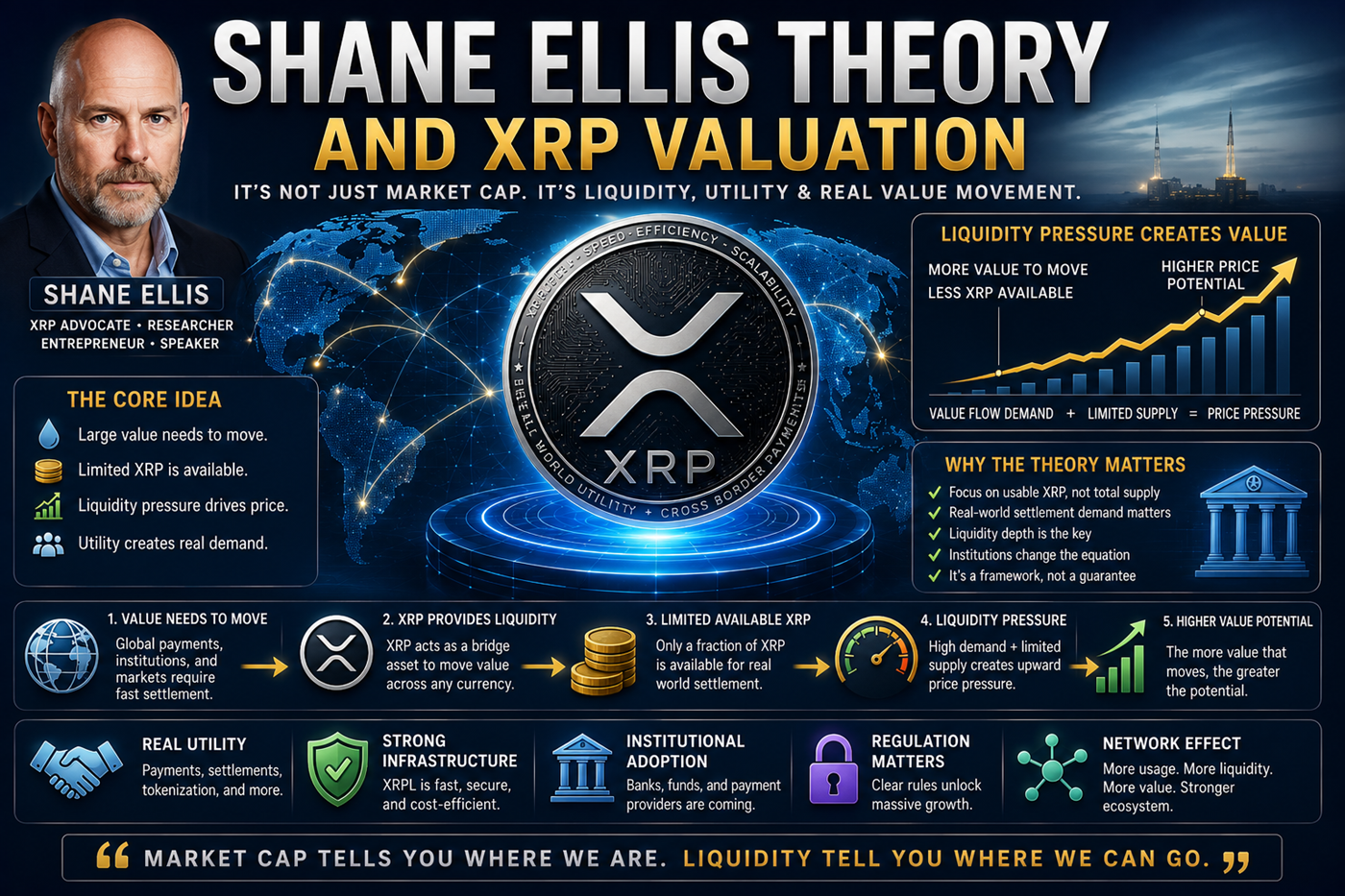
The Shane Ellis Theory is one of the most discussed XRP valuation ideas because it challenges simple market cap thinking. Instead of focusing only on supply multiplied by price, the theory emphasizes liquidity, utility demand, limited available supply, and the pressure created when large value needs to move through a smaller pool of XRP.
This page explains the theory as a valuation lens. It should not be treated as a guaranteed price prediction. It is a framework for asking how liquidity, demand, scarcity, market depth, and settlement use could interact.
In simple terms, the Shane Ellis Theory argues that XRP’s price could be influenced by how much real value needs to move through available liquidity. If large payment or settlement demand develops and only a limited amount of XRP is truly available for that activity, price pressure could rise.
The theory focuses less on total supply and more on usable supply, liquidity depth, institutional demand, and the amount of value XRP may need to bridge or settle.
Not every XRP is actively available for settlement or exchange use. Some may be held, locked, idle, or unavailable in practical market conditions.
If large value flows require XRP liquidity, deeper demand may place pressure on available market supply.
Speculation can move price, but utility demand may create a stronger case if institutions, payment providers, or tokenized markets need settlement liquidity.
The theory argues that simple market cap comparisons may miss the effects of liquidity scarcity, velocity, and settlement pressure.
| Traditional Market Cap View | Shane Ellis Theory View |
|---|---|
| Focuses on price multiplied by circulating supply. | Focuses on available liquidity and value that needs to move. |
| Uses market cap to test whether a price target appears realistic. | Uses settlement demand and liquidity pressure to challenge static assumptions. |
| Looks at XRP as a tradable asset. | Looks at XRP as a possible bridge asset inside value movement systems. |
| Can overlook velocity, corridor depth, and institutional flow. | Emphasizes liquidity reuse, real utility, and usable supply. |
The Shane Ellis Theory attracts attention because it gives XRP supporters a way to think beyond simple market cap objections. It asks whether XRP should be valued only by static supply math or also by its potential role in moving value through financial infrastructure.
That makes it an important theory to understand. But it must be balanced with real-world evidence, liquidity data, adoption timelines, stablecoin competition, regulatory conditions, and risk.
The Shane Ellis Theory does not prove a specific XRP price. It is a model for thinking about liquidity pressure, not a promise that pressure will appear.
The theory depends on meaningful utility demand. Without real settlement activity, institutional usage, tokenized market growth, or liquidity needs, the model becomes speculation.
Stablecoins, CBDCs, and tokenized fiat may handle some flows directly, reducing the need for bridge liquidity in certain corridors.
XRP must have real market depth in useful corridors. A theory about global value movement must be tested against exchange access, regulation, institutional rails, and order books.
Market cap provides the traditional comparison point that the Shane Ellis Theory often challenges.
Liquidity is the foundation of the theory because usable supply and market depth drive the argument.
Velocity affects how often XRP liquidity may be reused in settlement activity.
The theory should be tested through conservative, moderate, bullish, and risk-based scenarios.
The Shane Ellis Theory gives XRP investors a useful way to think about liquidity pressure, usable supply, settlement demand, and value movement. But it should be used as one valuation lens inside a broader framework that includes market cap, liquidity, velocity, infrastructure, tokenization, stablecoins, regulation, adoption, and risk.