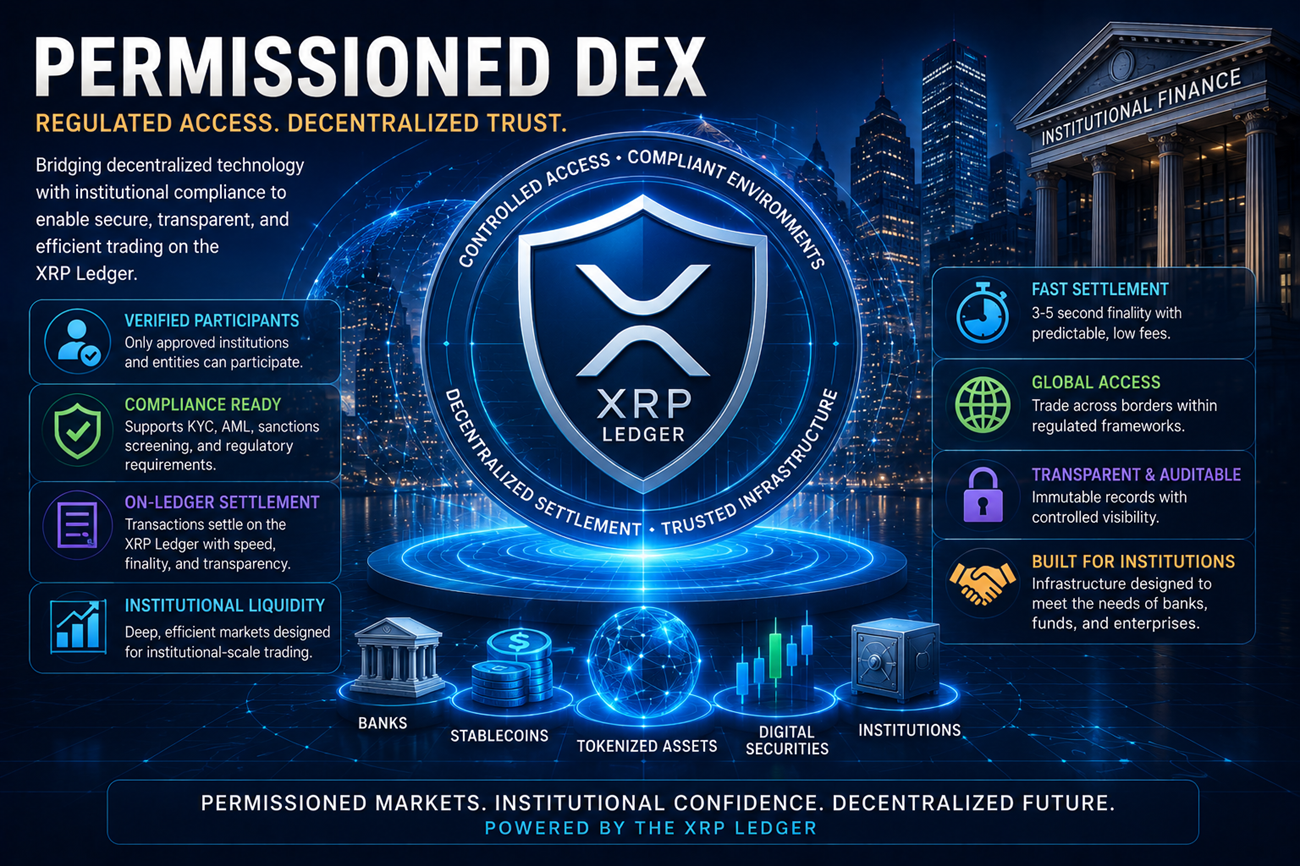
One of the most significant developments being explored for the XRP Ledger is the concept of a Permissioned Decentralized Exchange, often shortened to Permissioned DEX. Unlike traditional decentralized exchanges that allow anyone to participate, a Permissioned DEX introduces optional identity and compliance layers designed to support regulated financial institutions while still benefiting from blockchain technology.
The goal is not to replace open decentralized finance. Instead, it creates an additional environment where banks, financial institutions, asset managers, governments, and regulated companies can participate in tokenized markets while meeting legal and regulatory requirements.
Many of the world's largest financial organizations cannot legally transact in completely anonymous markets. Permissioned trading environments may allow them to participate in blockchain-based finance without sacrificing compliance, identity verification, or regulatory oversight.
Traditional decentralized exchanges were designed around openness. Anyone with a compatible wallet can generally participate. While this openness is one of blockchain's greatest innovations, regulated financial organizations operate under very different requirements.
Banks, investment firms, payment providers, and regulated financial institutions must comply with rules involving:
Participants often must verify their identities before engaging in regulated financial activities.
Institutions are required to monitor transactions for suspicious activity and comply with AML regulations.
Financial firms must avoid transactions involving sanctioned individuals, organizations, or jurisdictions.
Many institutions must maintain detailed records and reporting for regulators.
One common misconception is that "permissioned" automatically means centralized. Those concepts are not the same. A permissioned trading environment can still operate on a decentralized blockchain while limiting participation to verified entities.
Think of it as adding access rules rather than replacing blockchain technology. The XRP Ledger remains a decentralized public ledger while allowing certain applications to define who may participate in specific activities.
The underlying XRPL remains decentralized. Permissioned features simply allow certain assets, pools, or trading environments to apply participation requirements where appropriate.
Although implementations may evolve, the overall concept is straightforward. Approved participants gain access to specific trading environments while the blockchain continues providing transparent settlement and immutable recordkeeping.
Only approved wallets or institutions can access designated trading environments.
Certain tokenized securities or regulated assets may only trade among qualified participants.
Transactions still settle directly on the XRP Ledger using blockchain infrastructure.
The blockchain continues providing an auditable transaction history while respecting applicable compliance requirements.
Permissioned DEX environments attempt to combine two worlds that historically have been separate: the efficiency of blockchain technology and the compliance expectations of regulated finance.
Financial firms may be more willing to participate when compliance requirements are built into the trading environment.
Institutional participation could increase available liquidity for qualifying tokenized assets.
Blockchain settlement can reduce delays compared with many traditional financial systems.
Qualified participants may transact across borders more efficiently while remaining within regulatory frameworks.
Tokenization is expected to become one of blockchain's largest long-term growth sectors. Governments, banks, asset managers, and financial institutions are increasingly exploring how traditional financial assets can exist as digital tokens on blockchain networks.
Examples include treasury securities, corporate bonds, money market funds, private credit, commodities, real estate interests, and even carbon credits. Many of these assets require regulated ownership, transfer restrictions, and compliance monitoring—making permissioned trading environments especially attractive.
Stablecoins are expected to play an increasingly important role in institutional blockchain finance because they provide a digital representation of fiat currency while maintaining price stability.
Ripple's RLUSD represents one example of how stablecoins may integrate with the XRP Ledger. Rather than replacing XRP, stablecoins and XRP may serve different purposes inside the same financial ecosystem.
A regulated stablecoin designed for enterprise payments, institutional settlement, treasury management, and digital finance.
The native digital asset of the XRP Ledger that may provide bridge liquidity, fast settlement, and transaction efficiency.
Institutions may issue additional digital assets representing various forms of value.
Stablecoins, XRP, and tokenized assets may complement one another rather than compete.
Liquidity is often more important than technology itself. A blockchain may settle transactions in seconds, but large institutions still need counterparties, deep markets, market makers, and sufficient liquidity to move significant amounts of value efficiently.
Permissioned DEX environments may encourage additional institutional liquidity by allowing regulated firms to participate in markets that satisfy their compliance obligations.
Liquidity comes from market participants—not simply from blockchain technology. The more institutions willing to participate, the greater the potential liquidity available for qualified assets.
One of the fastest growing blockchain sectors is the tokenization of Real-World Assets (RWA). Rather than representing cryptocurrencies, these tokens represent ownership or claims on traditional financial assets.
Government securities may become digitally transferable on blockchain networks.
Debt instruments may eventually settle using blockchain infrastructure.
Fund ownership may become easier to transfer and manage digitally.
Tokenized lending markets continue attracting institutional interest.
Permissioned Domains are another proposed capability designed to support regulated participation on the XRP Ledger. Rather than allowing unrestricted access, Permissioned Domains define who may interact with specific assets, applications, or financial services.
Together, Permissioned Domains and Permissioned DEX functionality could provide much of the compliance framework institutional finance requires.
The XRP Ledger now supports Automated Market Makers (AMMs), which provide liquidity pools for decentralized trading. Permissioned DEX environments serve a different audience.
Built primarily for open decentralized finance, allowing liquidity pools to facilitate trading between supported assets.
Designed for regulated participation, identity verification, institutional compliance, and controlled market access.
Both seek to improve liquidity and make asset movement more efficient, but they serve different market participants.
The XRPL may ultimately support both open DeFi and regulated institutional finance simultaneously.
XRP itself does not become "permissioned." Instead, permissioned environments may determine who can participate in specific markets, while XRP continues functioning as the native asset of the XRP Ledger.
Depending upon the application, XRP may continue supporting:
Connecting currencies and tokenized assets.
Providing fast final settlement between approved market participants.
Supporting cross-border movement of value.
Helping institutions reduce capital tied up in pre-funded accounts where appropriate.
No. A Permissioned DEX is intended to complement the existing decentralized exchange by providing an additional environment for regulated participants who require compliance controls.
Yes. The XRP Ledger remains a decentralized public blockchain. Permissioned environments are designed for specific use cases and do not replace the public ledger.
Many institutions need identity verification, regulatory reporting, custody controls, and approved counterparties before participating in blockchain-based markets.
Many observers believe XRP may continue serving roles in settlement, liquidity, and bridge transactions where those functions provide value. Actual adoption will depend on real-world implementation, market demand, and regulatory developments.
Blockchain does not have to be entirely open or entirely closed. One of the most interesting trends emerging in digital finance is the ability to combine decentralized infrastructure with optional compliance layers.
The XRP Ledger's growing institutional roadmap reflects this broader evolution. Instead of forcing every participant into the same model, different environments may serve different needs—from open decentralized finance to highly regulated institutional markets.
Permissioned DEX functionality is not about limiting blockchain innovation. It is about expanding blockchain participation to organizations that must operate within regulatory frameworks while still benefiting from fast settlement, transparency, and blockchain efficiency.
Learn how controlled participation may support institutional blockchain applications.
Discover how decentralized finance is evolving for regulated financial institutions.
Explore tokenized real-world assets, stablecoins, and digital securities.
See how liquidity pools complement traditional order-book trading on the XRPL.
Understand how validators, ledgers, transactions, and native features work together.
Learn why settlement speed, reliability, and low fees matter for institutional adoption.
Discover why liquidity is often more important than transaction speed alone.
Continue your research using official XRPL resources and independent educational references.
A practical examination of XRP valuation, liquidity, and realistic expectations beyond market hype.
Explore liquidity, utility, tokenization, and the multiplier effect in digital finance.
An overview of XRP's expanding role during the institutional age of blockchain finance.
Browse Bruce Goldwell's growing library of educational XRP resources.
Permissioned DEX functionality represents one possible direction for institutional blockchain finance. Its purpose is to combine blockchain efficiency with compliance requirements that many regulated organizations must satisfy. Whether and how these systems evolve will depend on technology development, regulatory frameworks, market adoption, and real-world implementation.
The purpose of this page is educational. Readers are encouraged to continue researching official XRPL documentation, Ripple publications, regulatory guidance, and independent technical resources before forming investment or technology conclusions.